
Multiple Form 16s in One Financial Year: Why They Require Extra Attention During ITR Filing
Changing jobs during a financial year is a common occurrence. However, when an individual works with more than one employer during the same financial year, the Income Tax Return filing process may become slightly more complicated than a regular salary return.
Consider a situation where an employee leaves one organization in August and joins another employer in September. At the end of the financial year, the employee receives two separate Form 16s — one from the previous employer and another from the current employer. Many taxpayers assume that filing the Income Tax Return based only on the latest Form 16 is sufficient.
In practice, this assumption can create problems. If salary income from one employer is omitted, the Income Tax Return may not match the information available in AIS, Form 26AS, and TDS records maintained by the Income Tax Department. This can potentially result in additional tax liability, refund delays, salary mismatches, or departmental communication at a later stage.
The good news is that handling multiple Form 16s is generally straightforward when the salary details, TDS credits, deductions, and tax payments from all employers are consolidated correctly before filing the Income Tax Return. Proper reconciliation before submission can help avoid unnecessary notices, interest liability, or refund issues later.
Why Do Employees Receive More Than One Form 16?
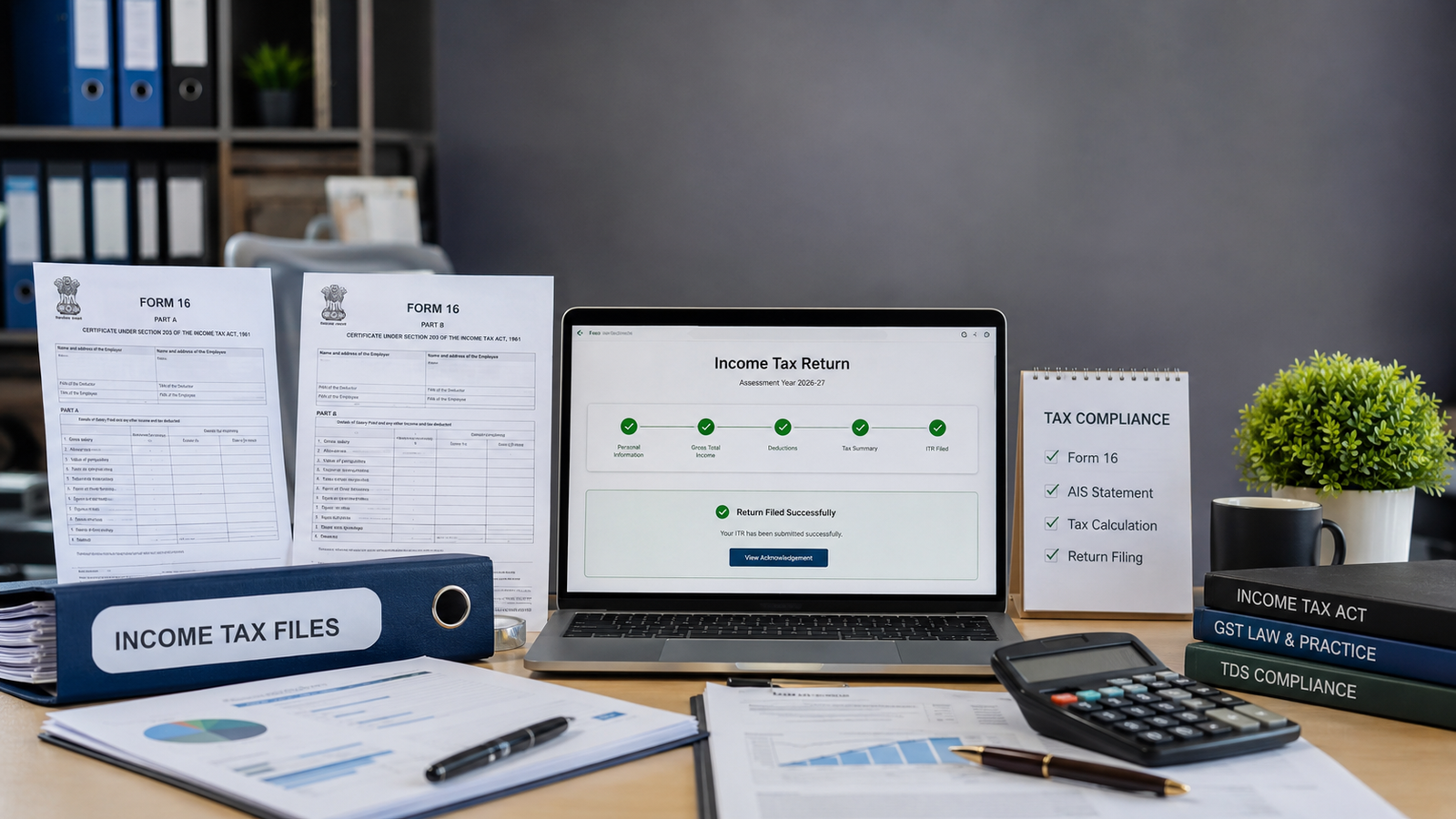
Receiving more than one Form 16 during a financial year is completely normal and, by itself, does not create any tax problem. Multiple Form 16s generally arise because salary income has been received from more than one employer during the same financial year.
Since each employer is responsible for issuing Form 16 only for the salary paid by that employer, an employee who receives salary from multiple employers during the year may receive multiple Form 16 certificates.
- Job change during the financial year — for example, changing employment during FY 2025-26 and receiving Form 16 from both the previous and current employer.
- Simultaneous employment arrangements — where salary income is received from multiple employers during the same period.
- Business mergers, acquisitions, or restructuring — where employment shifts to a new legal entity during the year.
- Rejoining a previous employer — resulting in salary being paid by the same organization during separate periods of the financial year.
- Transition from contract employment to permanent employment — where salary and TDS may be reported separately.
The existence of multiple Form 16s is not itself a compliance issue. The challenge generally arises only when taxpayers use only one Form 16 while filing their Income Tax Return and overlook salary income or TDS reported by the other employer.
The correct approach is to consolidate salary income, deductions, exemptions, and TDS information from all Form 16s received during the financial year and reconcile them with Form 26AS and AIS before filing the Income Tax Return.
Is It Possible to File Your ITR Using Only One Form 16?
No. Where an individual has worked with more than one employer during a financial year, the Income Tax Return must include salary income received from all employers during that year.
Income tax is calculated on the taxpayer’s total annual taxable salary income and not separately for each employer. Each employer deducts TDS only on the salary paid by that employer. Unless the employee discloses previous salary income to the new employer, the current employer may not consider the earlier salary while computing TDS deductions.
As a result, relying only on the latest Form 16 while filing the Income Tax Return may lead to incomplete reporting of income and incorrect tax computation.
- Incomplete disclosure of total salary income for the financial year.
- Incorrect claim of TDS credits appearing in Form 26AS.
- Additional tax liability due to underpayment of taxes during the year.
- Delay in processing of the Income Tax Return and refund claims.
- Potential communication or notice relating to salary mismatches after filing.
The correct approach is to combine salary figures, exemptions, deductions, and TDS information from all Form 16s received during the year and reconcile them with Form 26AS and AIS before filing the return.
Multiple Form 16s do not create a tax problem. The issue generally arises only when one or more Form 16s are omitted while filing the Income Tax Return. Proper consolidation of salary income and TDS records helps ensure accurate tax computation and avoids future mismatches with Income Tax Return records.
Typical Issues Faced by Taxpayers Receiving Multiple Form 16s
Taxpayers who receive more than one Form 16 during a financial year often face reconciliation issues while preparing their Income Tax Returns. Most of these problems arise because salary income, TDS credits, deductions, and tax calculations are considered separately rather than on a consolidated annual basis.
| Issue | Practical Consequence |
|---|---|
| Duplicate salary reporting | Salary income may be counted more than once, resulting in incorrect and higher taxable income. |
| Salary from one employer not reported | Total annual income becomes incomplete, creating mismatches with AIS and Form 26AS records. |
| Incorrect TDS claim | TDS credits may not match departmental records, resulting in refund delays or additional tax demands. |
| Incorrect tax computation | Failure to consider combined annual income may result in underpayment or excess tax liability. |
| Deductions and exemptions not consolidated properly | Taxpayers may fail to utilize eligible deductions fully or may incorrectly claim them, affecting final tax liability. |
The solution to most multiple Form 16 issues is simple: combine salary income, exemptions, deductions, and TDS details from all employers and reconcile them with Form 26AS and AIS before filing the Income Tax Return. Proper consolidation helps ensure accurate tax computation and smoother return processing.
Documents to Collect Before Filing an ITR with Multiple Form 16s
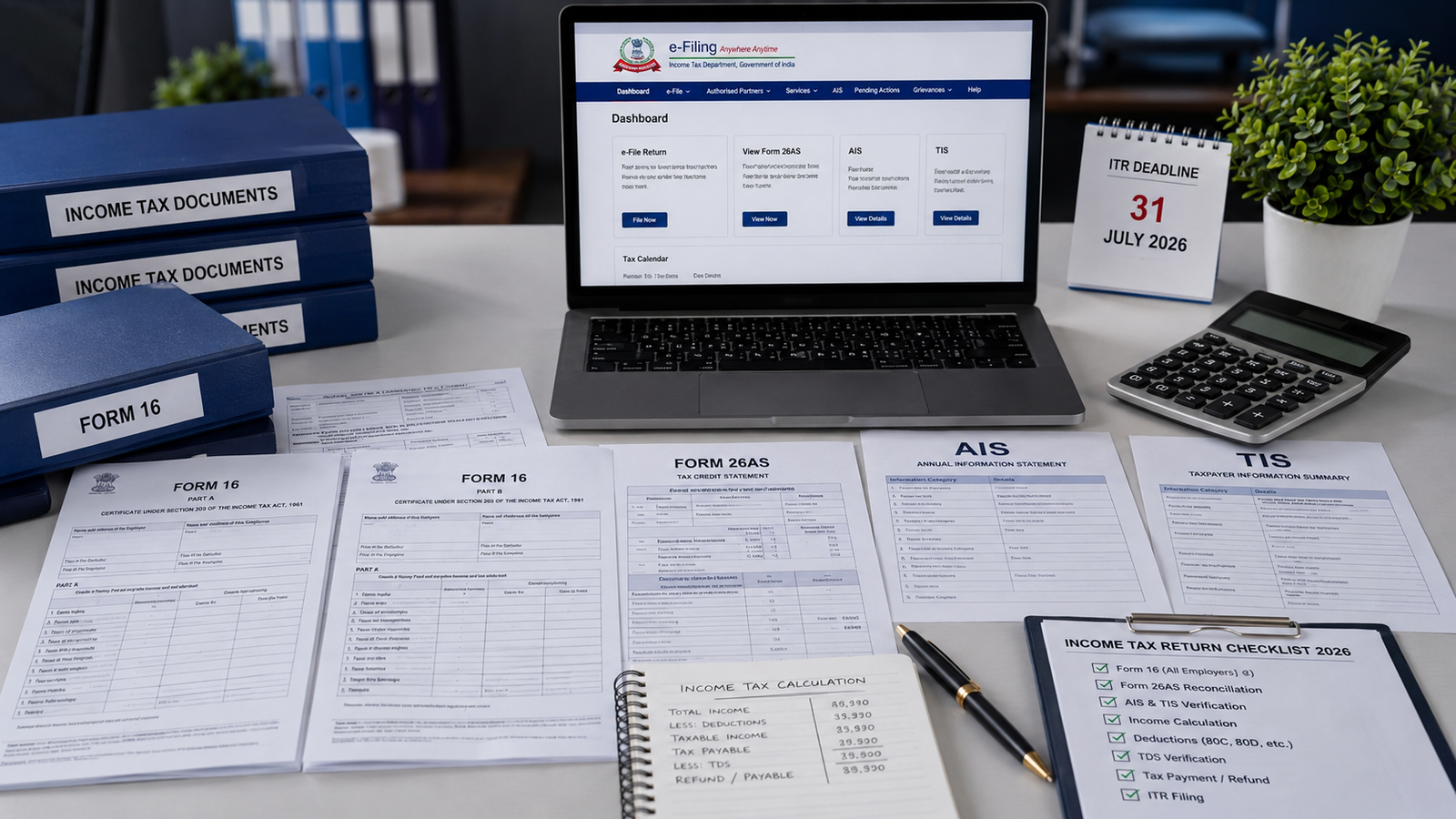
Before filing an Income Tax Return involving multiple Form 16s, taxpayers should gather and reconcile all supporting documents to ensure that salary income, TDS credits, deductions, and other income sources are reported correctly.
Proper document collection before filing helps reduce the possibility of salary mismatches, incorrect tax calculations, refund delays, and future compliance communication.
| Document | Importance |
|---|---|
| All Form 16s received during the financial year | Ensures complete reporting of salary income and TDS from all employers. |
| Form 26AS | Helps verify whether TDS deducted by employers has actually been deposited with the Income Tax Department. |
| Annual Information Statement (AIS) | Helps identify salary income, interest income, investments, and other transactions reported to the department. |
| Taxpayer Information Summary (TIS) | Provides a summarized view of information available in AIS for easier reconciliation. |
| Salary slips from all employers | Useful for salary reconciliation, exemption calculations, and identifying differences between employers. |
| Investment and deduction proofs | Required for claiming deductions under the applicable provisions of the Income-tax Act. |
| Bank interest certificates or account statements | Required for reporting savings account interest, fixed deposit interest, and other taxable interest income. |
Reconciling Form 16, Form 26AS, AIS, TIS, salary slips, and deduction documents before filing the return significantly reduces the chances of income mismatches, incorrect TDS claims, refund delays, and post-filing notices from the Income Tax Return.
Step-by-Step Process for Filing an ITR with Multiple Form 16s
Filing an Income Tax Return with multiple Form 16s may appear complicated initially, but the process becomes straightforward when salary income, deductions, and TDS credits are consolidated correctly before submission.
Step 1: Collect All Form 16s
Obtain Form 16 from every employer with whom you worked during the financial year. Missing even one Form 16 may result in incomplete salary reporting.
Step 2: Calculate Total Salary Income
Prepare a consolidated salary statement containing salary received from all employers during the financial year instead of relying on individual Form 16 figures separately.
Step 3: Verify TDS Credits
Compare the TDS reported in each Form 16 with Form 26AS to confirm that the taxes deducted by employers have actually been deposited with the Income Tax Department.
Step 4: Review Deductions and Exemptions
Verify the deductions and exemptions claimed during the year, including:
- Section 80C deductions
- Section 80D medical insurance deductions
- NPS deductions where applicable
- HRA exemption wherever eligible
Ensure that the same deduction is not claimed more than once while consolidating salary information from multiple employers.
Step 5: Compare with AIS and Form 26AS
Reconcile salary income, TDS, bank interest, and other income appearing in AIS and Form 26AS before filing the return to avoid mismatches later.
Step 6: Compute Final Tax Liability
After combining all income and deductions, calculate whether additional tax needs to be paid or whether a refund is due.
Step 7: File the Return Using Consolidated Figures
File the Income Tax Return using the combined salary income, eligible deductions, and total TDS credits from all employers instead of relying on only one Form 16.
The key principle while filing an ITR with multiple Form 16s is simple: the Income Tax Return taxes the taxpayer’s total annual income and not employer-wise salary separately. Proper consolidation of salary income, deductions, and TDS records ensures accurate filing and minimizes the risk of notices, tax demands, and refund delays.
Why Tax Demands Are Common in Cases Involving Multiple Form 16s
Tax demands are relatively common among taxpayers who change jobs during a financial year because each employer calculates and deducts TDS independently based only on the salary paid by that employer.
Unless the employee provides details of previous salary income to the new employer, the current employer may not consider earlier salary income while estimating TDS. As a result, the total tax deducted during the year may be lower than the final tax liability calculated on the taxpayer’s combined annual income.
- The employee did not disclose previous employer salary details to the new employer.
- The basic exemption limit was effectively considered twice while calculating TDS by separate employers.
- The annual taxable income was underestimated during TDS computation.
- Salary income from one employer was omitted while filing the Income Tax Return.
- Interest income from savings accounts or fixed deposits was not included in the return.
These discrepancies usually become visible when the Income Tax Department compares the Income Tax Return with Form 26AS, AIS, TIS, salary information, and TDS records reported by employers.
Receiving a tax demand in a multiple Form 16 situation does not necessarily indicate an error by the employer or the taxpayer. In many cases, the demand simply arises because TDS was deducted separately by different employers without considering the taxpayer’s consolidated annual income. Proper salary consolidation before filing helps avoid such situations.
Example: Employee Changes Jobs During the Financial Year
Case Illustration
Rahul worked with Employer A from April to July and later joined Employer B, where he continued working from August until March.
At the end of the financial year, both employers issued separate Form 16 certificates and deducted TDS independently based on the salary paid by each employer.
- Employer A deducted TDS only on salary paid during April to July.
- Employer B deducted TDS only on salary paid during August to March.
- Rahul initially prepared his Income Tax Return using only the Form 16 issued by Employer B.
- While reviewing Form 26AS and AIS, he noticed that salary income and TDS reported by Employer A were missing from the return.
- Rahul consolidated salary income from both employers, verified the total TDS credit available, recalculated the final tax liability, and corrected the filing position accordingly.
Key Learning: Multiple employers during the same financial year require the taxpayer to consolidate all salary income into a single Income Tax Return. Taxpayers do not file separate Income Tax Returns for separate employers. The Income Tax Department taxes the combined annual income of the taxpayer and not employer-wise salary separately.
Typical Filing Errors Made by Employees Having Multiple Form 16s
Employees who have changed jobs during the year frequently encounter filing issues because salary income, TDS credits, deductions, and additional income sources are not consolidated properly before filing the Income Tax Return.
| Error | Possible Consequence |
|---|---|
| Using only one Form 16 while filing | Salary income may be understated, resulting in tax demand or notices later. |
| Ignoring information appearing in AIS | Income figures may not match departmental records. |
| Claiming deductions multiple times | Incorrect deduction claims may result in tax adjustments or communication. |
| Ignoring bank interest income | Interest income omission may create additional tax liability and mismatches. |
When Is Professional Review Recommended Before Filing?
A professional review may become useful where the Income Tax Return involves multiple income sources or disclosure requirements beyond simple salary income.
- Multiple employers during the same financial year.
- Salary income along with capital gains.
- Rental income from house property.
- Business or professional income.
- Foreign income, foreign assets, or foreign tax credit claims.
- Combination of salary income and freelance or consulting income.
In such situations, merely combining salary figures may not be sufficient. Proper reconciliation of income, deductions, disclosures, TDS credits, and tax liability becomes equally important to ensure an accurate and compliant Income Tax Return.
Professional Review for Filing Income Tax Returns with Multiple Form 16s
Many taxpayers who have changed jobs during the financial year and received multiple Form 16s prefer to get their returns reviewed professionally before filing. The objective is not merely to complete the filing process, but to ensure that the return accurately reflects the taxpayer’s complete financial position.
Professional review becomes particularly useful where salary income, TDS credits, deductions, and other income sources require reconciliation across multiple employers and tax documents.
- Salary consolidation across all employers during the financial year.
- TDS validation to ensure that tax deducted by each employer matches departmental records.
- Form 26AS and AIS reconciliation to identify missing salary income, TDS credits, interest income, or reporting mismatches.
- Deduction verification to ensure deductions and exemptions are claimed correctly without duplication.
- Return preparation based on consolidated income and disclosures.
- Submission support including verification and post-filing guidance.
A number of taxpayers choose professional review services from firms such as JackRabbit Consultants, particularly where multiple employers, additional income streams, or complex disclosures are involved.
The objective of professional review is not simply to file the Income Tax Return faster. Its purpose is to improve filing accuracy, minimize the possibility of future notices or tax demands, reduce refund delays, and ensure consistency across Form 16, Form 26AS, AIS, and the Income Tax Return itself.
Before Filing Your Return with Multiple Form 16s…
Receiving multiple Form 16s during a financial year is a common outcome of job changes and, by itself, does not create any compliance issue. The real requirement is ensuring that salary income from all employers is properly consolidated and disclosed in a single Income Tax Return.
Taxpayers should ensure that salary received from every employer is included, TDS credits are reconciled with Form 26AS, and all income and deductions are reflected correctly in the return.
Filing the return quickly without verifying salary figures, TDS credits, bank interest income, and AIS information can result in tax demands, refund delays, and reconciliation issues at a later stage.
Proper reconciliation between Form 16, Form 26AS, AIS, TIS, deductions, and other income sources is essential before submission of the return.
Many taxpayers who have changed jobs during the year and received multiple Form 16s prefer to get their returns reviewed by professional consultants such as JackRabbit Consultants before filing.