

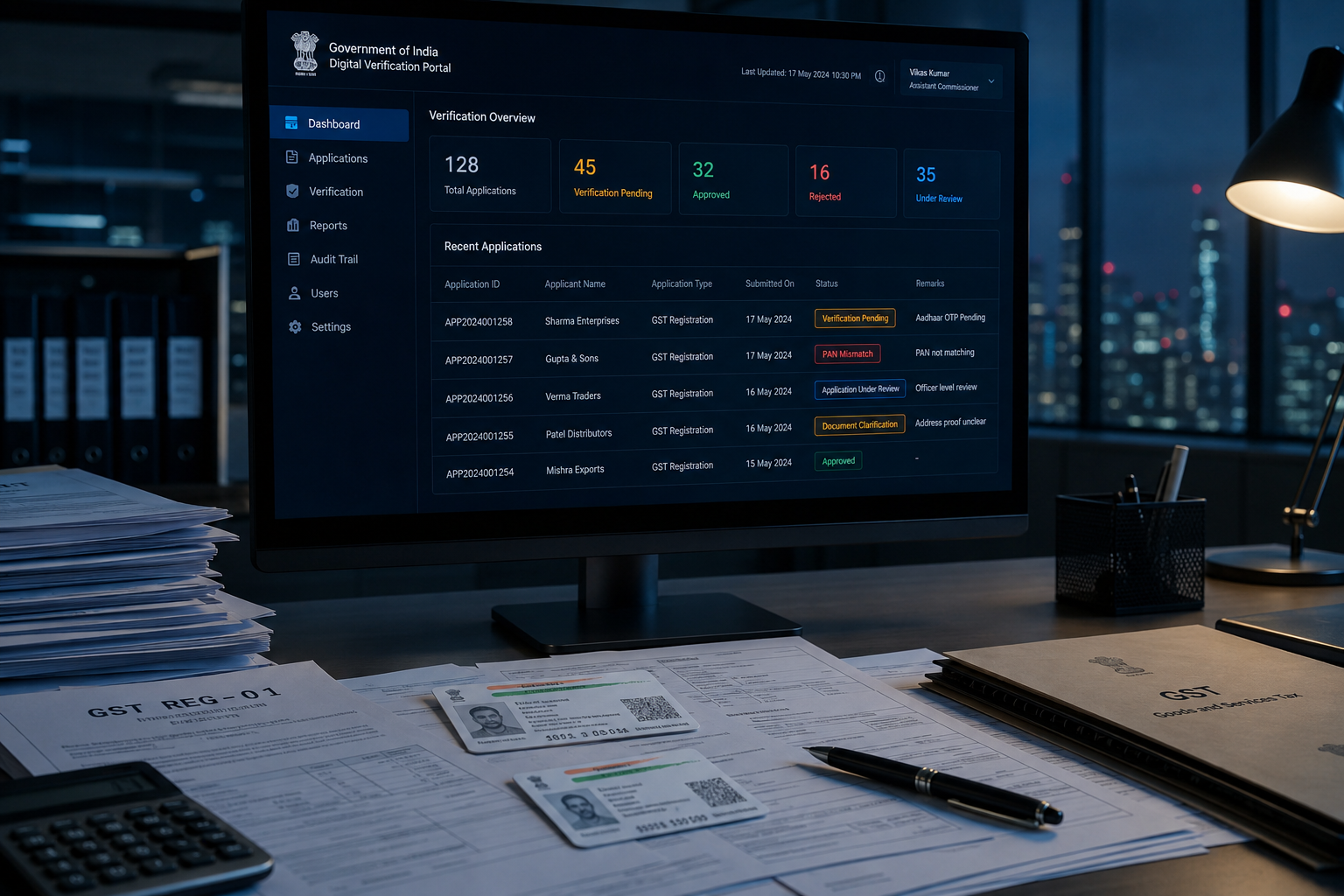
Why MSME Registration Verification Problems Are Increasing
The businessman applies for Udyam expecting a quick MSME certificate.
What he sees is:
- “Verification pending”
- “PAN already registered”
- “Data mismatch detected”
- “Application under process”
Time passes by.
Loan application is put on hold.
Participation in tender applications stops.
Onboarding at the bank stalls.
MSME registration in 2026 isn’t just a simple online task anymore. With PAN, GST, Aadhaar, Income Tax, and banking systems all being closely tied to one another, even minor discrepancies may lead to verification issues.
Most businessmen think it’s because of some technical glitch.
Actually, most MSME registration rejection cases are because of:
- identity mismatch
- wrong business categorization
- incorrect NIC code
- GST issues
- financial statement errors
- duplicate application
- backend verification problems
The problem isn’t with the actual form.
The problem is with the verification process itself.
The Udyam Registration Portal Seems Easy – Till Automated Validation Begins
The process of registering via the Udyam portal is purposefully kept straightforward.
- No physical documents
- No need to visit the office
- No manual approvals in regular cases
But beneath the surface, several databases undergo automated validations:
- PAN Database
- Aadhaar Authentication
- GST Network Entries
- Income Tax Return Filing
- Enterprise Turnover Data
- Investment Declarations
This is why numerous MSME registration issues arise post-submission, not during form-filling.
Even if your organization fills up the form correctly from your point of view, if inconsistencies exist in government databases, your application might:
- Stay pending
- Go under manual review
- Be rejected
- Produce a wrong certificate
- Become entirely blocked
The Topmost Issues That Lead to MSME Registration Rejection
| Reason for rejection | Practical Implications |
|---|---|
| PAN error | Automated validation fails at once |
| Aadhaar error | OTP verification or identity verification stops |
| Wrong NIC Code | Classification of the business becomes inaccurate |
| Duplicate PAN Registration | New registration via the portal becomes blocked |
| GST Error | Financial verification remains pending |
| Turnover Error | Wrong MSME category gets generated |
| Entity Type Error | Proprietorship/Company misclassification occurs |
| Old Mobile Number Linked With Aadhaar | OTP Verification Error |
| Confusion Between Business Names Under Same PAN | Backend Scrutiny Increases |
| Inaccurate Investment Figures | Misclassification of Categories Occurs Later |
Very few organizations realize the rigor involved in automated validation in 2026.
An example can be seen with a slight spelling mistake like:
- “PVT LTD” vs “PRIVATE LIMITED”
which can often lead to verification difficulties if there is an inconsistency in record keeping between various departments.
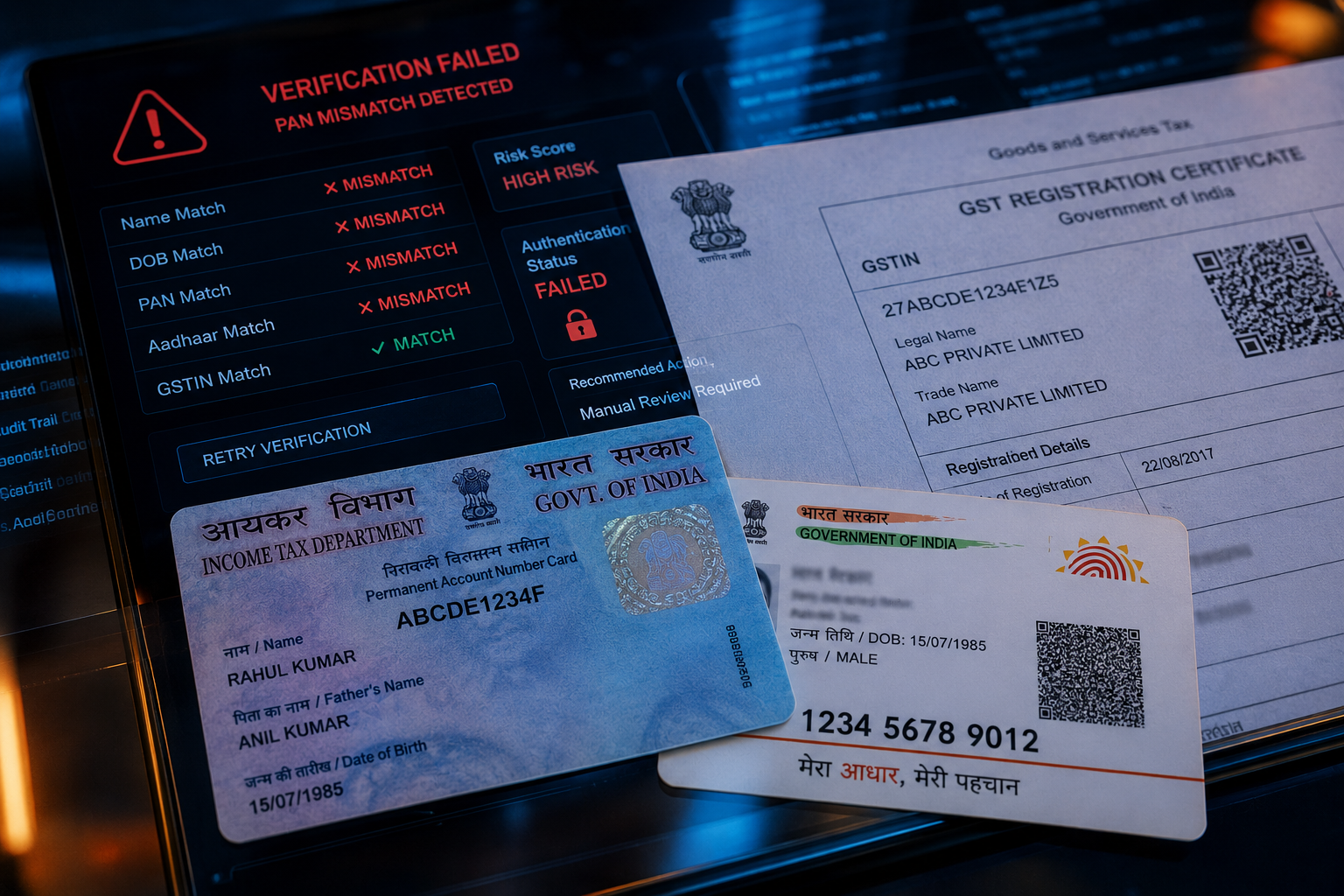
PAN, Aadhaar & GST Inconsistencies: Most Common Verification Issue
This still remains the most prominent cause of Udyam registration problems.
Typical inconsistency scenarios
Mismatch in Name
Example:
| Document | Name |
|---|---|
| PAN | “Rohan Enterprises Private Limited” |
| GST | “Rohan Enterprise Pvt Ltd” |
Even minor differences can prompt manual verification.
Non-active mobile number associated with Aadhaar ID
Failed OTP validation due to invalid mobile number in the database.
This problem occurs quite frequently in proprietorship registrations.
Non-linking of PAN with Aadhaar ID
Many times businesses do not know about it until they face difficulties in Udyam registration.
Sometimes the portal does not provide sufficient information.
Mismatch in GST & PAN Entities
Example:
| Document | Entity Type |
|---|---|
| PAN | belongs to proprietorship |
| GST | registered as partnership business |
Mismatch of Date of Birth
In proprietorship registration cases, mismatch in DOB details between PAN and Aadhaar can stop the process of ID verification altogether.
The smallest discrepancies between PAN, Aadhaar, GST, and Income Tax databases can stop the automation process in 2026.
For this reason, expert compliance consultants always cross-check for consistency in databases before making the actual submission.
In fact, most firms like JackRabbit Consultants do their homework in advance to avoid the danger of automatic rejection from backend processes which business owners cannot comprehend.
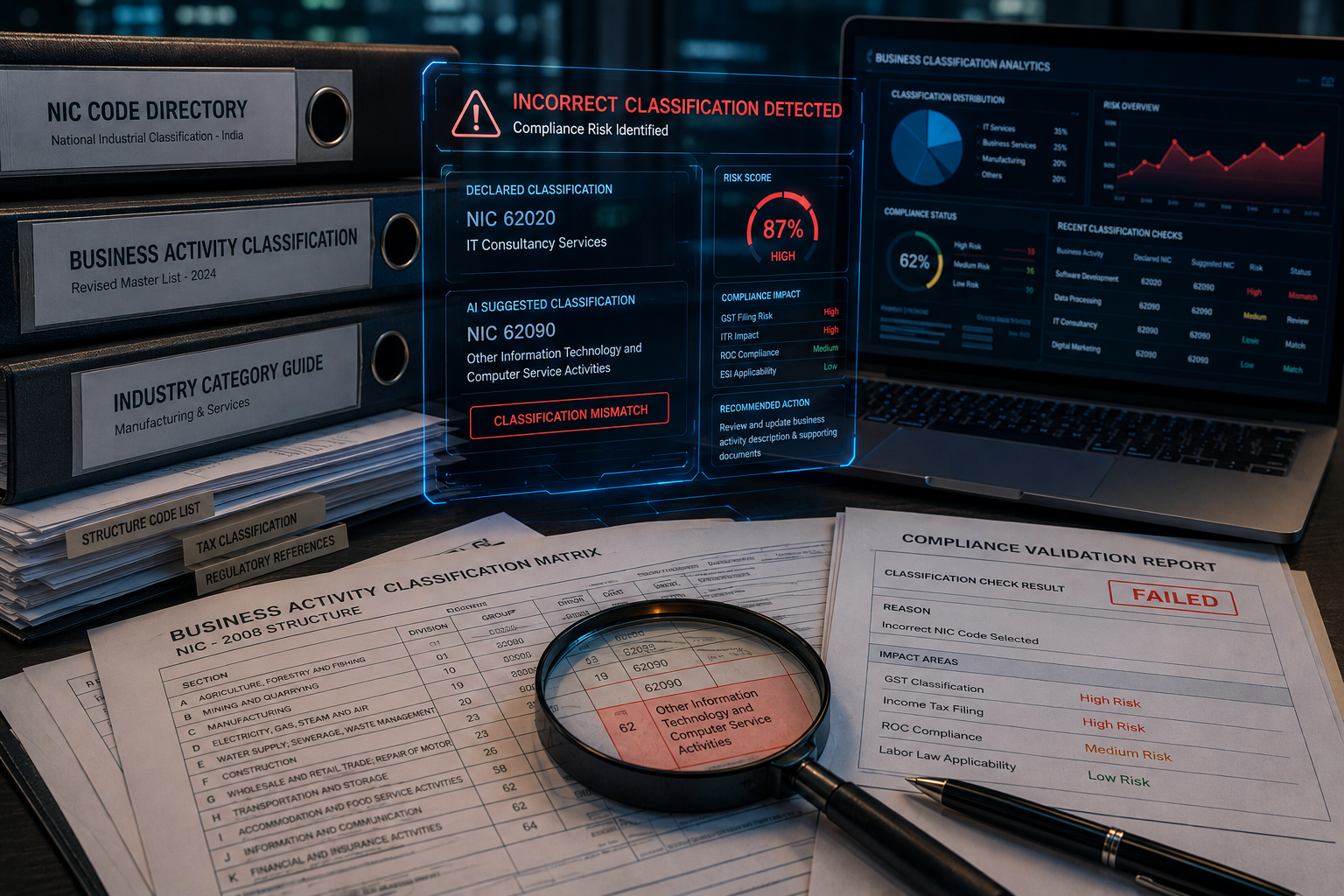
Why Inappropriate Selection of NIC Codes Poses Challenges Later On
Businesses do not take the matter of selecting appropriate NIC codes too seriously.
As a result, they face future compliance challenges.
What is the significance of NIC codes?
NIC codes refer to:
- Your principal business activity
- Classification in different sectors
- Eligibility in schemes
- Classification in compliance
- Classification in procurement purposes
They serve much more purpose than just being informational identifiers.
Why businesses use inappropriate NIC codes?
Primarily because:
- They select random codes at first sight
- Their misunderstanding about service categories
- Business activity as compared to the principal activity
- Mimicking competitors blindly
Practical Challenges Due to Incorrect NIC Codes
| NIC Code Error | Consequence |
|---|---|
| Industry classification error | Ineligibility for schemes |
| Tendering mistake | Vendor disqualification |
| Banking error | Loan processing complications |
| Error in compliance alignment | Future notifications |
| Industry misrepresentation | Issues in government verification |
A few companies later find that their MSME certification shows:
- manufacturing activities rather than service sector
- wholesale trade rather than consultancy services
- trade business rather than IT activities
Later correcting such errors becomes practically challenging for organizations.
Turnover & Investment Declarations that Companies Overlook
The MSME classification criteria updated in 2025 have significantly altered the criteria for enterprise classifications.
However, many enterprises continue using older criteria.
MSME criteria revised from April 2025
| Classification | Investment Criteria | Turnover Criteria |
|---|---|---|
| Micro Enterprises | ₹2.5 Crores | ₹10 Crores |
| Small Enterprises | ₹25 Crores | ₹100 Crores |
| Medium Enterprises | ₹125 Crores | ₹500 Crores |
It’s not only about enterprise classification.
But it involves disparity between:
- self-reported data
- GST data
- IT data
- audited financials
Common errors in practice
- Estimating Turnover instead of Filings
Companies may report expected earnings in place of actual official turnover reports.
Disregarding GST-related validations
The system now increasingly performs automatic verifications using GST information.
Employing outdated financial figures
Applicants may input last year’s data without reviewing the present fiscal period’s official filings.
Improper assessment of Plant & Machinery values
Organizations often misinterpret investment eligibility criteria under MSME categorization guidelines.
MSME Certificate Status Stuck at “Pending” for Months
It does not necessarily mean rejection in all instances where the application is pending.
However, persistent “pending” status is generally an indication of a problem.
Common causes
Validation delays at the back-end government database level
Especially when there is a high volume of submissions.
PAN/GST API connection problems
Temporary syncing difficulties between the two databases.
Human review required
This typically occurs because of:
- unusual financial reports
- inconsistencies in entity details
- multiple submissions
- abnormal activity
Delays in Aadhar number verification
Primarily due to overload conditions within the UIDAI validation system.
Website downtimes or upgrades
Occasional website maintenance performed by government authorities.
Real-Life Scenario: MSME Approval Held Up Due to a Simple Mistake
An MSME startup operating out of Delhi had filed an application for Udyam registration when applying for a working capital loan.
All seemed fine.
However, the GST certificate showed:
“Vertex Media Solutions LLP”
whereas the PAN certificate contained:
“Vertex Media Solution LLP”
The extra “s” led to backend verification discrepancy.
Impact:
- MSME certificate issuance delayed
- working capital loan approval process halted
- vendor onboarding stopped
- tender application deadline missed
The business believed the online portal was having a glitch.
In reality, the problem was a data inconsistency between government databases.
This scenario is becoming more prevalent in 2026.
Several Businesses Are Not Aware that the MSME Certificate Is Already Invalid
A few businesses get their MSME certificate but continue to encounter regulatory compliance hurdles.
This is because the problem lies not in getting approval.
It lies in the inaccuracies in the registered data.
Typical undetected mistakes
- activity misclassification
- category mistake
- turnover mismatch
- outdated contact information
- inaccurate plant investment statement
- improper form of constitution
Such errors become apparent later when reviewing:
- bank loans
- government tenders
- subsidies
- vendor KYC checks
- regulatory compliance
That is why the accuracy of data verification trumps speedy online approval.
MSME Registration Practical Checklist Prior to Submission
| Verification Requirement | Explanation |
|---|---|
| Name on PAN card | Prevents discrepancies in identity |
| Linking Aadhaar card | Authentication requirement |
| GST consistency | Necessitates backend verification |
| Proper NIC code | Prevents incorrect classification |
| Turnover figure accuracy | Prevents category discrepancies |
| Investment amount | Eligibility for MSME |
| Business entity structure | Consistency between proprietor and company |
| Mobile phone number availability | Required for receiving OTP |
| Email validity | Required for sending certificate |
| Past Udyam registration check | Prevents duplication of MSME registration |
Prior to submission, it is advisable that organizations validate each field according to:
- PAN card database
- GST certificate
- Tax records
- Incorporation records
- Bank records
A systematic approach to verification often averts problems during the subsequent operation of businesses.
This is why companies who engage compliance advisory firms, such as JackRabbit Consultants, rarely face disputes regarding MSME registration.
Actions for Business Enterprises Following MSME Registration Rejection
Avoid reapplying without understanding the reason.
Understand if the problem lies in:
- PAN misfitting
- Authenticity of Aadhaar data
- Duplicate application of MSME registration
- Mismatch between GST numbers
- Wrong choice of NIC code
- Irregularities in turnover calculation
Correction in the Udyam application may not always work.
Sometimes the correction needs to be made within:
- PAN data
- GST details
- Aadhaar information
Make sure you have the:
- Enterprise type correctly identified
- Turnover figures correctly stated
- Investment accurately disclosed
- Correct choice of NIC number
Unplanned resubmissions can further complicate matters.
It is safer to go through a proper revalidation procedure before applying.
Keep all the following documents safely:
- PAN proof
- Aadhaar
- GST certification
- Business financial statement
- Screenshot of rejection
- Communication proof
How Registration of an MSME Influences Compliance and Financing
An MSME certification in order will have implications for:
| Sector/Domain | Influence on Business |
|---|---|
| Banking facilities | Easier access to finance for MSMEs |
| Priority sector loans | Good bankability |
| Government contracts | Merits associated |
| Vendor registration | Benefits from corporate compliance process |
| Subsidy programs | Access to MSME-related subsidies |
| Protections against delayed payments | Safeguards related to MSME |
| Guarantee schemes for credit | Supporting finance access |
Wrong registration of an MSME may lead to problems in all sectors.
This is why business organizations must view the Udyam registration process as a compliance activity, not just as filling forms.

MSME Registration in 2026 Becomes More Verifiable
MSME registration is frequently viewed as a straightforward process that can be easily done via the Internet.
However, in 2026, verification becomes increasingly significant due to the close integration of government systems involving:
- PAN details
- GST information
- Aadhaar verification
- tax turnover
- compliance systems
Most pending or rejection instances concerning MSME certificates are not due to complex legal issues.
They are mostly due to avoidable mistakes.
A business that takes care to ensure identity coherence, financial information, classification correctness, and compliance consistency before submitting applications faces few challenges when it comes to MSME registration.
Excellent article! The information is clear, helpful, and easy to understand.