
The business receives a GST notice.
The GST returns have already been filed.
The applicable taxes have been paid.
The finance team believes everything is in order.
However, the GST officer requests supporting documents such as:
- Tax invoices
- Purchase records
- Vendor details
- E-way bills
- Reconciliation statements
- Payment proofs
- Contracts and agreements
At this stage, the issue is no longer about filing GST returns.
The challenge is whether the business can substantiate its GST position with proper documentation.
Today, many GST disputes do not arise because businesses intentionally avoid paying taxes.
Instead, they often arise because businesses are unable to produce complete, accurate, and well-organized records during departmental scrutiny, audits, or verification proceedings.
In 2026, GST compliance extends beyond timely return filing.
Businesses are increasingly expected to maintain reliable documentary evidence that supports every tax position, input tax credit claim, and reported transaction.
Difference Between GST Return Filing and GST Compliance
Many businesses believe that filing GST returns on time is the same as achieving GST compliance.
While timely filing of returns such as GSTR-1 and GSTR-3B is an important compliance requirement, it represents only one part of the overall GST framework.
Filing returns provides transaction details to the GST system, whereas actual compliance is demonstrated through supporting documentation and records.
| GST Return Filing | GST Compliance |
|---|---|
| Reports transaction details to the GST portal | Establishes that reported transactions are supported by valid records |
| Focuses on timely submission of returns | Focuses on maintaining complete documentation and statutory records |
| Shows what was reported | Explains and substantiates why it was reported |
During scrutiny or departmental verification, GST authorities commonly examine whether:
- The reported transactions actually took place
- Tax invoices support the reported figures
- Invoice details have been properly recorded
- Supplier reporting matches the recipient’s records
- Reconciliation statements substantiate the values reported in GST returns
Even if GST returns have been filed correctly, the absence of supporting documentation may create difficulties when responding to GST notices or departmental inquiries.
In practice, GST return filing demonstrates what was reported, while proper documentation demonstrates why those figures were reported and provides the evidence required during audits, inspections, and compliance reviews.
What Is a GST Audit Trail?
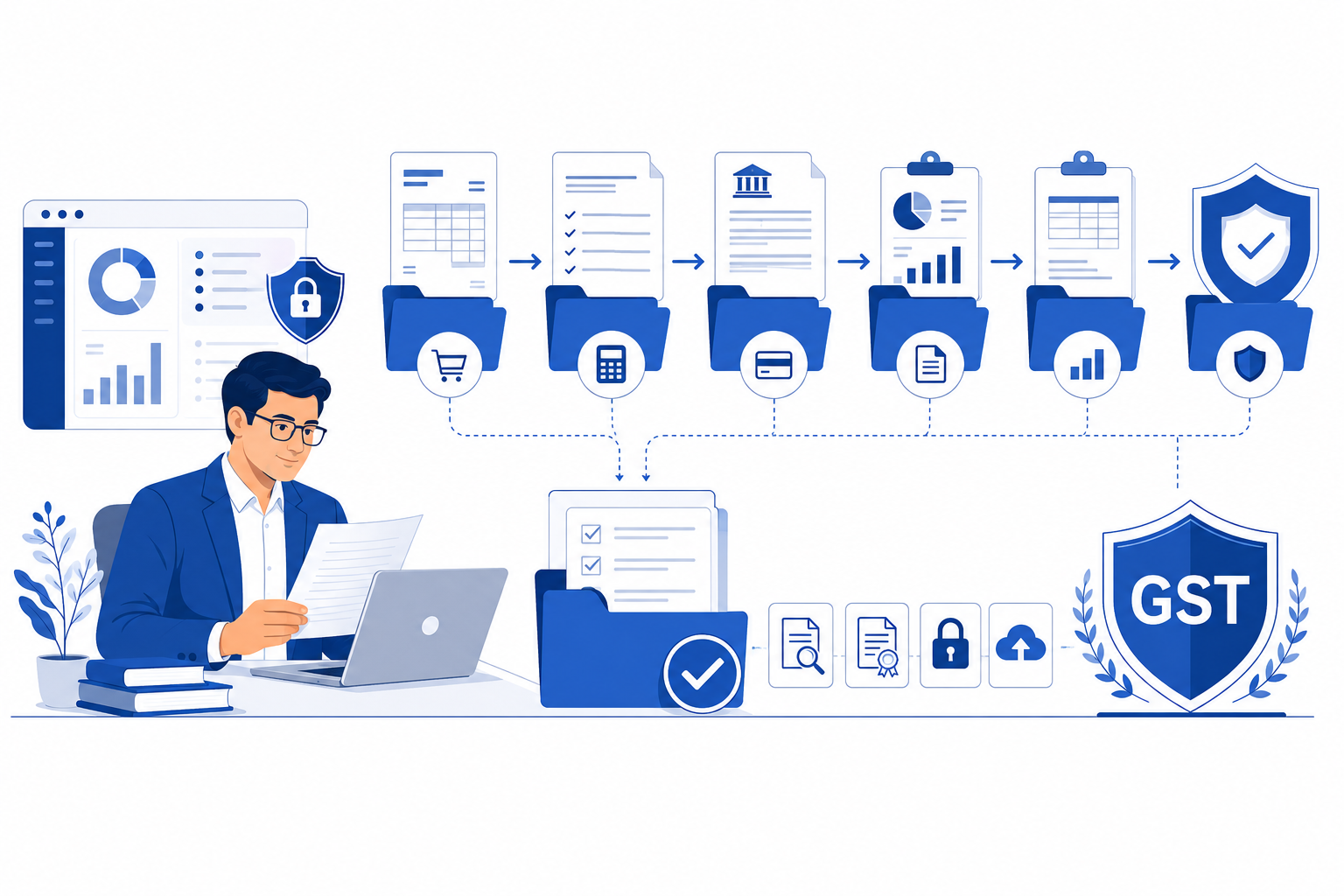
From a business and compliance perspective, a GST audit trail is the complete chain of documents that allows a transaction to be traced from its origin to its final reporting in GST returns and financial statements.
Rather than relying on a single invoice or payment record, an audit trail connects every stage of the transaction through supporting documentation.
A typical GST audit trail may look like this:
Each stage of the transaction is supported by documentary evidence, making the entire process transparent and verifiable.
During GST scrutiny, audits, or departmental verification, tax authorities may ask businesses to produce this audit trail to establish the authenticity of reported transactions.
A well-maintained GST audit trail helps businesses:
- Support Input Tax Credit (ITC) claims
- Verify turnover reported in GST returns
- Defend tax positions during departmental scrutiny
- Facilitate GST reconciliations
- Respond efficiently to GST notices and audits
- Maintain consistency between accounting records and GST filings
Maintaining a complete audit trail not only strengthens GST compliance but also reduces the time and effort required to respond to regulatory queries by ensuring that every reported figure is backed by clear documentary evidence.
Documents Frequently Requested by GST Officers During Scrutiny
The documents requested during a GST scrutiny or departmental verification may vary depending on the nature of the case.
However, certain records are commonly requested because they help authorities verify transactions, tax liability, and Input Tax Credit (ITC) claims.
| Document | Purpose |
|---|---|
| Tax Invoices | Verification of outward supplies and GST charged |
| Purchase Invoices | Support for Input Tax Credit (ITC) claims |
| Credit Notes | Verification of reductions in taxable value |
| Debit Notes | Validation of tax adjustments |
| E-Way Bills | Confirmation of movement of goods |
| Payment Receipts | Evidence supporting the validity of transactions |
| Bank Statements | Linking invoices with actual payments |
| Agreements / Contracts | Verification of commercial terms and transaction details |
| Purchase Orders | Evidence supporting the origin of business transactions |
| GST Returns | Comparison with books of accounts and supporting records |
| GSTR-2B Report | Verification of Input Tax Credit availability |
| Reconciliation Reports | Explanation of differences between accounting records and GST returns |
| Stock Ledger | Verification of inventory movement and stock transactions |
| Export Documents | Evidence for zero-rated supplies and refund claims |

Together, these documents form the foundation of a comprehensive GST audit trail.
They also serve as the primary evidence required when preparing a response to a GST notice, departmental scrutiny, audit, or investigation.
Businesses that maintain organized and easily accessible records are generally better equipped to respond to tax authorities promptly and substantiate the information reported in their GST returns.
Documentation Checklist for GST That Every Business Should Maintain
Businesses should establish a structured documentation system well before receiving a GST notice or departmental inquiry.
Maintaining complete and organized records on an ongoing basis makes it significantly easier to respond to audits, reconciliations, scrutiny proceedings, and compliance reviews.
| Document Type | Examples |
|---|---|
| Sales Documents | Tax invoices, credit notes, debit notes |
| Purchase Documents | Vendor invoices, Goods Received Notes (GRNs), purchase orders |
| GST Returns | GSTR-1, GSTR-3B, GSTR-9, GSTR-9C (where applicable) |
| ITC Documentation | Input Tax Credit register, GSTR-2B downloads, ITC working papers |
| Transport Documents | E-Way Bills, lorry receipts (LR), delivery challans |
| Banking Documents | Bank statements, payment confirmations, transaction references |
| Vendor Documents | GST registration copies, GSTIN verification records |
| Contract Documents | Agreements, work orders, quotations |
| Inventory Documents | Stock registers, inventory reports |
| Export Documents | Shipping bills, LUT, export invoices |
| Reconciliation Documents | Books of accounts vs GST returns reconciliation, ITC reconciliation statements |
A well-maintained documentation system enables businesses to quickly trace transactions, validate GST returns, support Input Tax Credit claims, and respond effectively to departmental queries.
More importantly, maintaining these records throughout the year is considerably easier than attempting to reconstruct documentation after receiving a GST notice.
Consistent record-keeping not only strengthens GST compliance but also helps businesses remain prepared for audits, inspections, reconciliations, and other regulatory verification processes.
Documentation for Input Tax Credit (ITC): Intent Alone Is Not Enough
Many business owners believe that making a genuine business purchase is sufficient to claim Input Tax Credit (ITC).
However, in practice, many GST disputes arise not because the transaction itself was invalid, but because the supporting documentation is incomplete or inadequate.
Common documentation issues include:
- Missing purchase invoices
- Vendor registration or GSTIN-related discrepancies
- Insufficient payment records
- Lack of documentary evidence confirming receipt of goods or services
- Unsupported or incomplete reconciliation statements
Even where a taxpayer has genuinely purchased goods or services, the absence of proper documentation may result in the Input Tax Credit claim being questioned during scrutiny or audit.
Claiming ITC is not based solely on the intention behind a transaction. It must be supported by appropriate invoices, payment records, supplier details, reconciliations, and other documentary evidence required under the GST framework.
During departmental verification, GST authorities typically expect businesses to demonstrate that every ITC claim is backed by complete and verifiable records.
Judicial decisions have consistently emphasized that taxpayers claiming Input Tax Credit should be able to substantiate their claims with adequate supporting documentation.
Maintaining organized records throughout the financial year not only strengthens GST compliance but also enables businesses to respond more effectively to notices, audits, and departmental inquiries.
The Value of Reconciliation in Defending GST Compliance
Reconciliation is one of the most effective internal controls for maintaining GST compliance.
Rather than waiting for a notice from the tax authorities, regular reconciliations help businesses identify and resolve discrepancies at an early stage.
Some of the most important GST reconciliations include:
| Reconciliation | Purpose |
|---|---|
| GSTR-2B vs Purchase Register | Identifies missing supplier invoices, Input Tax Credit (ITC) mismatches, and vendor reporting issues. |
| GSTR-3B vs Books of Accounts | Verifies tax liability, ITC claimed, and figures reported in GST returns. |
| GSTR-1 vs Sales Register | Confirms that outward supplies and turnover have been accurately reported. |
| Annual Return vs Financial Statements | Highlights discrepancies between year-end GST reporting and financial records. |
Regular reconciliation enables businesses to detect errors, omissions, and inconsistencies before they become compliance issues.
It also strengthens the reliability of GST returns by ensuring that accounting records, tax filings, and supporting documentation remain aligned.
During departmental scrutiny or audit, well-prepared reconciliation statements provide valuable evidence to explain reported figures and support a business’s GST position.
An effective reconciliation process demonstrates that the business actively monitors its GST compliance rather than waiting for discrepancies to be identified through notices or inspections.
The Often-Ignored Role of Vendor Documentation in GST Compliance Management
A significant portion of GST compliance risk originates outside the business itself.
Even when a company maintains strong internal documentation and accounting records, compliance issues may still arise because of errors or non-compliance on the supplier’s side.
Common vendor-related GST risks include:
- Incorrect GSTIN details on invoices
- Delayed filing of GST returns by suppliers
- Invoice discrepancies or mismatched transaction details
- Suspended, cancelled, or inactive GST registrations
- Incomplete or inadequate supporting documentation
Since Input Tax Credit (ITC) claims often depend on supplier compliance, businesses should perform periodic vendor verification rather than relying solely on invoices received.
As part of an effective GST compliance framework, businesses should maintain:
- Copies of supplier GST registration certificates
- GSTIN verification records
- Updated vendor master records
- Supplier contact and compliance details
- Supporting purchase documentation linked to each vendor
Maintaining accurate vendor documentation helps businesses verify supplier authenticity, strengthen Input Tax Credit claims, and reduce the likelihood of disputes during GST scrutiny or audit.
In today’s GST environment, vendor documentation has become an essential component of overall GST compliance management, supporting stronger internal controls and improving preparedness for departmental verification.
Example: A Company That Could Not Substantiate Its ITC Claims
Consider a business that claimed Input Tax Credit (ITC) on numerous purchases made during a financial year.
The purchases were genuine.
The goods had been delivered.
Payments to suppliers had also been completed.
However, after receiving a GST notice, the company discovered several documentation gaps:
- Some purchase invoices could not be located.
- Vendor confirmations were unavailable.
- Transport documents and e-way bills were missing.
- Monthly reconciliation statements had never been prepared.
Although the purchases were genuine and the ITC claims were based on actual business transactions, the company struggled to substantiate its position before the GST authorities.
The issue was not the legitimacy of the transactions—it was the absence of supporting documentary evidence.
If the business had consistently maintained:
- Invoice files
- Vendor records
- E-Way Bills and transport documents
- Payment proofs and bank records
- Monthly reconciliation statements
Responding to the GST notice would likely have been significantly easier, with stronger evidence available to support its Input Tax Credit claims.

How Long Should GST Documentation Be Kept?
Businesses are generally required to retain GST-related records for up to 72 months (six years) from the due date of filing the relevant annual return.
However, where a business is involved in any pending appeal, audit, investigation, assessment, or other legal proceeding, the relevant records should be preserved until the matter has been completely resolved, even if this extends beyond the normal retention period.
As part of good record management practices, businesses should maintain:
- Physical copies of documents wherever required
- Secure electronic backups of all important GST records
By 2026, digital document storage continues to be widely accepted, provided that records remain complete, accessible, and can be retrieved whenever required by the GST authorities.
GST Document Filing Issues That Can Lead to Compliance Problems
| Documentation Issue | Potential Risk Created |
|---|---|
| Missing invoices | Difficulty defending Input Tax Credit (ITC) claims |
| Incomplete vendor documentation | Supplier-related compliance disputes |
| Reconciliation gaps | Increased compliance risk and reporting inconsistencies |
| Missing agreements or contracts | Difficulty substantiating business transactions |
| Poor document storage practices | Delayed response to GST notices and audits |
| Unorganized filing system | Challenges during departmental inspections and audits |
| Missing transport documents | Difficulty proving movement of goods |
| Absence of payment records | Questions regarding the authenticity of transactions |
| No backup copies of documents | Loss of critical supporting evidence |
| Delayed year-end reconciliations | Greater exposure during GST scrutiny and verification |
Most of these documentation issues are preventable through consistent record-keeping, timely reconciliations, organized filing systems, and regular internal compliance reviews.
Maintaining complete and well-organized GST records throughout the year enables businesses to respond confidently to notices, audits, and departmental scrutiny while strengthening overall GST compliance.
Building a GST Compliance System That Is Always Audit-Ready
GST compliance should be treated as a continuous business process rather than an activity performed only at the end of the financial year.
A structured compliance schedule helps businesses identify discrepancies early, maintain complete documentation, and remain prepared for departmental scrutiny, audits, and GST notices.
| Frequency | Key Compliance Activities |
|---|---|
| Monthly |
|
| Quarterly |
|
| Yearly |
|
Following a structured GST compliance schedule enables businesses to identify issues proactively instead of reacting to departmental notices after they arise.
Regular reconciliations, systematic documentation, periodic vendor reviews, and annual compliance assessments together create a stronger internal control environment and significantly improve readiness for future GST scrutiny, audits, and investigations.
How Professional GST Review Services Help Companies Build an Audit Trail
Many businesses undertake periodic GST documentation reviews with the support of professional firms such as JackRabbit Consultants to identify documentation gaps before a scrutiny or notice situation arises.
A GST review usually focuses on:
- GST reconciliations
- Quality of documentation
- Audit trail integrity
- Input Tax Credit support validation
- Compliance testing
- Notice response preparation
JackRabbit Consultants helps companies evaluate whether their documentation process is strong enough to defend their GST position during future scrutiny, audit, or departmental verification.
The purpose is not limited to filing GST returns.
The broader objective is to ensure that every reported transaction can be supported with proper invoices, records, reconciliations, payment proofs, vendor details, and other relevant documents.
In GST compliance, the ability to defend every transaction often matters as much as filing the return itself.
Before the Next GST Notice Arrives…
The next time your business receives a GST notice, the discussion is unlikely to begin with complex provisions of tax law.
More often, it starts with a request to produce information, records, and supporting documentation.
Your ability to present tax invoices, reconciliation statements, vendor records, payment proofs, contracts, transport documents, and other supporting evidence frequently determines how effectively you can defend your GST position.
Filing GST returns on time remains essential, but strong documentation and a complete audit trail are equally important for demonstrating compliance during scrutiny.
An effective GST compliance framework should include:
- Well-maintained audit trails
- Regular reconciliations
- Complete supporting documentation
- Robust internal controls
- Organized record management practices
Many businesses choose to review their GST documentation periodically with the assistance of professional advisers such as JackRabbit Consultants to strengthen their compliance processes and identify documentation gaps before they become regulatory concerns.
The strongest defense against a future GST notice is not created after the notice is received.
It is built through consistent documentation, accurate reconciliations, and disciplined compliance practices maintained throughout the year.