

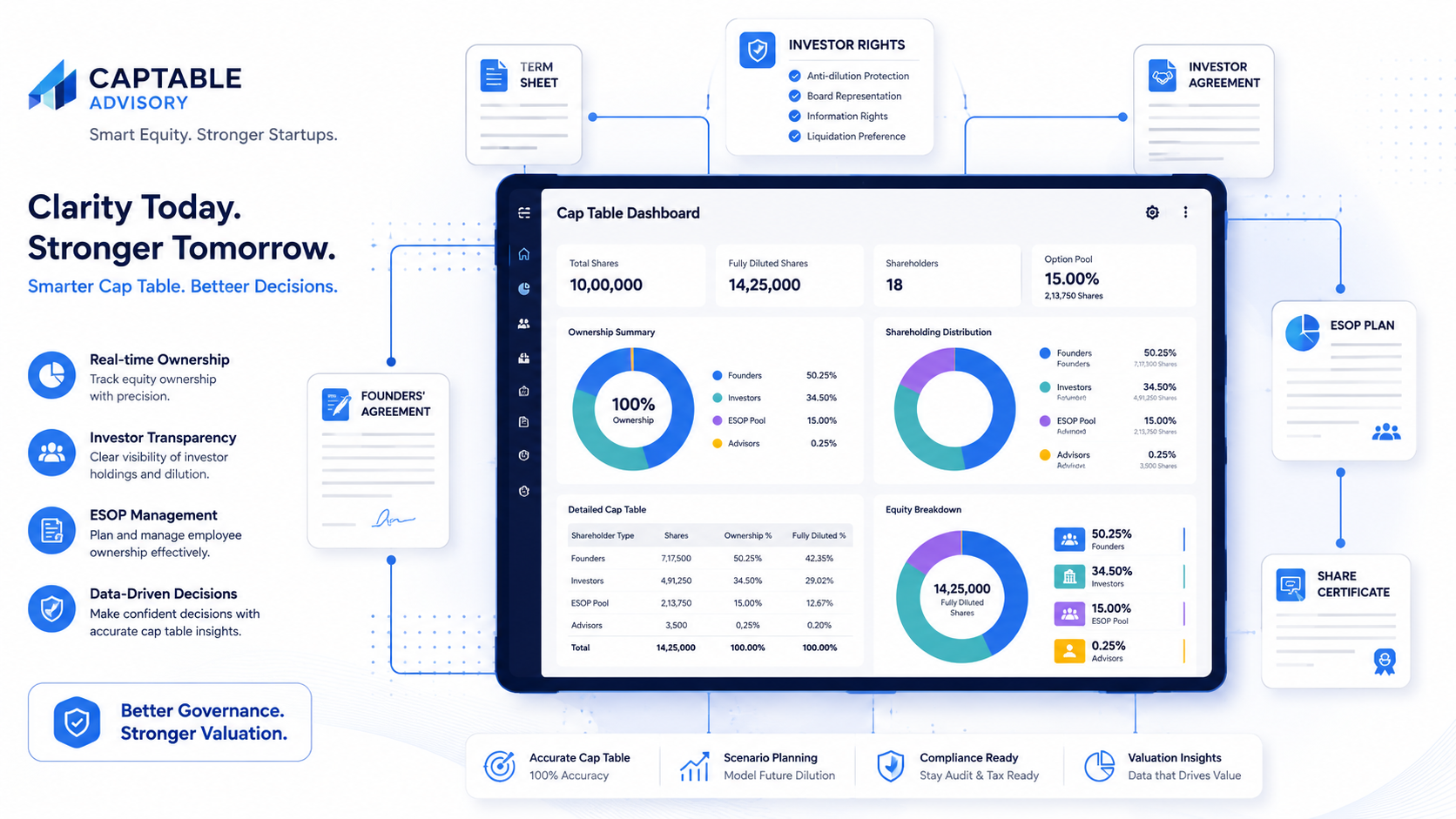
The startup enters its investor pitches.
The product gains traction.
There are growing customer numbers.
Revenues start coming through.
The startup’s pitch deck looks professional.
And then the investor asks:
“Could you please provide me with your cap table?”
All of a sudden, the discussion gets awkward.
Founders mention conflicting ownership percentages.
The ESOP structure is ambiguous.
Early commitments regarding advisor equity were not documented.
Several convertible structures were issued over various rounds of financing without being properly modeled.
Many fundraising issues arise not due to the lack of good products and business models but rather due to poorly managed ownership.
By 2026, investors are analyzing the cap tables of startups like never before.
A clean cap table represents a company’s maturity, governance standards, and fundraising readiness.
A messy cap table often leads to delays, valuation concerns, additional due diligence requirements, and difficult negotiations.
This guide explains how cap table management affects fundraising, investment decisions, dilution, ESOP planning, and startup governance.
It also highlights some of the most common ownership mistakes that startup founders often regret making later.
Reasons Why Investors Care So Much about a Startup’s Ownership Structure
Investors rarely evaluate startups solely on the basis of their products, technology, or current revenue.
They also assess the underlying ownership and governance structure of the business.
Typical areas of investor focus include:
- Who owns the startup
- Who controls important business decisions
- Potential future dilution scenarios
- Governance and compliance risks
- The startup’s ability to raise future funding
A startup’s ownership structure has a direct impact on fundraising outcomes.
Investors generally want confidence that:
- Ownership records are accurate and up to date
- Share issuances have been completed legally
- No undocumented dilution has occurred
- Founder incentives remain aligned with long-term growth
- Governance rights and decision-making authority are clearly defined
A well-maintained cap table demonstrates discipline, transparency, and operational maturity.
By contrast, an unclear ownership structure often raises questions regarding governance, compliance, and future fundraising readiness.
For investors, a clean ownership structure is not simply an administrative requirement—it is often viewed as a reflection of how well the business itself is being managed.
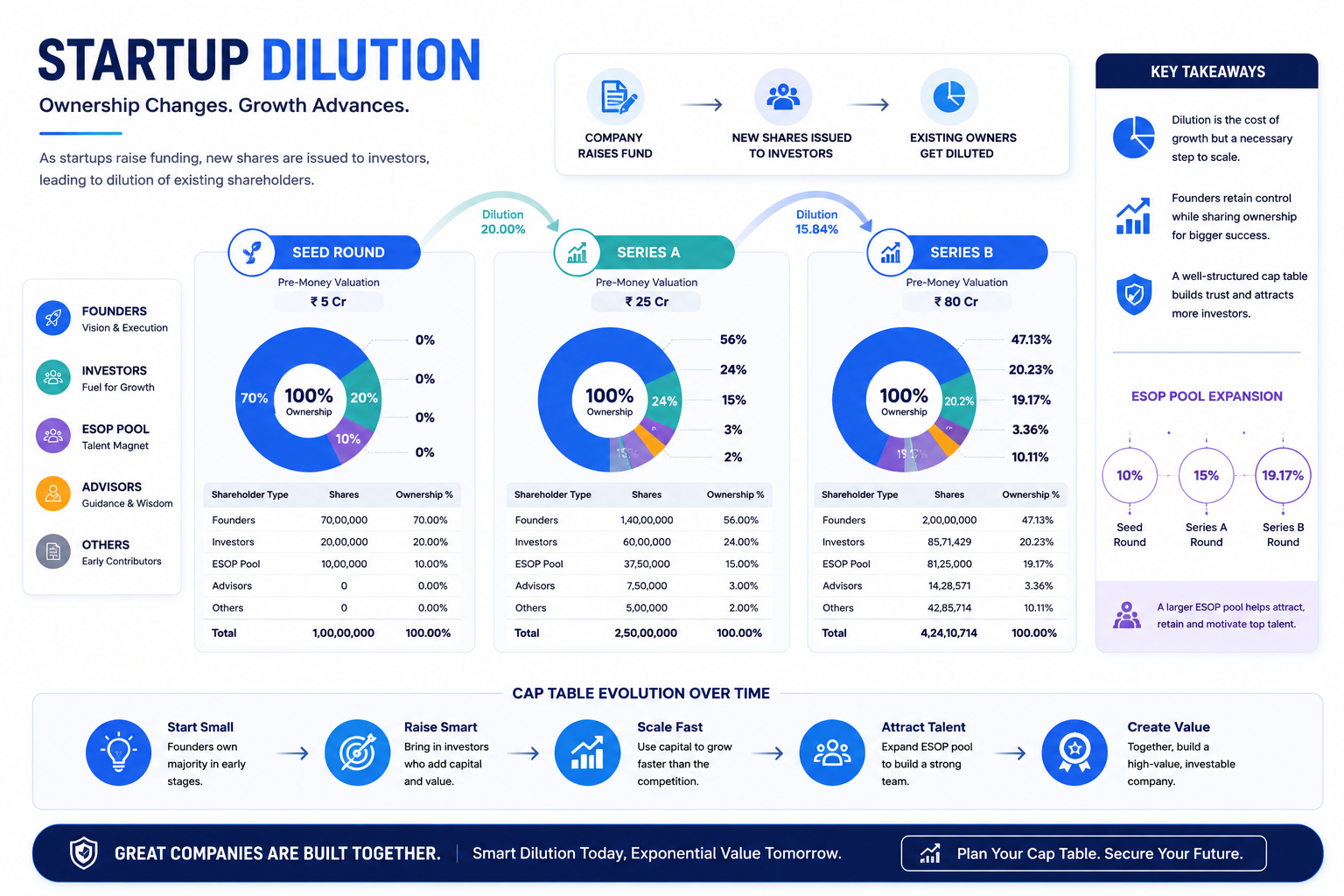
Ownership History of a Startup Is Captured in Its Cap Table
A startup cap table is much more than just a spreadsheet.
It serves as the central record of the company’s ownership structure and how that ownership has evolved over time.
Nearly every significant equity-related decision eventually finds its way into the cap table.
These may include:
- Founder equity allocations
- Investor ownership stakes
- Employee Stock Option Plans (ESOPs)
- Advisor equity grants
- Share transfers
- Future fundraising rounds
As startups grow, the cap table becomes one of the most important documents used by founders, investors, advisors, auditors, and potential acquirers.
A well-maintained cap table allows stakeholders to clearly understand:
- Who owns the company today
- How ownership has changed over time
- The impact of past funding rounds
- Current and future dilution levels
- Available and allocated ESOP pools
Proper cap table management creates transparency and helps support fundraising, due diligence, governance, and strategic planning.
On the other hand, poorly maintained cap tables often create confusion, ownership disputes, valuation concerns, and delays during investment or acquisition discussions—precisely when clarity becomes most important.
The Typical Features of an Ideal Startup Cap Table
| Ownership Element | Aim |
|---|---|
| Founders | Strategic management and company building |
| ESOP Pool | Talent attraction and retention |
| Angel Investors | Early-stage financial assistance |
| VC Investors | Growth financing and strategic support |
| Advisors | Specialized expertise and guidance |
| Future Reserved Equity | Flexibility for future fundraising and strategic allocations |
An ideal startup cap table cannot be defined merely by the percentage ownership assigned to each stakeholder group.
Instead, a strong cap table is one that is:
- Precisely documented
- Transparent in terms of ownership
- Clear in its equity allocation structure
- Supported by proper governance records
- Prepared for future fundraising activities
Investors, founders, employees, and future stakeholders should be able to understand the ownership structure without ambiguity.
A clean cap table not only improves fundraising readiness but also reduces the likelihood of ownership disputes, due diligence delays, and governance concerns as the startup grows.
The Most Common Ownership Mistakes Startup Founders Make
Many ownership-related issues emerge long before institutional investors become involved.
What appears to be a minor administrative oversight in the early stages can become a significant fundraising obstacle later.
| Error | Future Consequence |
|---|---|
| Founder over-dilution in early stages | Reduced founder control during future funding rounds |
| Undocumented equity commitments | Ownership disputes during due diligence |
| Poor shareholder record management | Regulatory and governance concerns |
| Lack of share issuance documentation | Fundraising delays and ownership verification issues |
| Excessive advisor equity allocation | Reduced flexibility for future talent and strategic hires |
| Absence of ESOP planning | Future recruitment and retention challenges |
Most ownership problems do not appear serious in the beginning.
During the startup phase, founders often focus on product development, customer acquisition, and fundraising rather than ownership administration.
However, these issues typically become visible when investors begin conducting detailed due diligence and asking questions about ownership history, share issuances, ESOP allocations, and shareholder rights.
A clean and properly documented ownership structure helps investors gain confidence in the business, while unresolved ownership issues can create delays, additional legal reviews, and difficult fundraising negotiations.
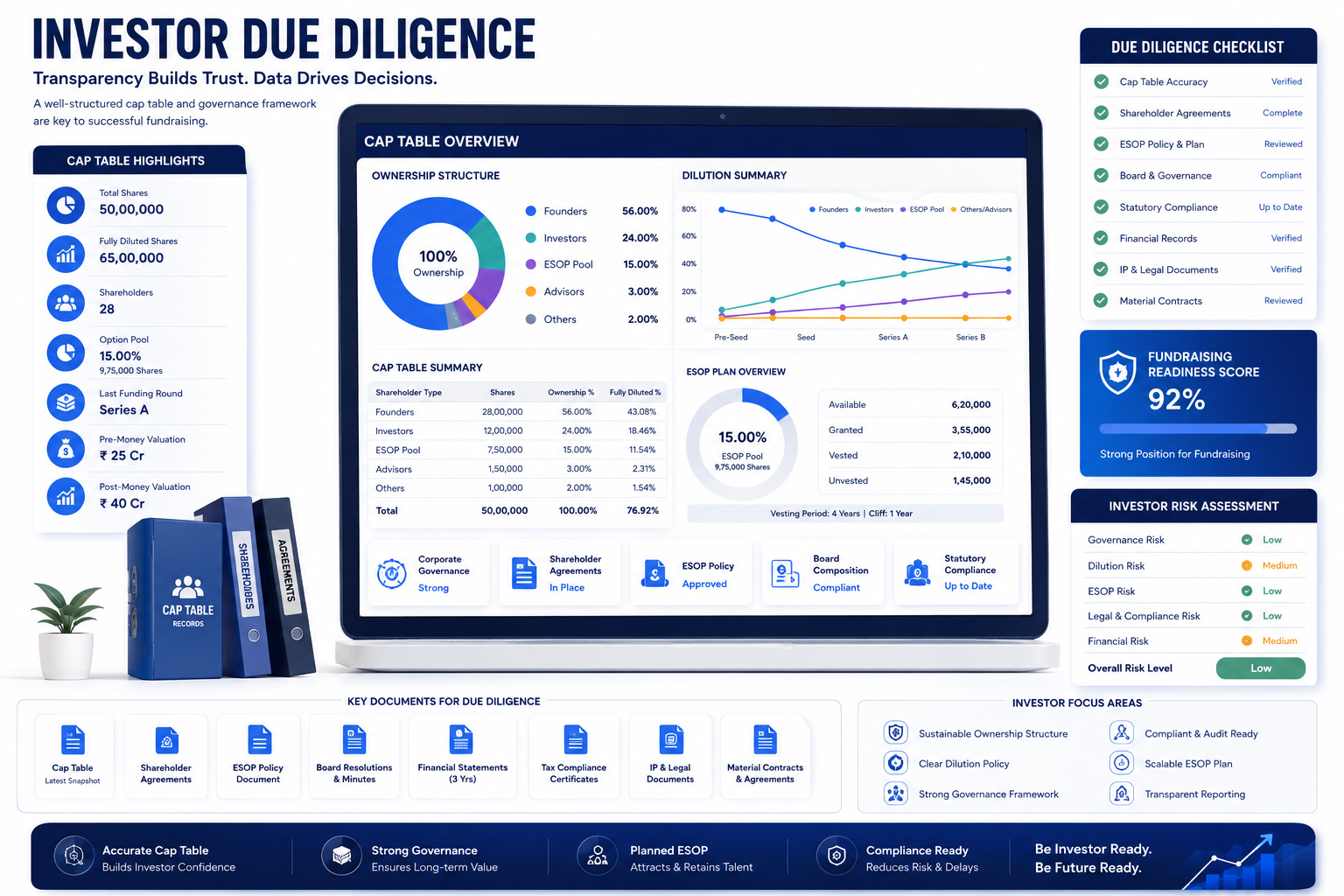
How Dilution in Startups Really Occurs
While most entrepreneurs understand the basic concept of dilution, many underestimate its long-term impact on ownership and control.
Dilution generally occurs through:
- Angel investment rounds
- Seed funding rounds
- Venture capital investments
- Creation of ESOP pools
- Expansion of existing ESOP pools
- Conversion of convertible notes
- Conversion of SAFE instruments
Simple Dilution Example
| Funding Stage | Founder Ownership |
|---|---|
| Startup Inception | 100% |
| Angel Round | 85% |
| Seed Round | 70% |
| ESOP Expansion | 65% |
| Series A Funding | 55% |
In many cases, founders may continue holding the same number of shares.
However, as new shares are issued to investors, employees, or convertible security holders, the total number of outstanding shares increases.
As a result, the founder’s percentage ownership decreases even though the actual number of shares owned remains unchanged.
This is the essence of dilution.
Dilution is not always negative. It often accompanies fundraising, talent acquisition, and business growth.
The key challenge is ensuring that founders understand how each funding round, ESOP allocation, or convertible instrument may affect future ownership levels.
That is why investors typically expect founders to understand dilution scenarios before entering fundraising discussions and making equity-related decisions.
The ESOP Pool Issue That Most Founders Ignore
One of the most overlooked aspects of startup ownership planning is the Employee Stock Option Plan (ESOP) pool.
During fundraising discussions, investors frequently recommend that startups establish or expand their ESOP pool before a financing round is completed.
The reasoning is straightforward:
Growing startups need talented employees, and attracting high-quality talent often requires equity-based compensation in addition to salary.
However, creating or increasing an ESOP pool usually results in dilution for existing shareholders, including founders.
While many founders focus heavily on valuation negotiations, they sometimes underestimate how an expanded ESOP pool can affect their ownership percentage over time.
A well-planned ESOP strategy can support:
- Improved hiring capability
- Employee retention and long-term alignment
- Stronger investor confidence
- Smoother future fundraising rounds
Investors often view a thoughtfully structured ESOP pool as evidence that the startup has considered future talent requirements and long-term growth plans.
Consequently, founders should evaluate ESOP expansion alongside valuation, dilution, and fundraising strategy rather than treating it as a separate issue.
Effective cap table planning requires balancing founder ownership, investor participation, and employee incentives in a way that supports sustainable growth.
Equal Founder Ownership Splits: When Fairness Creates Future Challenges
Many startups begin with an equal ownership split among founders.
While this may appear fair at the outset, equal ownership does not always reflect future contributions, responsibilities, or long-term involvement.
Challenges often emerge when:
- One founder exits the business early
- Founder responsibilities change significantly over time
- A founder becomes inactive
- Leadership contributions evolve differently
Consider a startup with two co-founders who initially divide ownership equally at 50% each.
Three years later:
- Founder A manages the business on a day-to-day basis
- Founder B has minimal involvement in operations
Despite the difference in contribution levels, both founders continue holding equal ownership.
Without a properly structured founder agreement and vesting mechanism, situations like this can create significant governance, ownership, and fundraising challenges.
Investors often scrutinize such arrangements because they may indicate misaligned incentives and future decision-making risks.
This is why many startups establish vesting schedules, founder agreements, and ownership governance frameworks early in their journey to ensure that equity remains aligned with long-term contribution and commitment.
Example: How a Poorly Managed Cap Table Delayed a Fundraising Round
Consider a growing startup preparing for its Series A fundraising round.
Investor interest is increasing.
Revenue is growing.
Business metrics look promising.
As part of the due diligence process, investors request:
- The current cap table
- Share allotment history
- ESOP records and allocations
- Details of convertible instruments
During the review, several ownership-related issues emerge:
- Advisor equity grants were never formally documented
- SAFE conversions were incorrectly modeled
- ESOP allocations differed across various records
- Founder ownership percentages did not match legal documentation
As a result, investors require additional explanations and verification.
Legal advisors become involved to review ownership records and validate historical transactions.
The fundraising process is delayed by several weeks while the company reconstructs and reconciles its ownership information.
Eventually, the issues are resolved.
However, the damage extends beyond the delay itself.
Investor confidence is affected because uncertainty around ownership often creates concerns about governance, compliance, and internal controls.
This example highlights an important lesson:
Fundraising delays are not always caused by weak products, poor traction, or lack of market opportunity.
Sometimes they result from ownership records that should have been properly maintained long before investors arrived.
Red Flags in a Cap Table That Commonly Concern Investors
During due diligence, investors review a startup’s cap table not just to understand ownership, but also to assess governance quality, documentation standards, and future fundraising readiness.
Certain ownership-related issues frequently attract additional scrutiny.
| Red Flag | Reason for Concern |
|---|---|
| Vague ownership structure | May indicate governance and documentation weaknesses |
| Excessive founder dilution | May create future incentive and control concerns |
| Inactive founders holding significant equity | May indicate poor alignment among stakeholders |
| Undocumented advisor equity allocations | May create legal and ownership risks |
| Incomplete ESOP records | May suggest weak governance and compliance processes |
| Overly complex SAFE or convertible structures | May create uncertainty around future dilution |
| Multiple undocumented side agreements | May create ownership ambiguity and legal exposure |
Importantly, these red flags do not automatically destroy an investment opportunity.
Many startups successfully resolve ownership and governance issues during the fundraising process.
However, the presence of these concerns often leads to:
- Additional due diligence requests
- Extended legal reviews
- Longer fundraising timelines
- Greater investor caution
- Questions regarding governance quality
The objective of good cap table management is not merely to satisfy compliance requirements.
It is to ensure that investors can quickly understand ownership, assess governance risks, and move forward with confidence during fundraising discussions.
How Cap Tables Relate to ESOPs, Share Transfers, and Startup Valuation
The importance of a cap table extends far beyond showing ownership percentages.
It acts as the central source of truth for several critical startup activities.
ESOP Planning
Employee stock option pools must be accurately reflected in the cap table to ensure proper tracking of grants, vesting, exercises, and future dilution.
Share Transfers
Founder exits, advisor equity changes, and shareholder transfers should be recorded correctly to maintain an accurate ownership history.
Startup Valuation
Investors and advisors can assess valuation more effectively when ownership structures are transparent and properly documented.
Fundraising
During investment discussions, investors analyze the cap table to understand dilution, ownership concentration, governance, and future financing requirements.
In reality, these four areas are closely interconnected.
A change in one area often affects the others.
For example, creating an ESOP pool may affect dilution, which in turn influences valuation discussions and future fundraising outcomes.
Similarly, a founder share transfer can alter ownership percentages, governance rights, and investor perceptions during due diligence.
This is why successful startups treat cap table management as an ongoing governance process rather than a one-time ownership record.
A well-maintained cap table provides clarity, supports strategic decision-making, and helps ensure that valuation, fundraising, ESOP planning, and ownership changes remain aligned as the business grows.
When Startups Typically Benefit from a Professional Cap Table Review
Cap table issues are generally easier and less expensive to resolve before fundraising begins than during an active investment process.
As startups grow and ownership structures become more complex, professional cap table reviews can help identify gaps, inconsistencies, and potential governance concerns before they become obstacles.
Professional review is often considered during:
v- Seed financing rounds
- Series A fundraising preparation
- Investor onboarding
- ESOP pool creation and expansion
- Founder fundraising and ownership restructuring
- Share transfer transactions
- Business valuation exercises
- Due diligence preparation
Ownership Verification
Ensuring that founder, investor, advisor, and employee ownership records are accurate and properly documented.
Dilution Analysis
Reviewing historical and projected dilution resulting from funding rounds, ESOP pools, and convertible instruments.
Governance Readiness
Verifying that share issuances, transfers, board approvals, and ownership records align with legal documentation.
Fundraising Preparation
Helping founders present a clear and investor-friendly ownership structure during due diligence.
Investors often evaluate ownership clarity as an indicator of operational maturity and governance discipline.
A clean cap table can streamline due diligence, while unresolved ownership discrepancies may result in additional legal reviews, valuation discussions, and fundraising delays.
For this reason, many startups choose to review and organize their cap tables before entering major fundraising discussions rather than attempting to resolve ownership issues in the middle of investor negotiations.
How Professional Startup Advisory Helps Maintain Ownership Clarity
As startups grow, ownership structures often become more complex due to fundraising rounds, ESOP allocations, share transfers, advisor equity grants, and convertible instruments.
To prepare for future fundraising and due diligence requirements, many startups choose to work with professional advisory firms such as JackRabbit Consultants to review ownership records, governance practices, and compliance documentation.
Professional startup advisory can assist founders in several areas, including:
- Assessment of dilution risks
- Presentation and verification of ownership records
- Evaluation of fundraising readiness
- Governance framework improvements
- ESOP planning and structuring
- Due diligence preparation
Dilution Planning
Reviewing current and projected ownership scenarios to help founders understand future dilution implications.
Cap Table Management
Ensuring ownership records remain accurate, consistent, and aligned with legal documentation.
Governance Readiness
Strengthening corporate governance processes and ownership transparency before investor review.
Fundraising Preparation
Helping startups organize ownership information for smoother investor discussions and due diligence exercises.
JackRabbit Consultants assists startups with ownership structuring, startup compliance, governance evaluation, investor-readiness planning, and related documentation requirements.
The objective is not merely to maintain records.
The broader goal is to create a transparent ownership structure that supports fundraising, governance, future growth, and long-term stakeholder confidence.
Before the Next Fundraising Conversation…
Fundraising is not only about growth metrics, customer traction, revenue, or valuation.
Investors also place significant importance on ownership clarity and governance discipline.
A well-managed startup cap table demonstrates:
- Governance maturity
- Fundraising readiness
- Ownership transparency
- Strategic planning capability
- Long-term scalability
Founders who understand dilution, maintain accurate ownership records, plan ESOP allocations carefully, and continuously monitor their cap table are generally better positioned during investor discussions.
In contrast, many ownership-related issues discovered during due diligence could have been identified and resolved months before fundraising began.
Successful fundraising is often supported by ownership clarity, accurate records, documented equity issuances, properly structured ESOP pools, and a clear understanding of future dilution.
Before approaching investors, startups should ensure that:
- Ownership records are accurate and updated
- All share issuances are properly documented
- ESOP pools are correctly structured
- Founder ownership percentages are verified
- Convertible instruments are properly modeled
- Future dilution scenarios are understood
- Governance documentation is complete
Many founders choose to work with startup advisory firms such as JackRabbit Consultants to review ownership structures, governance frameworks, ESOP strategies, fundraising readiness, and compliance records before entering investment discussions.
The objective is not simply to maintain documentation.
It is to build a startup that can withstand investor scrutiny, support future fundraising rounds, and scale with confidence.
In modern fundraising environments, ownership clarity is no longer just a compliance exercise—it is often viewed as a direct indicator of how prepared a startup is for its next stage of growth.