

A company completes its rebranding process, and the new name is approved by the Ministry of Corporate Affairs (MCA). The Registrar of Companies issues a fresh Certificate of Incorporation reflecting the new company name.
The management informs its stakeholders about the name change and assumes that the entire process has been completed.
In reality, obtaining approval from the Ministry of Corporate Affairs (MCA) is only the beginning.
A company name change has far-reaching implications across multiple legal, financial, operational, and regulatory areas. After the issuance of the new Certificate of Incorporation, businesses are generally required to update the new name across various registrations, records, contracts, and business documents to maintain consistency and compliance.
The change may affect:
- Income Tax records
- GST registration and related records
- Bank accounts and banking documents
- Vendor and customer master records
- Business contracts and agreements
- Invoices and accounting documents
- Licences and statutory registrations
- Company website and digital presence
- Statutory registers and corporate records
- Other compliance-related documents maintained by the company
Completing these post-approval updates is essential to ensure that the company’s legal identity remains consistent across all regulatory authorities, business partners, financial institutions, and internal records.
This guide explains the end-to-end compliance process that companies should consider after changing their name in India, including the key legal, tax, GST, and operational updates generally required during 2026.
Why Changing the Company Name Is Only the Beginning of the Compliance Process
A company name change does not result in the creation of a new legal entity. The company continues to be the same legal person, retaining its rights, liabilities, assets, contracts, obligations, and corporate history.
What changes is the company’s legal identity, which must then be updated consistently across various regulatory authorities, financial institutions, business records, and operational systems.
In practice, a company name change involves compliance at multiple levels rather than merely obtaining approval from the Registrar of Companies.
| Compliance Level | Meaning | Why It Matters |
|---|---|---|
| Legal Identity | Name approved and registered with the Ministry of Corporate Affairs (MCA) and the Registrar of Companies (ROC). | Establishes the company’s official legal name. |
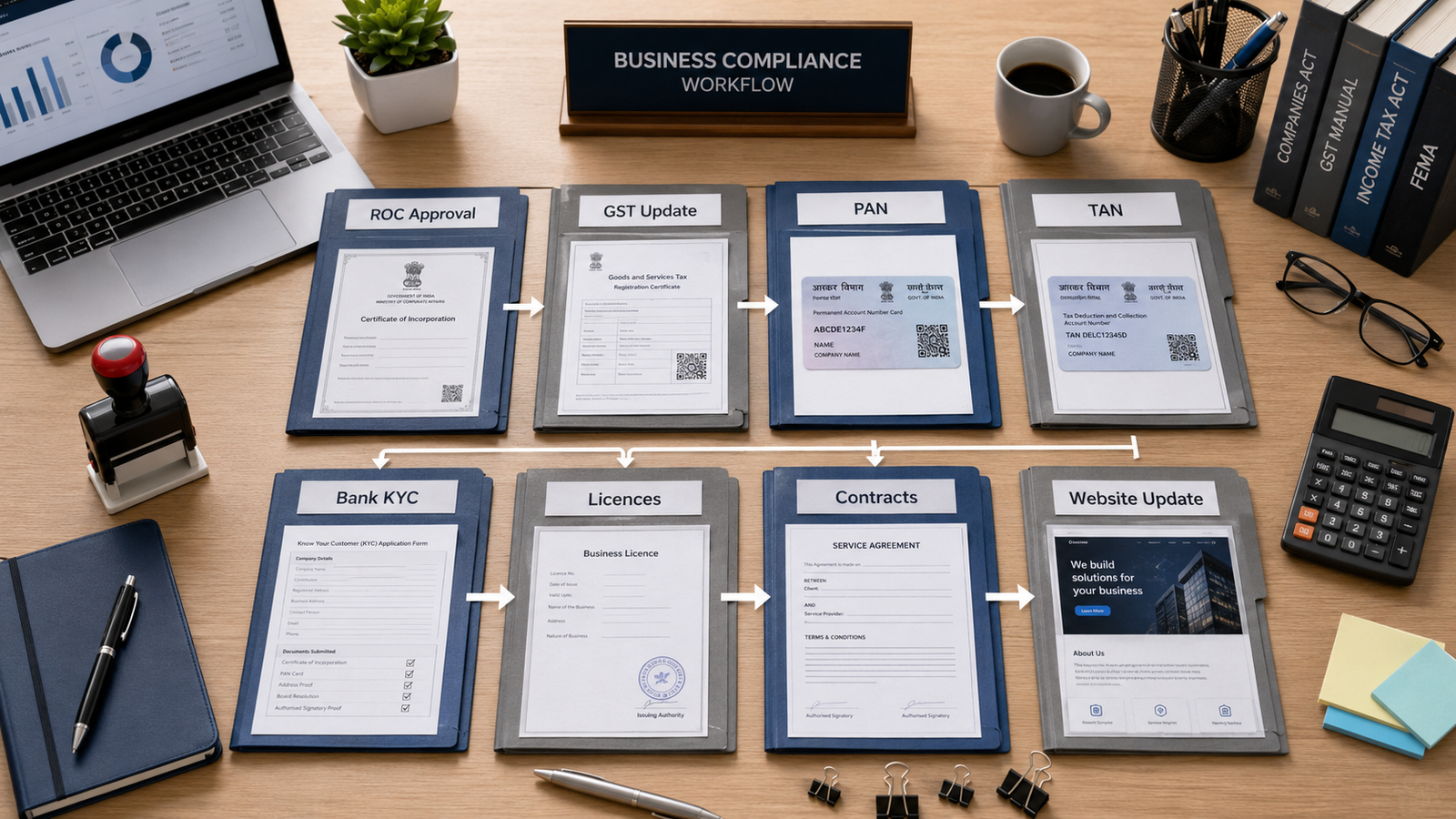
| Regulatory Identity | Updates across GST, PAN, TAN, Import Export Code (IEC), EPF, ESIC, and other statutory registrations and licences. | Ensures that government records remain consistent with the company’s legal identity. |
| Operational Identity | Updates to bank accounts, invoices, contracts, websites, email domains, vendor records, customer records, and other business documents. | Helps avoid confusion in banking, billing, contractual obligations, and business communications. |
Many companies complete the ROC formalities but delay updating their regulatory registrations and operational records.
These inconsistencies can create practical difficulties, including delays in banking transactions, GST-related issues, contractual discrepancies, vendor confusion, and administrative complications during audits or due diligence.
A successful company name change is therefore not limited to obtaining a fresh Certificate of Incorporation—it also requires ensuring that the company’s new identity is consistently reflected across all legal, regulatory, and operational records.
Common Commercial Reasons for Changing a Company Name
Businesses may decide to change their company name for a variety of commercial and strategic reasons rather than purely legal considerations.
As organizations evolve, a new name may better reflect their market positioning, business objectives, or future growth plans.
| Reason | Practical Example |
|---|---|
| Rebranding | The existing company name no longer aligns with the business’s brand identity or market positioning. |
| Business Expansion | A locally focused business expands nationally or diversifies into new products or services. |
| Industry Shift | The company changes its primary line of business or enters a different industry. |
| Investor Preference | Existing or prospective investors recommend a name that better reflects the company’s growth strategy or branding. |
| Brand or Trademark Considerations | The existing or proposed company name creates trademark conflicts or branding challenges. |
| Corporate Reorganization | The company adopts a new name as part of a merger, restructuring, or broader corporate reorganization. |
While commercial objectives often drive the decision to rename a company, businesses should also carefully evaluate the legal, tax, regulatory, and operational implications of the proposed change.
Proper planning before the name change—and timely compliance updates afterward—can help ensure a smooth transition while minimizing disruption to business operations and regulatory compliance.
ROC Process for Changing a Company Name
The process of changing a company’s name through the Registrar of Companies (ROC) involves more than simply filing statutory forms.
Each stage serves a specific legal purpose and helps ensure that the proposed name change complies with the requirements of the Companies Act, 2013 and the applicable rules.
| Stage | Purpose |
|---|---|
| Board Approval | The Board of Directors approves the proposed name change and authorizes the application for name reservation. |
| Name Availability Check | The proposed name is examined to ensure that it is not identical, deceptively similar, or otherwise restricted under applicable naming guidelines. |
| Name Reservation | The proposed company name is reserved through the prescribed MCA procedure. |
| Shareholders’ Approval | Members approve the alteration of the Memorandum of Association by passing a Special Resolution. |
| Filing of Resolution | The Special Resolution is filed with the Registrar of Companies in Form MGT-14. |
| Approval from ROC / Central Government | Application for approval of the company name change is made through Form INC-24, wherever applicable. |
| Fresh Certificate of Incorporation | The company officially adopts its new name upon issuance of a fresh Certificate of Incorporation by the Registrar of Companies. |
| Amendment of MOA & AOA | The Memorandum and Articles of Association are updated to reflect the company’s new legal name. |
The above process applies specifically to companies incorporated under the Companies Act, 2013.
Limited Liability Partnerships (LLPs) follow a separate procedure governed by the Limited Liability Partnership Act, 2008 and the applicable LLP Rules, including the prescribed LLP forms.
However, once the name change has been approved, the subsequent compliance requirements—such as updating tax registrations, bank records, contracts, licences, invoices, statutory records, and other operational documents—follow broadly similar principles for both companies and LLPs.
Post-Approval Compliance Checklist Every Company Should Follow
Obtaining a fresh Certificate of Incorporation after a company name change is only the first milestone. The company should then undertake a structured post-approval compliance exercise to ensure that its new legal identity is reflected across all statutory, financial, contractual, and operational records.
Failure to update these records may lead to inconsistencies during tax assessments, banking transactions, regulatory inspections, audits, vendor onboarding, customer invoicing, and due diligence processes.
| Compliance Area | Action Required | Purpose |
|---|---|---|
| GST Registration | Update the legal name in the GST registration (where PAN remains unchanged). | Ensures GST certificates and tax invoices reflect the company’s new legal name. |
| PAN | Update the company name associated with the existing PAN. | The PAN generally remains unchanged, but the legal name should be updated. |
| TAN | File a correction request to update the deductor’s name. | Ensures TDS filings and certificates match the company’s legal name. |
| Bank Accounts | Submit the fresh Certificate of Incorporation, Board Resolution, and KYC documents. | Prevents banking delays and name mismatch issues. |
| Import Export Code (IEC) | Update IEC details where the company undertakes import or export activities. | Maintains consistency with DGFT and customs records. |
| MSME / Udyam Registration | Update the registered business name. | Ensures government registration records remain accurate. |
| FSSAI Licence | Update the licence details where applicable. | The Food Business Operator licence should reflect the new legal name. |
| Shops & Establishment Registration | Update local registrations wherever required. | Maintains consistency with labour and local authority records. |
| Professional Tax Registration | Update employer details where applicable. | Supports state-level compliance requirements. |
| EPF / ESIC | Update the employer’s registered name. | Ensures employee statutory records remain accurate. |
| Trademark Records | Update the proprietor’s name where ownership remains unchanged. | Maintains consistency across intellectual property records. |
| Existing Contracts | Issue formal notices or execute amendments wherever required. | Ensures contractual continuity under the new company name. |
| Supplier Agreements | Notify suppliers and update vendor master records. | Prevents procurement and payment-related discrepancies. |
| Customer Agreements | Inform customers and update contractual records. | Maintains consistency across commercial relationships. |
| Lease Agreements | Notify landlords and amend lease records where necessary. | Ensures lease documentation reflects the new legal identity. |
| Employment Documentation | Update future employment letters and HR documentation, where appropriate. | Maintains consistency in employee records. |
| Purchase Orders | Issue future purchase orders under the new name, mentioning the former name where appropriate during the transition. | Supports continuity with vendors. |
| Sales Invoices | Update invoice templates after the GST registration reflects the new company name. | Ensures legally compliant billing. |
| Website | Update company name across the website, footer, privacy policy, terms of use, and other legal pages. | Maintains consistency across digital assets. |
| Email Domain & Signatures | Synchronize official email addresses, signatures, and branding where necessary. | Supports professional communication. |
| Social Media Profiles | Update handles, display names, and company descriptions. | Ensures consistent public branding. |
| Accounting Software | Update the company master records. | Ensures reports, invoices, and accounting records display the correct legal name. |
| ERP Systems | Modify legal entity and tax master data. | Prevents inconsistencies across internal business processes. |
| Letterheads, Business Cards & Company Seals | Issue updated stationery with appropriate statutory disclosures. | Supports official and commercial correspondence. |
| Insurance Policies | Update the insured entity’s name with insurers. | Avoids complications during future claims. |
Companies should also note that, following a name change, applicable provisions of company law may require references to the former name in certain official documents and communications for the prescribed period, wherever applicable.
Completing this structured post-approval compliance exercise helps ensure that the company’s legal identity remains consistent across all statutory authorities, financial institutions, contractual relationships, and operational systems.
How a Company Name Change Affects GST, PAN, TAN, and Income Tax Records
Changing a company’s name does not create a new legal entity. The company continues to exist with the same legal identity, and its tax obligations generally remain unchanged.
However, the company’s updated legal name should be reflected across various tax registrations and government records to ensure consistency in statutory filings, invoices, and financial documentation.
| Registration / Tax Record | Update Required? | Purpose of the Update |
|---|---|---|
| GST Registration | Yes, where the legal name changes while the PAN remains the same. | Ensures that the GST Registration Certificate, GST returns, and tax invoices reflect the company’s current legal name. |
| PAN | Yes, the company name associated with the PAN should be updated. | The PAN generally remains unchanged, but the name in the PAN database should match the company’s new legal identity. |
| TAN | Yes. | The deductor’s name should be updated so that TDS returns, challans, and certificates carry the correct legal name. |
| Income Tax Records | No new taxpayer registration is generally required. | The company’s Permanent Account Number (PAN) continues to represent the same taxpayer, while the taxpayer profile should reflect the updated legal name. |
| Bank KYC Records | Yes. | Banks generally require the fresh Certificate of Incorporation issued by the ROC along with updated KYC documents before changing the company’s name in banking records. |
Updating these registrations promptly helps maintain consistency across tax filings, banking records, invoices, statutory documents, and government databases.
Keeping all regulatory records aligned with the company’s new legal name also reduces the likelihood of mismatches during tax assessments, GST verification, banking transactions, audits, and regulatory inspections.
What Happens to Existing Contracts, Invoices, and Purchase Orders After a Company Name Change?
A change in the company’s name does not create a new legal entity or invalidate existing contracts. The company continues to be the same legal person with the same rights, obligations, assets, liabilities, and contractual commitments.
However, businesses should ensure that their commercial records are updated and that all relevant stakeholders are formally informed of the change in the company’s legal name.
It is generally advisable to notify customers, suppliers, banks, lenders, landlords, business partners, and other counterparties so that future transactions and communications are carried out under the updated company name.
| Information to Include in the Notice | Purpose |
|---|---|
| Previous Company Name | Helps stakeholders identify existing contracts, invoices, and business records. |
| New Company Name | Communicates the company’s updated legal identity. |
| Corporate Identification Number (CIN) | Confirms that the legal entity remains the same despite the name change. |
| Effective Date of Name Change | Links the change to the fresh Certificate of Incorporation issued by the Registrar of Companies. |
| GST and PAN Details | Clarifies whether the tax registrations continue under the same identification numbers with only the company name updated. |
| Bank Account Details | Confirms whether banking details remain unchanged or whether updated banking information should be used for future transactions. |
For significant commercial agreements, financing arrangements, long-term service contracts, or lease agreements, the counterparty may request an addendum or amendment reflecting the company’s new legal name while confirming that all other contractual terms remain unchanged.
Updating contracts, invoices, purchase orders, and related business documents promptly helps maintain consistency across commercial records and minimizes the risk of payment delays, contractual disputes, or administrative issues arising from the company’s name change.
Common Mistakes Companies Make After a Name Change That Can Lead to Compliance Issues
Many companies complete the legal process of changing their name but overlook several post-approval compliance requirements. These omissions can result in inconsistencies across regulatory records, banking systems, contracts, and business communications.
A coordinated update across all statutory and operational records helps minimize compliance risks and ensures a smooth transition to the company’s new legal identity.
| Common Error | Potential Consequence |
|---|---|
| Issuing invoices under the old company name after updating the GST registration | Mismatch between GST records, invoices, and accounting documentation. |
| Updating the ROC records but not the GST registration | Vendor onboarding issues and inconsistencies in tax documentation. |
| Updating GST records but not bank account details | Delays or complications in banking transactions and payments. |
| Failing to update the company name associated with PAN or TAN | Mismatch in Income Tax and TDS records, leading to administrative issues. |
| Not updating the Import Export Code (IEC) or other statutory licences | Compliance inconsistencies relating to import, export, or industry-specific regulations. |
| Not informing customers about the company name change | Confusion regarding the continuity of the legal entity and business relationship. |
| Failing to update existing contracts or execute amendments where required | Potential contractual, audit, or payment-related complications. |
| Continuing to display the previous company name on the website | Inconsistency between public-facing information and statutory records. |
| Changing the official email domain without notifying stakeholders | Reduced customer confidence and communication challenges. |
| Continuing to use outdated letterheads, business cards, or official stationery | Risk of incorrect statutory disclosures and inconsistent corporate documentation. |
One of the most common misconceptions is treating a company name change solely as a branding exercise.
In practice, a company name change is a comprehensive legal and compliance process that requires coordinated updates across regulatory registrations, taxation records, banking arrangements, contracts, internal systems, and customer-facing documents.
Completing these updates in a timely and systematic manner helps ensure regulatory compliance, operational continuity, and consistency across all aspects of the business.
Example: A Company That Completed the ROC Process but Overlooked Operational Compliance
Consider a Private Limited Company that changed its name after expanding from a regional service provider into a nationwide consulting business.
The company completed the ROC formalities successfully, obtained approval for the new name, and received a fresh Certificate of Incorporation from the Registrar of Companies.
However, several important operational records continued to reflect the company’s previous name.
The company continued issuing invoices under its old name, its GST registration had not yet been updated, and the new legal name was also missing from its bank account records.
During a commercial transaction, a major client noticed that the company name appearing in the MCA records, GST registration, and banking documents did not match.
As a result, the client declined to process the documents until the inconsistencies were resolved.
In this situation, the challenge was not the company name change itself—it was the incomplete implementation of the post-approval compliance process.
Corrective Measures Taken
| Compliance Area | Corrective Action |
|---|---|
| GST Registration | Updated the company’s legal name in the GST registration. |
| PAN & TAN Records | Submitted correction requests to update the company’s legal name. |
| Bank Records | Completed fresh KYC formalities and updated the company’s banking records. |
| Vendor & Customer Communication | Issued formal name-change notifications to business partners. |
| Invoice Templates | Updated billing documents to display the new legal name. |
| Commercial Contracts | Updated or amended relevant agreements to reflect the company’s new legal identity. |
This example demonstrates that obtaining a fresh Certificate of Incorporation is only one part of the overall name-change process.
Completing the corresponding updates across tax registrations, banking records, contracts, invoices, and business communications is equally important to ensure operational continuity and regulatory compliance.
30-Day Compliance Action Plan After a Company Name Change
Once a fresh Certificate of Incorporation has been issued, companies should follow a structured implementation plan to update their legal, regulatory, financial, and operational records.
Completing these activities in a phased manner helps maintain consistency across government registrations, banking records, contracts, and business communications while reducing the risk of compliance gaps.
| Timeline | Key Activities |
|---|---|
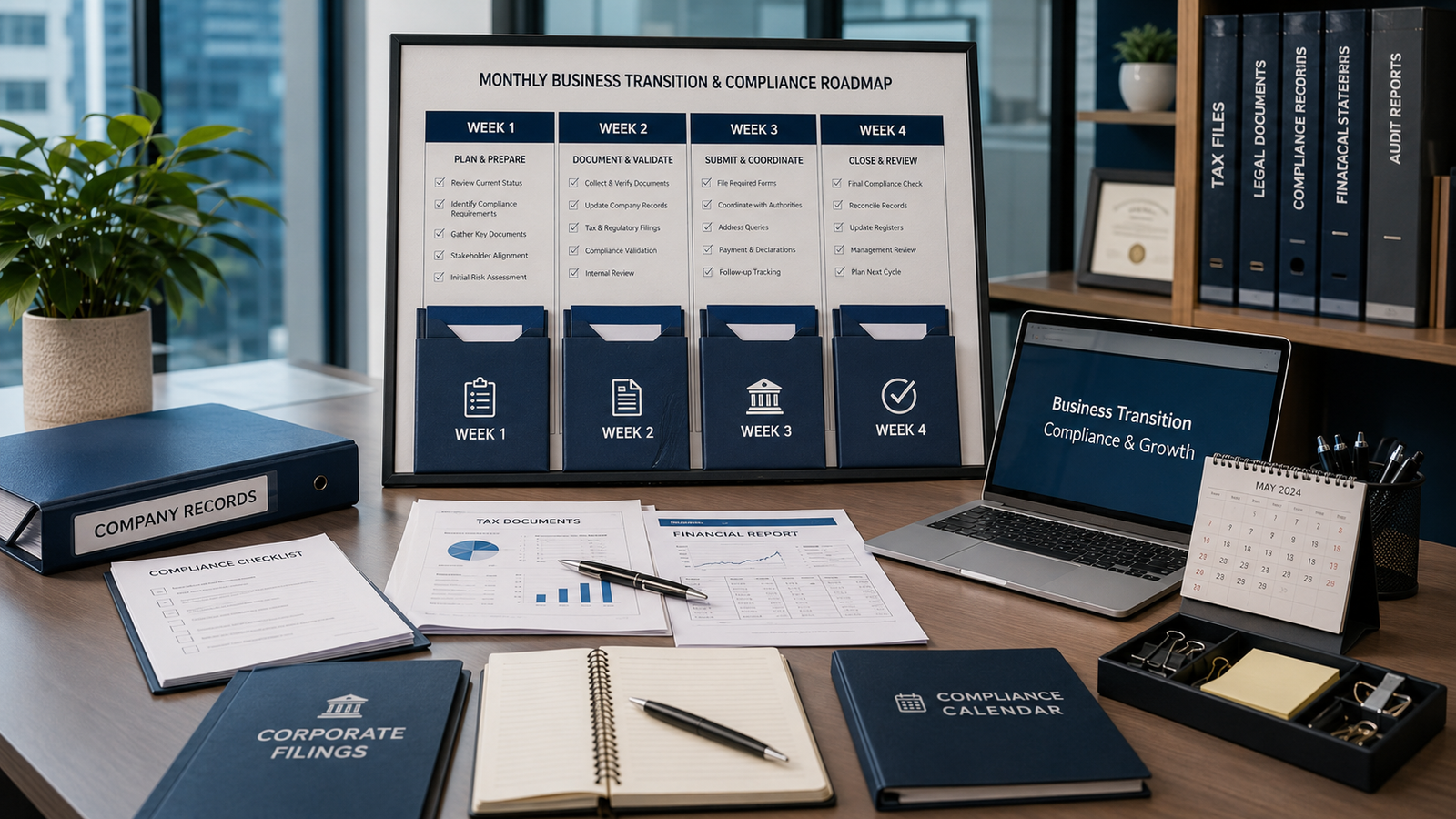
| Week 1 | Obtain the fresh Certificate of Incorporation, update the Memorandum of Association (MOA) and Articles of Association (AOA), and complete the necessary Board authorisations for implementing post-name-change compliance activities. |
| Week 2 | Update the company’s GST registration, PAN records, TAN records, and complete the required KYC formalities with banking institutions. |
| Week 3 | Update other statutory registrations, including the Import Export Code (IEC), Udyam/MSME Registration, FSSAI Licence, Shops & Establishment Registration, EPF, ESIC, and any other industry-specific licences or registrations applicable to the business. |
| Week 4 | Update contracts, invoice templates, accounting software, ERP systems, websites, email signatures, social media profiles, vendor and customer master records, and other business documents reflecting the company’s legal name. |
Following a structured 30-day implementation plan helps businesses complete post-name-change compliance in an organized manner while minimizing disruption to day-to-day operations.
A timely review of statutory registrations, tax records, banking arrangements, commercial agreements, and internal systems also reduces the likelihood of inconsistencies during audits, regulatory inspections, banking transactions, and future due diligence exercises.
How Professional Compliance Reviews Help Companies Transition Smoothly After a Name Change
Changing a company’s name involves much more than obtaining approval from the Registrar of Companies. The real challenge lies in ensuring that every statutory, regulatory, financial, and operational record reflects the company’s new legal identity.
To reduce the risk of inconsistencies, many businesses engage professional advisers such as JackRabbit Consultants to conduct comprehensive post-name-change compliance reviews before discrepancies result in regulatory or operational issues.
A professional compliance review generally covers:
- Verification of ROC and corporate records
- Review of GST registration and related tax records
- Review of Income Tax, PAN, and TAN records
- Examination of statutory registers and corporate documentation
- Verification of licences, permits, and regulatory registrations
- Review of internal records, working papers, and supporting documentation
JackRabbit Consultants assists businesses with post-name-change compliance by reviewing regulatory updates, preparing documentation, identifying compliance gaps, and providing guidance on implementing the necessary changes across legal and operational records.
Professional assistance can be particularly valuable for companies that operate across multiple GST registrations, undertake import and export activities, maintain banking and credit facilities, prepare investor reports, manage large vendor networks, or hold industry-specific licences requiring coordinated updates.
A structured compliance review helps businesses achieve consistency across government registrations, tax records, banking arrangements, contracts, internal systems, and commercial documentation, enabling a smoother transition following a company name change.
Before You Start Operating Under Your New Company Name…
Obtaining approval from the Ministry of Corporate Affairs (MCA) is an important milestone, but it does not complete the company name change process.
The issuance of a fresh Certificate of Incorporation marks the beginning of the post-approval compliance phase. From that point onward, businesses should ensure that their new legal identity is consistently reflected across all statutory registrations, financial records, contractual documents, and operational systems.
A successful company name change is not measured only by ROC approval—it is measured by how consistently the new legal name is implemented across every aspect of the business.
A comprehensive post-name-change compliance plan should include updates to:
- Income Tax, PAN, and TAN records
- GST registration and related documentation
- Bank accounts and KYC records
- Industry-specific licences and statutory registrations
- Customer and vendor agreements
- Invoices, accounting software, and ERP systems
- Company website, email communications, and branding materials
- Corporate records, statutory registers, and internal documentation
Completing these updates in a timely and coordinated manner helps maintain consistency across regulatory authorities, financial institutions, customers, suppliers, and other stakeholders while reducing the risk of operational disruptions and compliance issues.
Many businesses choose to conduct a structured post-name-change compliance review with professional advisers such as JackRabbit Consultants to verify that all legal, tax, regulatory, and operational updates have been completed accurately.
A well-planned compliance strategy ensures that a company name change supports business growth without creating avoidable complications in taxation, banking, contracts, statutory filings, or future due diligence processes.