
A startup has filed all its ROC documents as per its yearly ROC compliance requirement.
The company directors have confirmed that everything is fine.
However, then a new investor approaches the company for conducting due diligence before any fund-raising exercise . Statutory Registers Under Companies Act is often ingore in 2026
But instead of requesting any ROC filings, the investor demands the Register of Members, Register of Directors, records of beneficial ownership, records of related-party transactions, and statutory minutes.
It is here that the company management learns about the fact that no record had been made of the share transfers, directors’ appointments, ESOPs issued, and other ownership changes in their statutory register.
This kind of scenario happens more often than we would like to believe.
There are many entrepreneurs who presume that merely filing annual ROC documents makes them comply with their corporate obligations.
On the contrary, statutory registers as per the Companies Act provisions are something different altogether, which need to be maintained separately.
This is irrespective of whether ROC documents are always filed on time or not.
This article outlines the statutory registers usually overlooked by many private limited companies and why it continues to be important in 2026.
Why It Is Important to Maintain Statutory Records Despite Up-to-date ROC Filing?
While ROC filings give the regulator an insight into a company’s business periodically, the statutory records act as the record of the company’s business internally.
Some of the things for which statutory records are essential include:
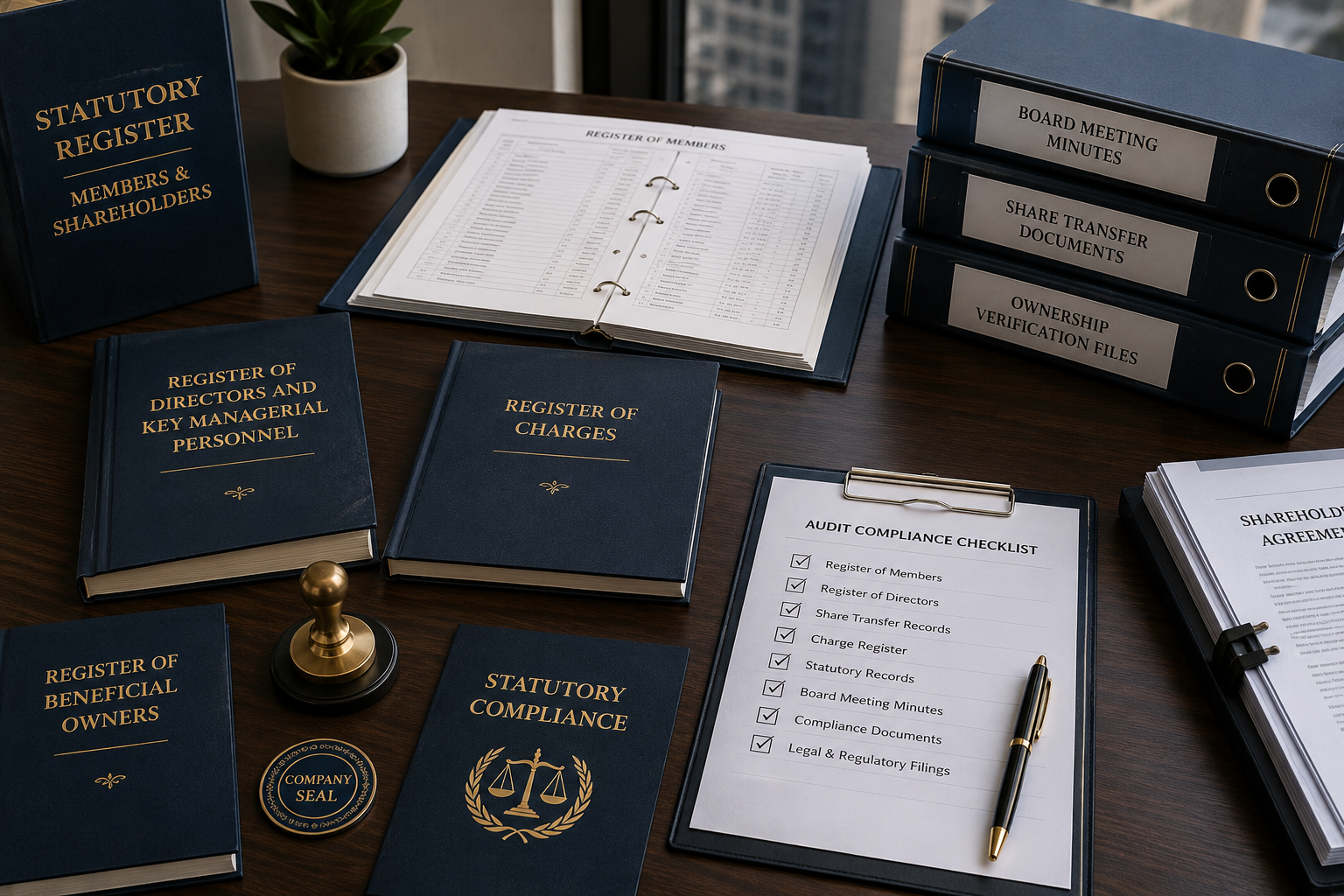
- Shareholdings of individuals and corporations
- Appointments of directors
- Beneficial shareholding structure
- Related party transactions
- Liability
- Loans
- Company’s resolutions and decisions
- Past shareholding transactions
In the event of any audit, inspection, due diligence or in case of any litigation, these records prove useful as the primary documents of verification.
Even if a company makes its MGT-7, DIR-12 or CHG filings in order, the statutory records might lack information which will cause compliance problems for the company.
It is important for investors and creditors that the company’s ownership and management history can be verified.
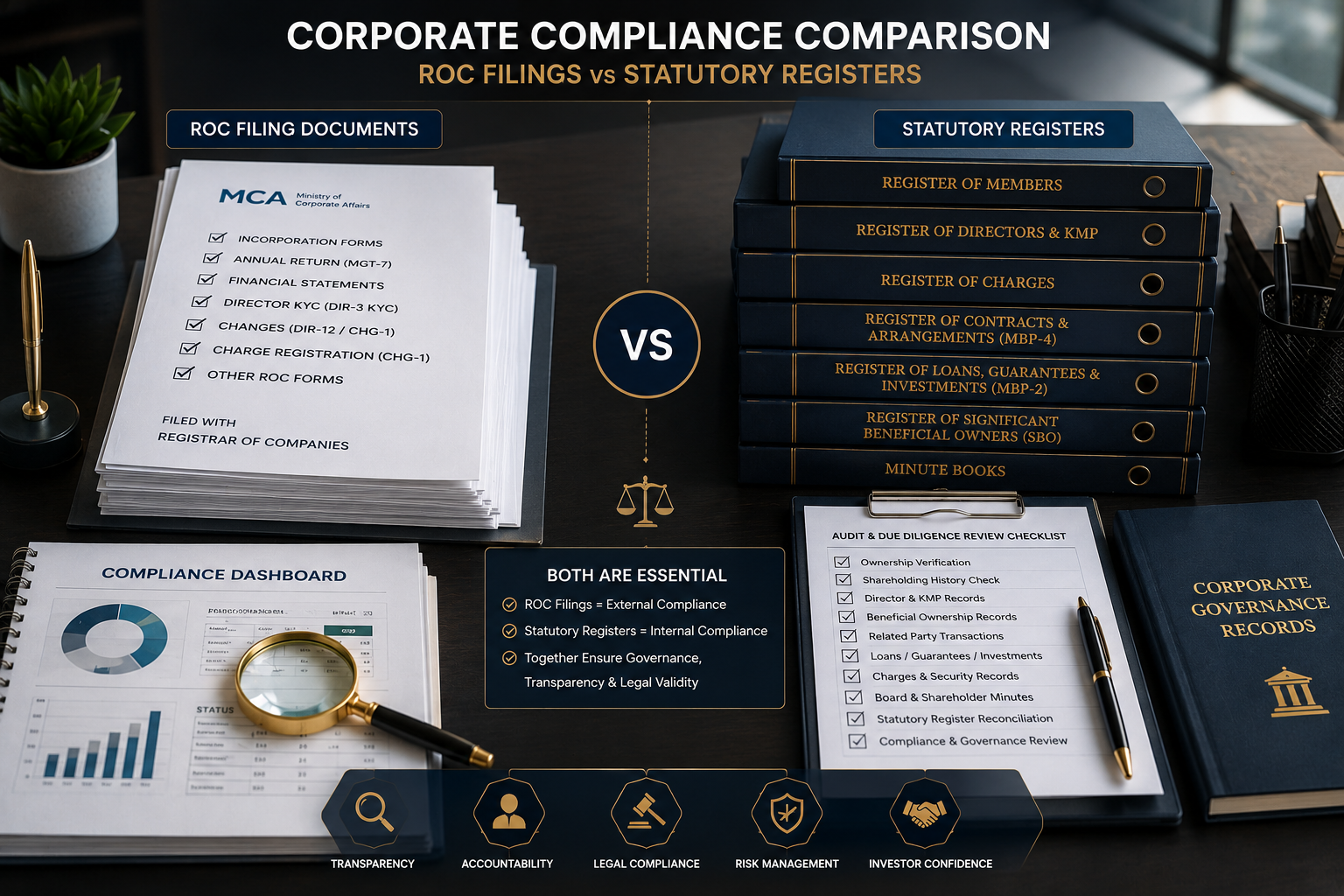
The Various Statutory Registers Maintained by Private Limited Companies
| Register | Purpose | Importance |
|---|---|---|
| Register of Members | Membership and holding of shares | Establishment of ownership |
| Register of Debenture Holders & Security Holders | Membership of debentures & securities issued by the company | Evidence to investors & lenders |
| Register of Directors and KMP | Membership of Directors & Key Managerial Personnel | Evidence of management |
| Register of Director’s Shareholding | Membership of securities held by Directors | For governance & disclosure |
| Register of Charges | Secured borrowings and other charges on properties | Vital for lenders and due diligence |
| Register of Contracts and Arrangements (MBP-4) | Related party transactions & Interested Directors transactions | Conformity with governance requirements |
| Register of Loans, Guarantees, Securities & Investments (MBP-2) | Evidence of transactions made under Section 186 | Useful for Group companies |
| Register of Significant Beneficial Owner (BEN-3) | Details of significant beneficial owners | For identification of ownership |
| Beneficial Interest Registers | For Section 89 Declarations | For establishing beneficial ownerships |
| Minutes Books | Evidence of decisions of the board of directors & general meetings | Legal requirement for decision-making |
Though all the statutory registers are important, some of them tend to be ignored more often than not.
The Register of Members: The Most Important But Most Overlooked Document
Of all the statutory documents needed for compliance with private limited companies, the Register of Members is definitely the most important.
The Register of Members is the definitive proof of ownership of the company.
In case a company goes through:
- Share allocation
- Share transfer
- Exiting by founders
- Investment by outside parties
- Transmissions of share interests
- Restructuring of shareholdings
it has to be updated immediately.
If companies use cap tables stored in Excel sheets and don’t update their statutory documents, this can cause problems.
When undertaking due diligence, investors usually check:
- ROCs submitted to the ROC
- Shares certificates issued
- Share subscriptions executed
- Register of Members
How Share Transfers, ESOP, and Funding Rounds Impact the Statutory Registers
It is generally believed that after the transaction is made, there is no further need to make any more compliance-related activities because of the transaction’s legal paperwork.
In actuality, the statutory register needs to be altered accordingly.
Share Transfers
Every time shares are transferred, a record of that event needs to be made for keeping the ownership record.
ESOP
A company making an ESOP scheme needs to take care of the employee ownership records too.
Funding Rounds
The angel investments, venture capitalists, and other investors’ money brings about considerable changes in shareholding.
Every round of funding needs to be followed by updating:
- The Register of Members
- The beneficial ownership records
- The director ownership records
- The corporate minutes
Statutory Register Issues Faced by Companies
| Issue | Outcome |
|---|---|
| Register not updated after incorporation | Obsolteness of ownership information |
| Failure to update share transfer | Disputes concerning ownership |
| Beneficial ownership register missing | Compliance issues during due diligence process |
| Change in directors not updated | Inconsistent information |
| Related party transactions register incomplete | Observations from audit/regulation bodies |
| Failure to keep Register of Charges | Ongoing borrowing process issues |
| Entries missing | Difficulties in proving corporate acts |
| Maintain minutes inadequately | Weak evidence of decision making |
| ESOP register missing | Disputes among employees |
| Dependence on ROC filings alone for compliance | Misstatements although successfully filed |
Most of the above-mentioned errors do not surface until some major business transaction happens.
Items Considered by Investors During Due Diligence
Investors seldom base their investigation on ROC filings alone.
Among other things, investors will consider:
Verification of Ownership
Investors need to have proof that the current shareholders hold the shares as documented in the company’s registers.
Ownership History
Review will be made concerning any change in ownership, allotment, transfer and founder’s exit.
Directorship
Governing practices can be evaluated through records of directors and the board.
Structure of Equity
Proper documentation of the entire capital structure is required.
Example: A Company That Has Made ROC Filings but Failed Diligence
A tech start-up about to enter Series A fundraising had:
- Made its annual ROC returns on time
- Filed their director appointment forms
- Conducted its share allotment filings
But when asked by investors to provide statutory registers, it was discovered that:
- Their Register of Members was incomplete
- History of past share transfer lacked record
- Director shareholding data was outdated
- Beneficial owner data lacked
The deal was stalled until the company reconstituted years’ worth of information.
While they were able to overcome their mistakes, it added cost to their fundraising efforts.
It is an example of how important statutory register compliance is, even with up-to-date ROCs.
How Can Professional Compliance Reviews Be Useful for Preventing Future Problems
It is common practice for firms to perform statutory record review processes prior to capital raises, audits, and large business dealings.
The following aspects are usually considered during these reviews:
- Ownership record checks
- Register verification
- Governance documentation
- Business compliance gaps
- Due diligence preparation
Professional agencies like JackRabbit Consultants can be helpful to corporations by performing compliance reviews, managing statutory registers, verifying ownership records, and preparing company law documentation.
Prior to Your Upcoming Audit, Fundraising Round, or ROC Inspection…
The importance of statutory registers required under the provisions of the Companies Act will mostly come into play only when your firm is undergoing an audit, raising funds, subject to an inspection by a lender, facing a shareholder dispute, or is otherwise involved in a compliance issue.
It should be emphasized that keeping up-to-date statutory registers in limited liability firms is not a mere formality; rather, it is a crucial part of due diligence preparedness and good business practice.
Businesses who have already made a habit of reviewing their statutory register compliance are usually well-prepared for any future auditing, fund-raising process, mergers or acquisitions, or any other similar corporate activity.
This is why many firms resort to conducting statutory register compliance reviews at least from time to time with the assistance of consultants like JackRabbit Consultants.