
In most cases, many of these private limited companies do not intentionally avoid being ROC compliant. They are simply unaware of the requirements of their business and the filing period.
These private companies often find themselves facing last-minute issues like penalty fees and, at worst, severe legal actions.
This is not merely an issue of lack of knowledge on the part of companies; it is a systemic issue.

What Does ROC Compliance Really Mean for Businesses?
In essence, ROC compliance does not simply mean having to file forms before the deadline expires at the end of each year.
It involves a consistent series of activities which include:
- Preparation of financial reports (audited financial statements)
- Annual return filing (details on company’s structure, shareholding and board of directors)
- Director identity disclosure (KYC)
- Event-driven filing of reports (changes in share capital, board of directors, company headquarters and more)
Most companies that default in filing reports regard ROC compliance as something that should only be done towards the end of the year.
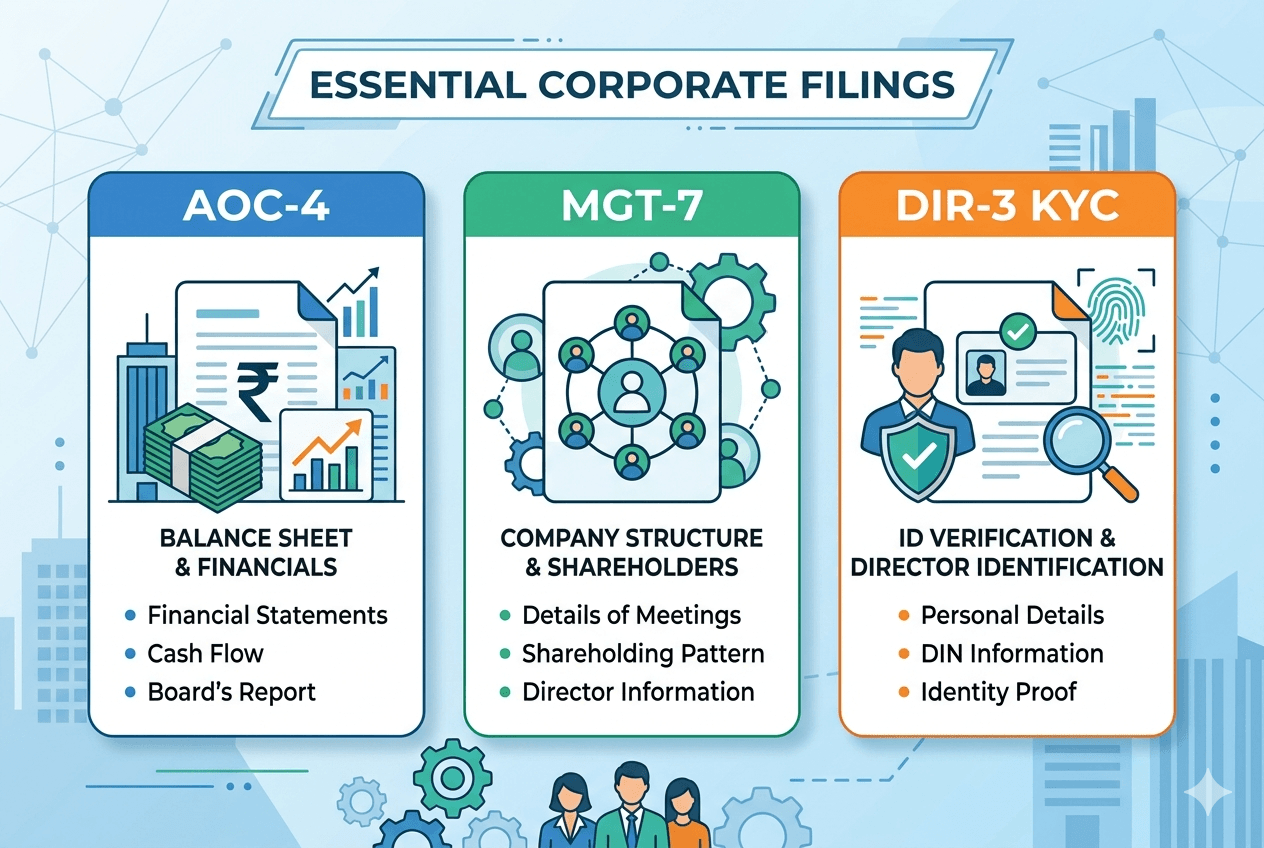
Required ROC Filing All Private Companies Must Take Care Of
Below are the important filings all businesses need to handle:
| Filing | Purpose | Applies To | Frequency |
|---|---|---|---|
| AOC-4 | Filing financial statements | All companies | Annual |
| MGT-7 / MGT-7A | Annual return (Company Data) | All companies | Annual |
| DIR-3 KYC | Director identity verification | All directors with DIN | Annual |
What These Filings Do
AOC-4 (Financial Statements)
- Filing made under Section 137
- Balance sheet, P&L, auditor report are included
- Indicates the financial state of the business
Why it Matters: Data used by banks, investors, and governing bodies; failure to comply raises flags.
MGT-7 / MGT-7A (Annual Return)
- Filing made under Section 92
- Lists shareholders, directors and shareholding pattern
Why it Matters: This is the officially recorded structure of your business.
DIR-3 KYC (Director compliance)
- Compulsory KYC for directors
- Makes sure that the DIN does not expire
Why it Matters: If this isn’t filed, your director’s DIN will expire, blocking other filings.
ROC Compliance Calendar for FY 2026
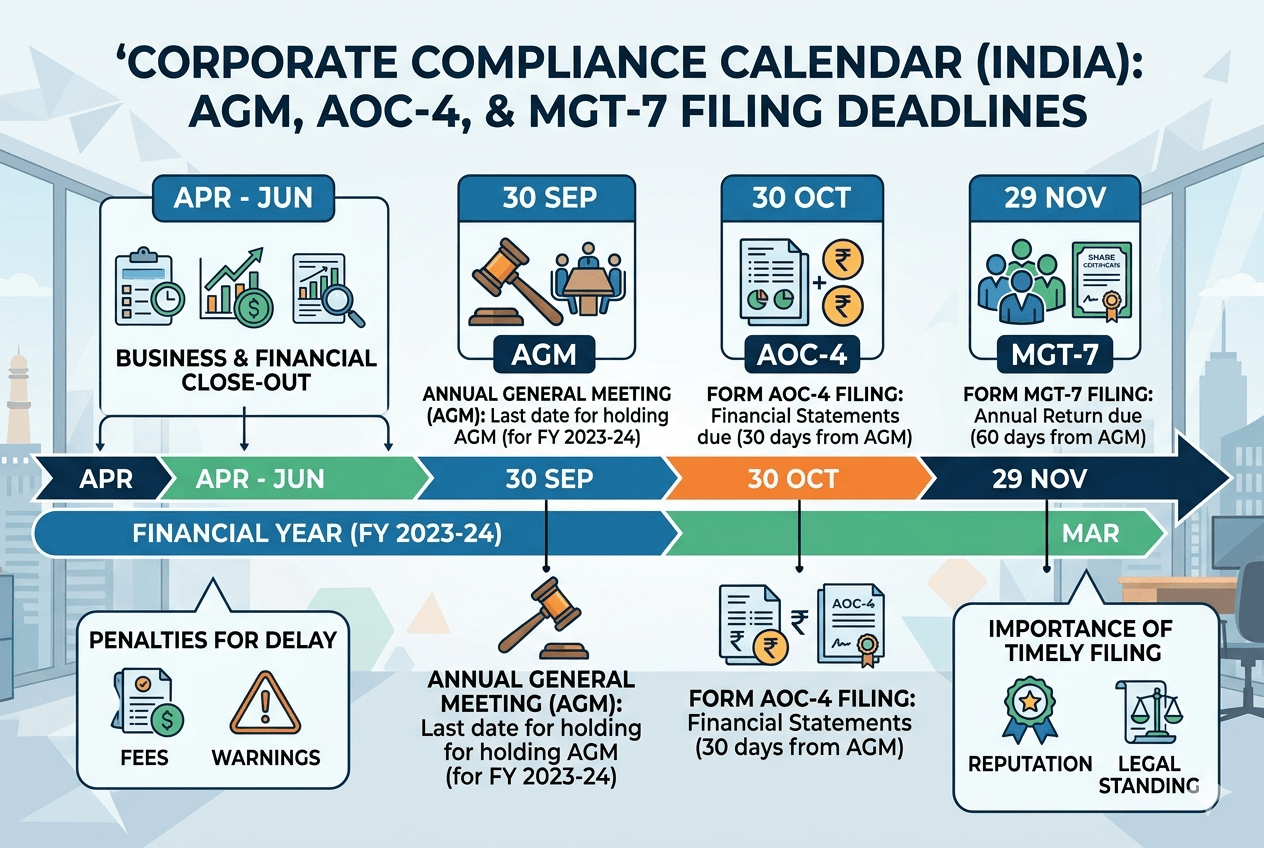
The ROC compliance schedule is where most businesses fail. Below is an operational calendar:
| Time | Compliance Activity |
|---|---|
| April 30, 2026 | MSME-1 (if required) |
| June 30, 2026 | DPT-3 filing |
| September 30, 2026 | AGM & DIR-3 KYC |
| 30 days after AGM | AOC-4 filing |
| 60 days after AGM | MGT-7 / MGT-7A filing |
Application of These Principles in Practice
- AGM should be completed by 30 September 2026 (Section 96)
- The AOC-4 filing deadline is revised to 30 October 2026
- The MGT-7 filing deadline is revised to 29 November 2026
These factors produce a very narrow timeframe for compliance after AGM, in which delays often start to happen.
2026 Update: CCFS-2026 (Important for Defaulting Companies)
The most significant 2026 update is the introduction of the Companies Compliance Facilitation Scheme (CCFS-2026):
- Term: 15 April 2026 to 15 July 2026
- Bonus: Pay just 10% of any late penalties incurred
- Objective: Eliminate backlogs of pending ROC filing
What It Means for You
Defaulting companies have the opportunity to:
- Restructure their compliance filings at lower cost
- Eliminate future compliance enforcement actions
- Establish clear compliance records ahead of greater scrutiny
What Will Happen When You Miss ROC Filing?
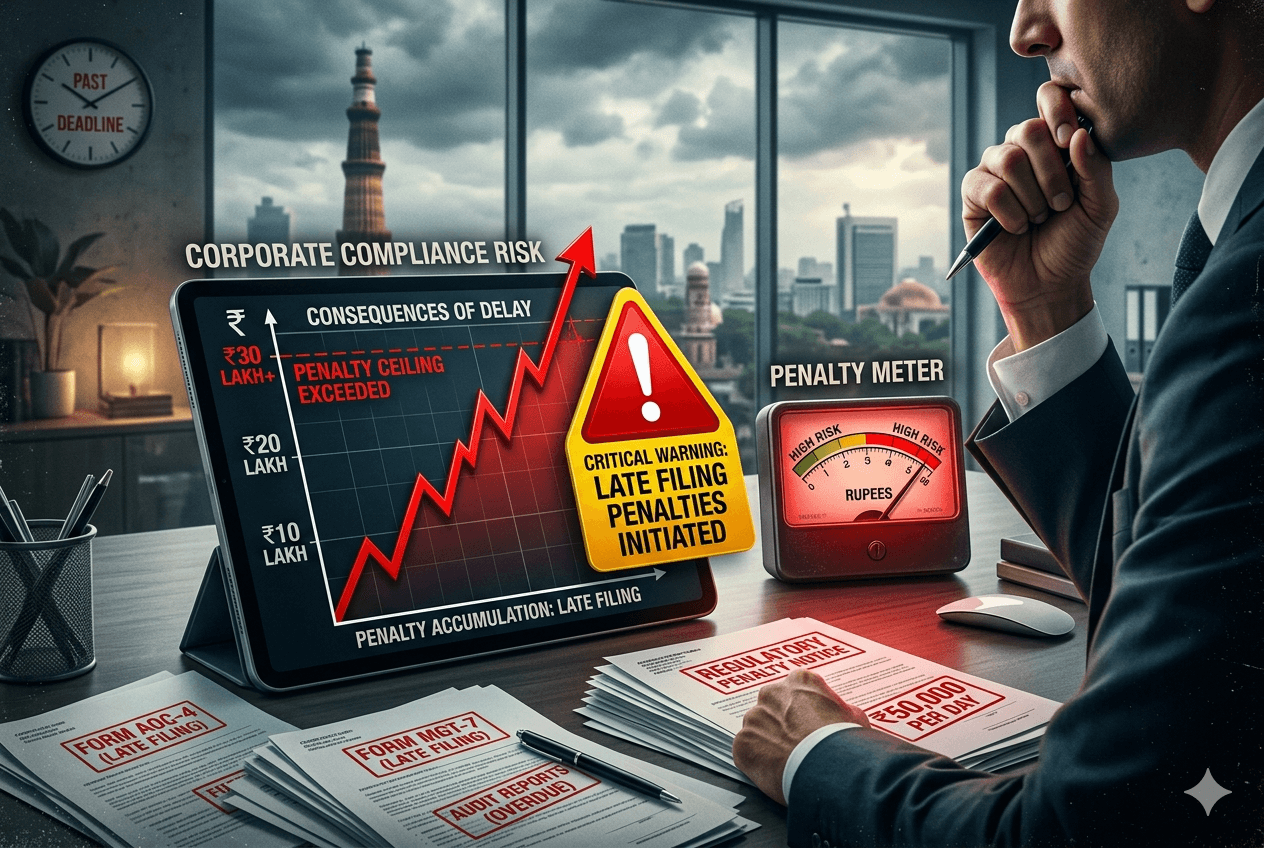
Here is where the reality of compliance comes into play.
A. Penalty
- ₹100 penalty per day of delay
- No upper limit in most scenarios
A delay of just six months can be financially painful.
B. Impact on Company Status
- Categorized as non-compliant
- Risk of strike-off by ROC
- Trouble in getting statutory approvals
C. Impact on Directors
- Danger of being disqualified under the Companies Act
- Risk of DIN inactivation due to DIR-3 KYC default
D. Impact on Business Operations
- Trouble in receiving loan approvals
- Investors tend to avoid non-compliant firms
- Issues in due diligence before funding or sale
Scenario Analysis: Missing the AOC-4 by 60 Days
For example:
- Deadline for filing: 30 October 2026
- Filed: 30 December 2026
- Days overdue: 60 days
Penalty Computation
- ₹100 × 60 days = ₹6,000 extra fee
In case of adjudication:
- Starting penalty: ₹10,000 + additional penalty per day
Consequences
- Financial penalty
- Affects compliance status
- Higher scrutiny in future filings
Reasons for Defaults by Companies
Even with such detailed guidelines, defaults are prevalent. This is because:
- Inadequate compliance management systems
- Oversight on accountants
- Unavailability of financials on time
- Internal coordination issues
- Ignoring timelines until deadlines are missed
Compliance breaches are seldom a function of complicated processes; they occur due to inadequate systems.
Some Other ROC Compliances
Annual compliances are not the only ones that need attention. Some others that companies need to focus on are:
| Event | Filing |
|---|---|
| Appointing/dismissal of directors | DIR-12 |
| Changing the registered office | INC-22 |
| Issue of shares | PAS-3 |
| Capital changes | SH-7 |
| Creation/alterations in charges | CHG-1 & CHG-4 |
| Resolution passed at board meetings | MGT-14 |
The compliances have very stringent timelines (usually within 15–30 days).
Proper Method for ROC Compliance Management
The following steps will minimize the risk of default almost entirely:
- Use a compliance calendar
- Know when the next AGM date is coming up
- Generate financial statements ahead of time
- Work ahead with your auditors
- Monitor the KYC status of directors
- Schedule forms filing immediately following the triggering event
Those companies which manage their compliance similarly to how they close books financially tend to perform much better.
In many instances, companies working with structured compliance experts such as JackRabbit Consultants implement systematized processes that align filings with the financial calendar.
In reality, most cases of ROC default are not due to complex processes but improper tracking and delayed decision-making.
Organizations that integrate compliance management into their regular workflow rarely face such issues.
Professional supervision in compliance ensures that deadlines are anticipated rather than reacted to.
ROC compliance is not only a statutory requirement but also a reflection of the internal processes and discipline within a company.