

The company invests abroad, assumes the bank or the adviser will handle everything, and then several months later finds out that no FEMA filing has been done. As a result, fines and audits follow.
This happens frequently and is how most FEMA compliance problems in India begin.
Why Does FEMA Compliance Fail in Real Business?
Because:
- There is no internal system of compliance
- The process depends too much on CA/Consultants without oversight
- Timelines are misunderstood (30 days vs. 60 days confusion)
- There is a belief that everything will be handled by the AD bank
- Lack of coordination between finance, legal, and accounts departments
Most businesses execute their transactions correctly but fail when it comes to reporting them.
FEMA Compliance Is About Regular Reporting, Not Transactional
A common assumption is:
“Funds received → Shares issued → Done.”
However, FEMA compliance actually consists of:
- Transaction-wise reports (FC-GPR, FC-TRS, ODI)
- Quarterly/annual reports (FLA Return, APR)
- Supporting documents (valuation reports, KYC, board resolutions, etc.)
Important Point: Most FEMA offenses occur after the transaction, not before or during it.
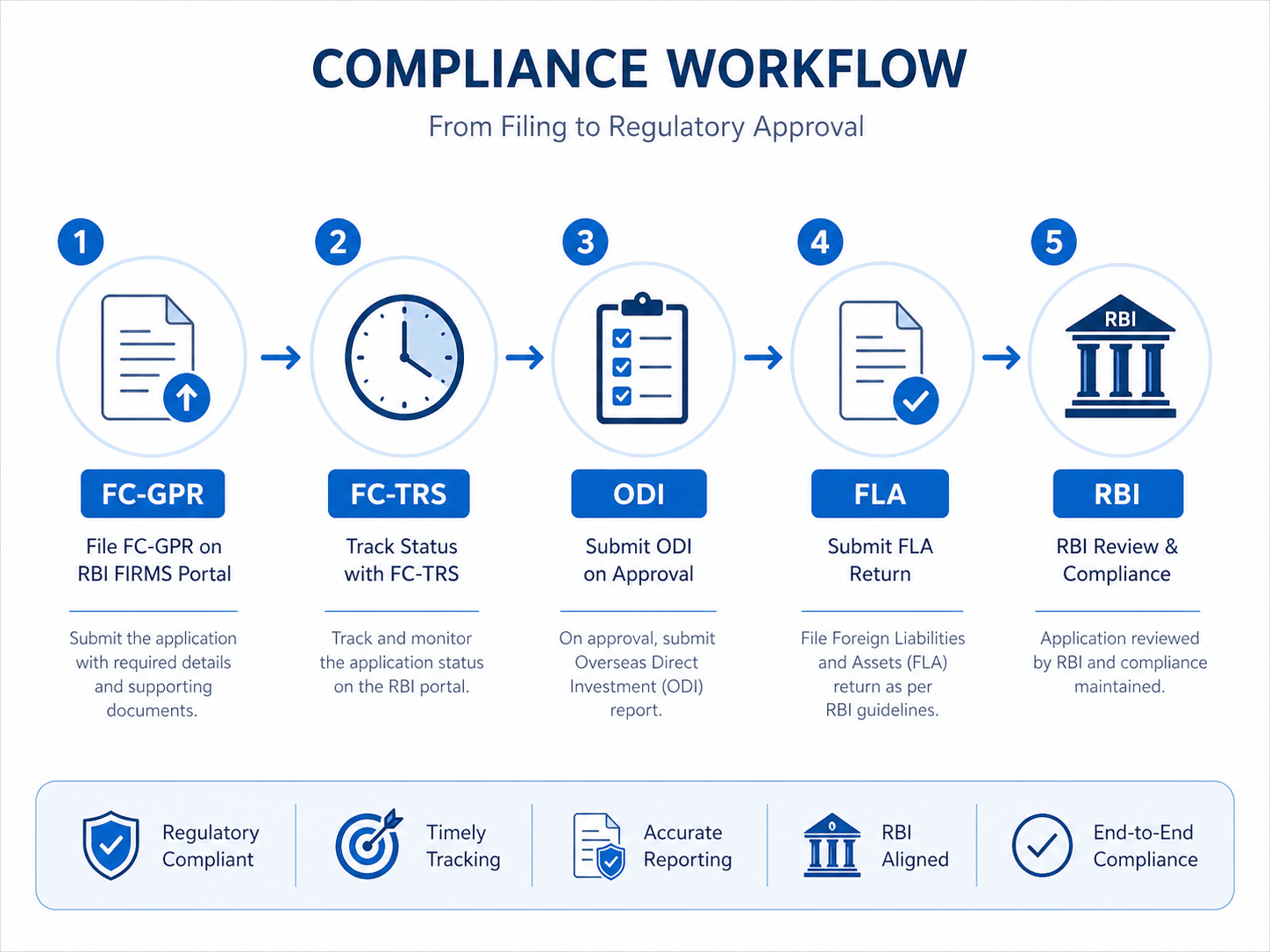
FEMA Compliance Checklist Completion
| Compliance Area | Form/Requirement | Timeline | Applies To |
|---|---|---|---|
| FDI – Share Issue | FC-GPR filing | Within 30 days | Indian Company accepting FDI |
| Share Transfer | FC-TRS filing | Within 60 days | Resident vs Non-resident transaction |
| ODI Investment | Form ODI | Within 30 days | Indian Entity investing abroad |
| Annual Reporting | FLA Return | By July 15 | All entities accepting FDI/ODI |
| ODI Annual | APR (Part III) | Yearly | Overseas subsidiaries/joint ventures |
| Borrowings | ECB Reporting | As per schedule | External Commercial Borrowings |
Practical Meaning
- FC-GPR → Report that the foreign fund has been invested as shares
- FC-TRS → Report change in shareholding between resident and non-resident
- ODI → Report overseas investment and obtain UIN
- FLA Return → Provide annual consolidated foreign assets and liabilities data
- APR → Report performance of overseas entity
FDI Reporting: The Practical Process
Steps involved in FDI reporting:
- Foreign investor remits the money
- Company receives funds through bank
- The company allots shares
The crucial part begins now:
FC-GPR filing must be completed within 30 days.
Important Points to Remember
- Valuation Certificate by CA/Merchant Banker
- Board Resolution
- KYC issued by remitting bank
- File online on RBI website through Authorized Dealer Bank
Typical Reasons for Failure
- Delays in valuation report
- Lack of documentation
- Misconception that “the bank will file it”
Transfer of Shares Between Residents and Non-Residents (FC-TRS)
Applicable in the following scenarios:
- A non-resident transfers shares to a resident
- OR a resident transfers shares to a non-resident
To Be Followed
- FC-TRS filing must be completed within 60 days after the transaction
Example
A founder of an Indian start-up sells shares to a foreign company → FC-TRS filing becomes mandatory.
Common Mistake
- Money is paid and shares are transferred
- Filing is often overlooked
This creates a mismatch between actual ownership and RBI records, leading to compliance issues.

Overseas Direct Investment (ODI) Compliance
When an Indian resident entity invests outside India, ODI compliance requirements apply.
Main Activities
- Net worth requirement check (up to 400%)
- Application for Unique Identification Number (UIN)
- Filing Form ODI within 30 days
Note
- Approval is not always required
- Reporting is always mandatory
Update 2026
- ODI filings are processed through the PRAVAAH portal
- Handled by RBI regional offices
Practical Error: Companies focus on investment execution but ignore mandatory filing requirements.
Yearly FEMA Compliance
Even if there are no new transactions, FLA Return filing is still required.
- Date of filing: July 15 each year
- Based on:
- Current FDI
- Current ODI
Fact
- Many firms overlook this requirement
- Predominantly startups after receiving funding
Outcome: Non-compliance can occur even when there are no new transactions.
Scenario
A startup receives ₹5 crore in foreign funding:
- Funding received in January
- Shares issued in February
- FC-GPR filing not completed
What Follows
- Non-compliance discovered during due diligence or audit
- Issues in RBI filings → compounding required
- Higher legal and financial costs
Implications
- Delay in next funding round
- Investor concerns
- Negative compliance track record
Regulatory Sanctions for Violations
FEMA violations are typically handled through:
- Compounding procedures
- Monetary penalties
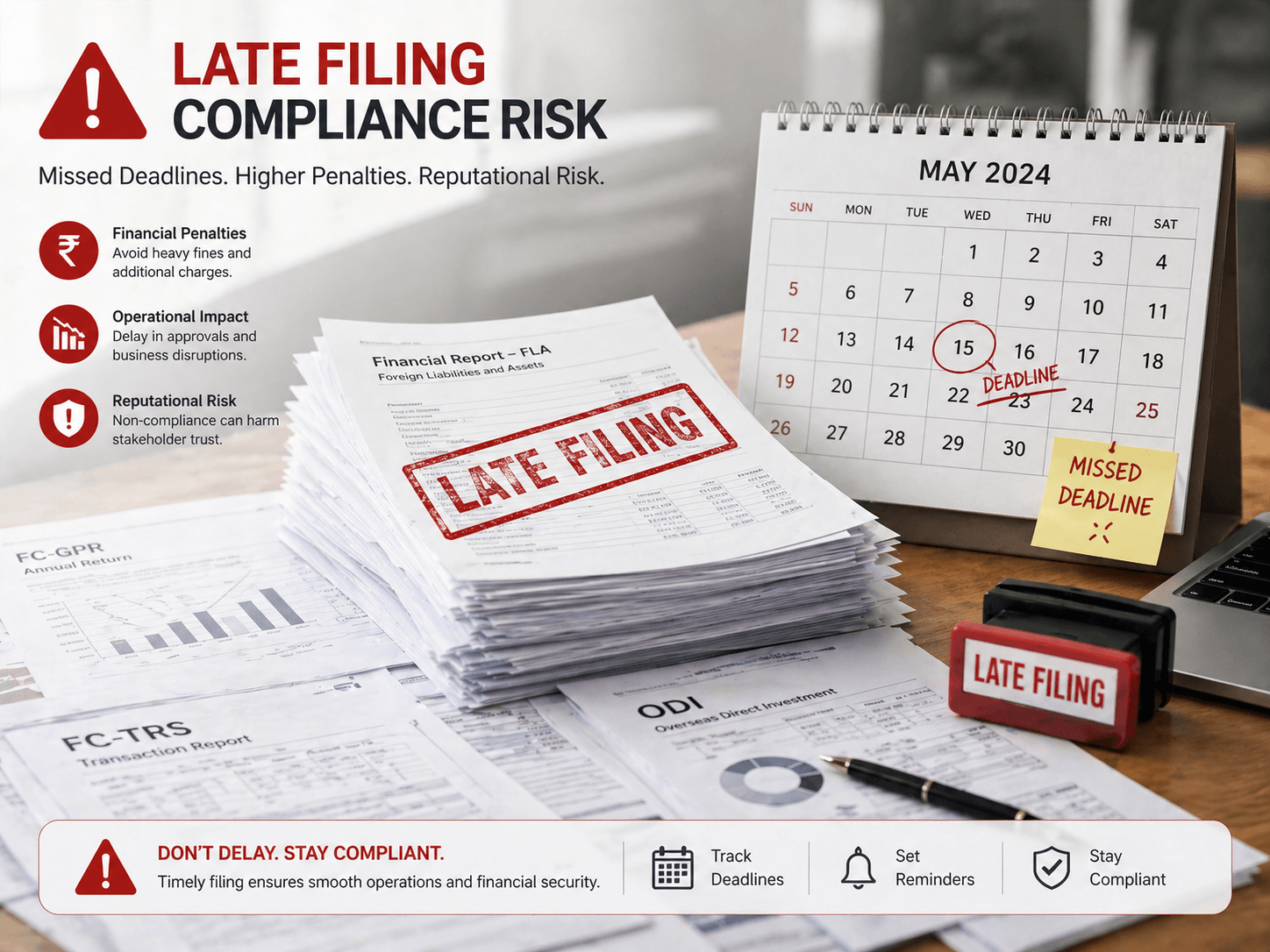
Common Violations
- Delay or failure in FC-GPR filing
- Missed ODI filings
- FLA return not submitted
Outcomes
- Monetary penalties imposed
- Increased documentation scrutiny
- Delays in approvals and processing
These consequences are not severe—but they are entirely preventable with proper compliance tracking.
Typical Errors Made by Companies
- Neglecting reporting deadlines
- Valuation errors
- Lack of document centralization
- Believing compliance can be discretionary
- Failing to file annually (FLA/APR)
- Ineffective collaboration with advisors
Approach to FEMA Compliance for Businesses
To prevent these issues, businesses should adopt a structured approach:
-
Keep a Schedule for Compliance Activities
- Plan all FEMA-related activities in advance
- Set reminders (30 days / 60 days / annual deadlines)
-
Document All Foreign Transactions
- Track funding, transfers, and foreign investments
- Record dates and corresponding compliance obligations
-
Work in Sync with CA and CS
- Do not rely entirely on delegated work
- Verify filings independently
-
Maintain Proper Documentation
- FIRC
- Valuation reports
- Board resolutions
- Filing acknowledgements
-
Utilize RBI Portals Effectively
- FLAIR
- ODI portal
- PRAVAAH
Companies that work with structured advisors such as JackRabbit Consultants typically avoid these mistakes because their compliance processes are systematic rather than reactive.
Expert Tips
FEMA non-compliance is rarely due to lack of knowledge. It usually occurs due to delayed execution and absence of a structured compliance system.
Even financially strong companies face compliance issues when deadlines are not actively monitored.
Professional compliance support ensures that regulatory requirements are integrated into regular business processes rather than handled reactively.
FAQs (Frequently Asked Questions)
The compliance process under FEMA is continuous and not just for once in order to ensure regulatory status and reputation. Organizations that monitor and follow up on their compliance requirements avoid fines, delays, and legal issues.