
Unexpected income tax compliance e-mails lead to immediate confusion in most instances.
An income tax compliance email in 2026 is usually generated when the Income Tax Department detects mismatches between AIS/TIS records, TDS details, financial transactions, and the taxpayer’s ITR. Common triggers include interest income differences, stock transactions, high-value deposits, and incorrect AIS reporting.
A number of people in 2026 have been receiving e-mails relating to:
- compliance checks
- AIS mismatch
- high value transactions
- information mismatch
- defective return letters
- mismatched income alerts
These e-mails may not be penalty notices in all cases; rather, they arise due to a detection of information mismatch between the following data:
- ITR file by taxpayers
- AIS/TIS information
- TDS information
- financial transactions reported by banks
- investment information
- high value financial activities
The receipt of such an income tax compliance mail, if totally ignored, will certainly bring trouble after some time.
Knowing the reason behind its generation, what needs to be checked and under what circumstances expert advice will become necessary has now become essential.

Why Taxpayers Receive More Compliance Emails in 2026
The compliance monitoring done by the Income Tax Department has evolved considerably technologically over time.
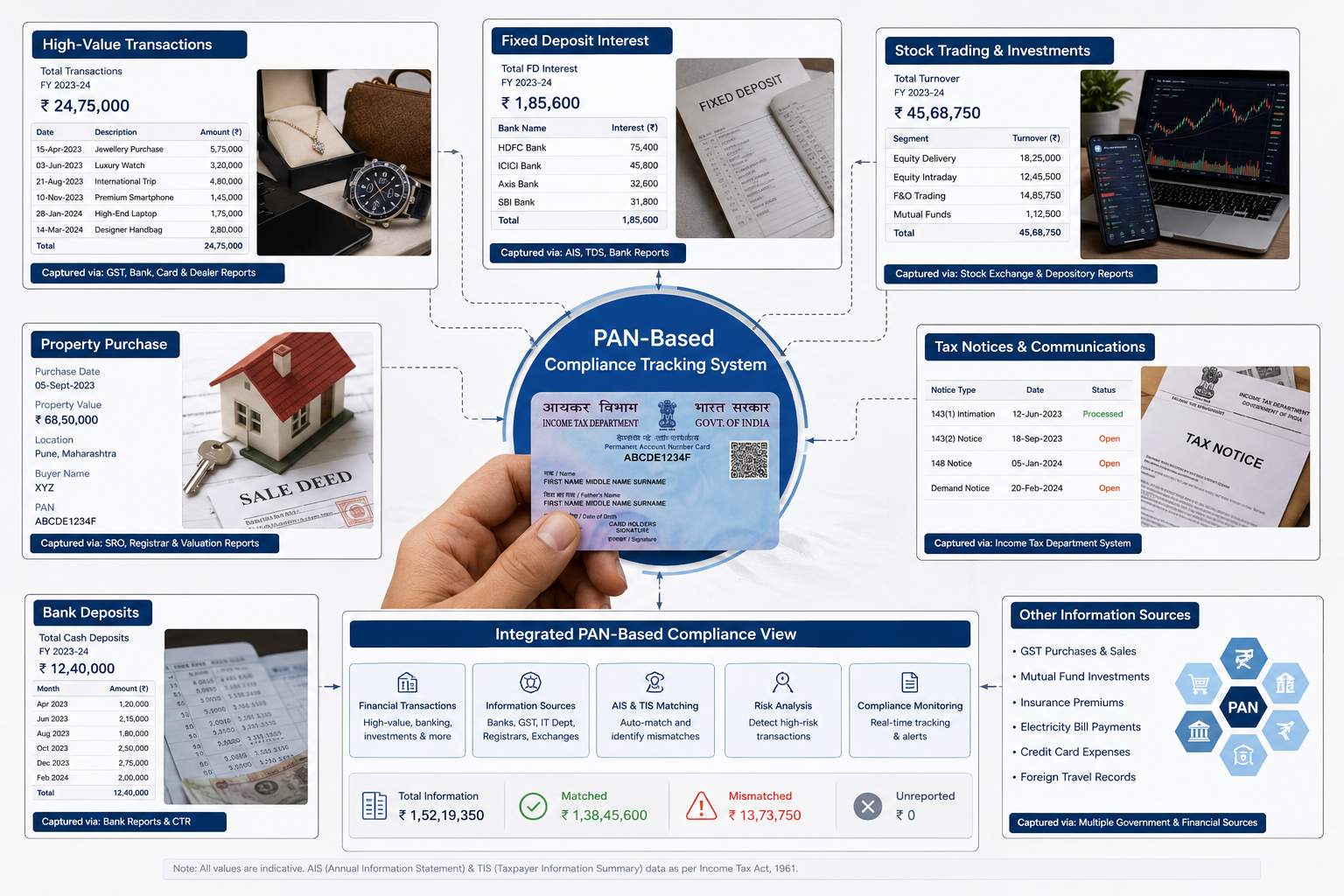
Currently, various financial systems are connected via PAN reporting and include:
- banks
- stock brokers
- mutual funds
- property registrars
- employers
- payment gateways
- GST systems
The AIS/TIS structure adopted by the income tax department has been capturing much more financial information than that in the conventional Form 26AS.
Therefore, in some cases, taxpayers will receive an email from the income tax department for minor discrepancies such as:
- mismatch in FD interest
- dividend income mismatch
- inconsistency in stocks transactions
- TDS discrepancies
- modified employer reports
- major cash deposits
Compliance monitoring in 2026 has evolved from manual to automated.
Difference between Income Tax Compliance Mail and Income Tax Notice
| Compliance Mail | Tax Notice |
|---|---|
| Generally for information purposes or verification | Final legal process |
| Automatically issued | Legally issued under specific sections |
| Could be a request for clarification/verification | Necessitates legal compliance |
| Could pertain to AIS-TIS discrepancies | Could pertain to scrutiny/reassessment |
| Could be preventive measure | Possibly serious based on section used |
| An initial level communication | Is an escalated tax process |
The recipient of an income tax compliance email should first determine whether the mail being sent by the taxpayer is:
- a compliance mail,
- a portal discrepancy mail,
- or a statutory notice under:
- Section 139(9)
- Section 142(1)
- Section 143(1)
- Section 143(2)
- Section 148A
- Section 148
It is vital to know that distinction.
What is AIS and TIS Mismatch?
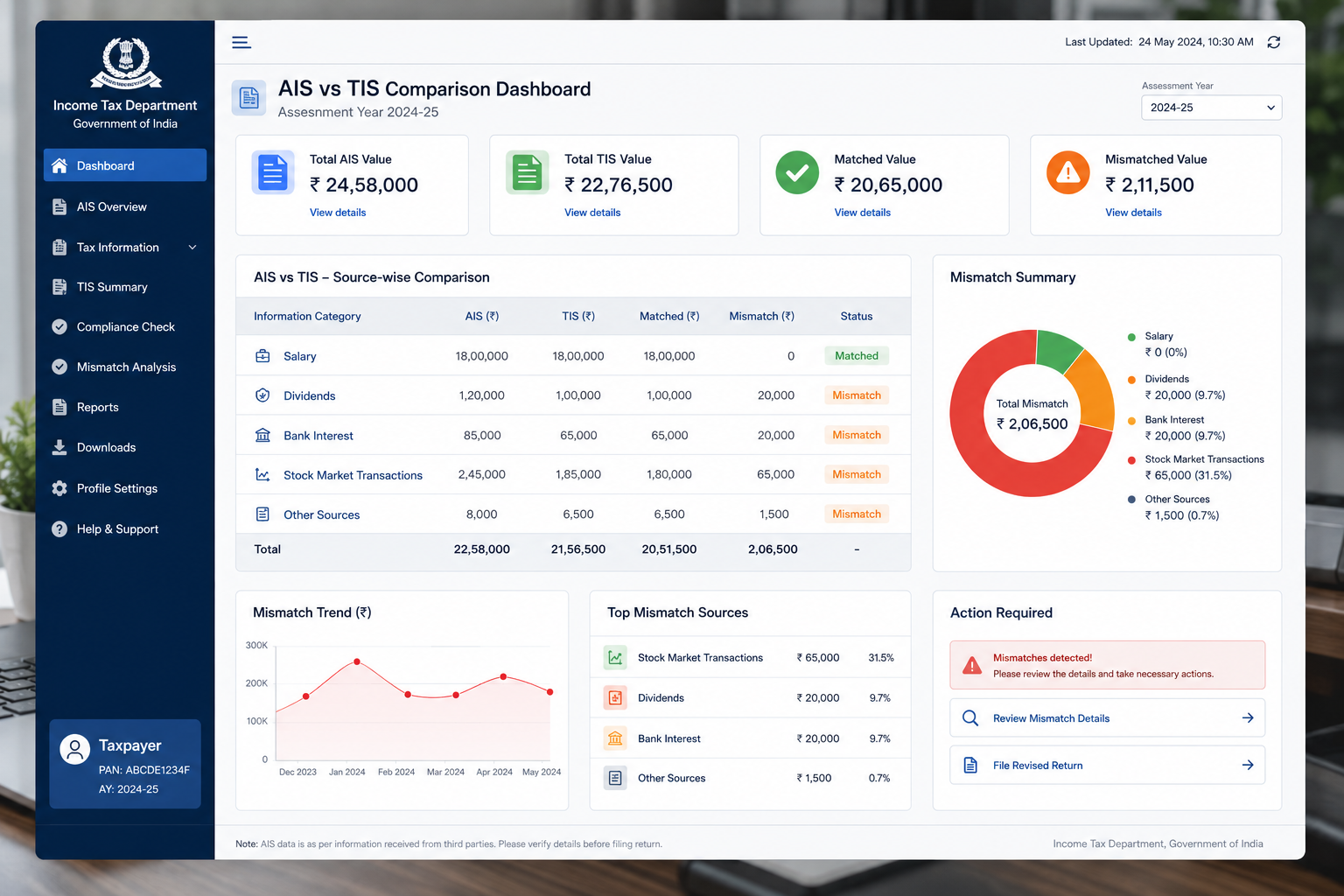
AIS = Annual Information Statement.
TIS = Taxpayer Information Summary.
The AIS consists of transactional details recorded on the basis of the taxpayer’s PAN, including
- salary
- interest
- dividend
- mutual fund investments
- transactions involving securities
- property transactions
- tax deductions
- high-value transactions
The TIS is basically the summary of the above details.
Reasons Behind the Occurrence of AIS and TIS Mismatches
Some common reasons include:
- Incorrect report from banks and other institutions
- Duplicates
- TDS revisions
- Misconceptions regarding gross and net income
- Late reporting
- Invalid PAN tagging
- Joint account reporting issues
- Non-reporting of the transactions
Example
A taxpayer earns a dividend of ₹90,000 after the TDS deduction.
AIS could be showing
- Gross amount as ₹1,00,000.
But the taxpayer may be reporting
- ₹90,000 only.
In such a case, there will be an AIS mismatch notice generated.
What Taxpayers Should Verify After Receipt of Compliance Mailer
| Verification | Reason |
|---|---|
| AIS review | Determine source of discrepancy |
| TIS verification | Double check summarization |
| Form 26AS | Verify TDS/TCS credit |
| Filed ITR | Verify actual details |
| Bank statements | Verify bank transactions |
| Capital gains forms | Verify stocks/mutual funds |
| Form 16/Form 16A | Verify salary and TDS |
| Property transactions | Verify reporting consistency |
It is always recommended that taxpayers do not act in a haphazard manner when responding to compliance notices.
One should first reconcile the discrepancies.
A lot of taxpayers are today consulting professionals at organizations such as JackRabbit Consultants for their responses to compliance email regarding AIS discrepancy.
When an Income Tax Compliance Email Turns Serious
Not all compliance emails signify high risk of tax issues.
However, it becomes a serious issue when:
- There are multiple notices
- The taxpayer does not respond
- Scrutiny starts
- The taxpayer receives reassessment notices
- The defective return notice is not sorted
- Unexplained large transactions occur
High-risk notices that are worth paying attention to include:
| Notice Type | Hazard Level |
|---|---|
| 139(9) Defective Return | Moderate |
| 142(1) Inquiry Notice | High |
| 143(2) Scrutiny | High |
| 148A Reassessment | Very High |
| 148 Reopening Notice | Very High |
The following are types of emails that the taxpayer should take into account carefully:
- high value transaction
- foreign income
- capital gains
- business turnover
- cash deposits
Common Mistakes Made by the Taxpayers After Compliance Email
Ignoring the Notice
It appears to the taxpayers as a scam or insignificant issue.
Ignoring compliance correspondence may lead to escalation in the future.
Filing Revised Return Before Analysis
There are taxpayers who tend to file revised returns without realizing:
- the cause for the mismatch
- the accuracy of the AIS system
- the effect on taxes
This results in further inconsistencies.
Thinking the AIS Is Infallible
AIS information is prone to:
- repetitive reporting
- time issues
- reporting mistakes
- wrong category
The taxpayer needs to ensure AIS information.
Reply Without Necessary Information
Submitting reply without:
- reconciliation
- statement of bank balances
- tax calculation
- records
Are Compliance Emails Wrong?
They can be.
There may be reasons for triggering such an email as follows:
- Delayed reporting
- Duplicate reporting by institutions
- Incorrect PAN linkage
- Revision of financial details
- Tech-based reporting mistakes
Nevertheless, it would be unwise of taxpayers to dismiss such messages entirely based on the likelihood of mistakes.
Instead, it is wiser to:
- Check
- Balance
- Document
- Respond as required
Effects of Ignoring Income Tax Compliance Emails
By ignoring income tax compliance emails, taxpayers may end up facing:
- Requests for further checks
- Selction for scrutiny
- Delayed refunds
- Reassessment actions
- The creation of demand outstanding
- Increased compliance checks
In most cases, receiving the initial email isn’t a problem.
It is only when follow-up messages go unacknowledged that issues arise.
When Is Professional Tax Review Needed?
When there are multiple sources of income, business income, freelancing income, stock market dealings, crypto activities, foreign income, high-value transactions, property dealings, or complicated AIS mismatches.
Most individuals have trouble with the fact that AIS entries do not necessarily reveal:
- the taxable income amount,
- actual gains,
- legality of dealings and
- duplicate income entries.
That’s when proper reconciliation becomes necessary.
JackRabbit Consultants also helps salaried professionals, freelancers, and businesses to review the following problems associated with tax:
- AIS Mismatches,
- Tax Notices,
- Defective Return Notices and Resolutions,
- Reassessment Responses, and
- tax reconciliations.
Why The Importance Of AIS, TIS, And Compliance Monitoring Are Expected To Increase In Future
The tax-compliance mechanisms in India are getting more data-driven.
In future, the Income Tax Department is expected to be increasingly dependent on:
- PAN-based Reporting
- Automated Transaction Monitoring,
- AI-based Risk Assessment, etc.
This implies that you must be extra careful about the accuracy and completeness of your:
- Reporting,
- Transaction Reconciliation,
- and documentation.
The importance of AIS and TIS is increasing as central components of return verification processes.

Prior to Responding to an Income Tax Compliance Communication…
Taxpayers should not engage in panic-induced reactions.
Prior to taking any form of action:
- check for legitimacy
- examine the AIS and TIS documents
- check against the actual numbers
- identify whether there really is a mismatch
- document all evidence
In most instances, the matter can be sorted out by reconciling the accounts correctly without litigation.
But when the problem involves reassessment notices, financial differences, capital gains, or multi-source incomes, it is advisable to seek professional help.
As compliance systems are now growing evermore automated in 2026, accurate record keeping and proper reconciliation will be increasingly essential rather than quick tax filings.
Taxpayer compliance is now increasingly being facilitated by professional advisory firms such as JackRabbit Consultants in dealing with:
- mismatched AIS and TIS
- cases involving income tax compliance notices
- defective return notices
- tax reconciliations
- scrutiny preparation
- reassessments