

Startup India Seed Fund Scheme 2026
It is getting the first-round of startup funding where most entrepreneurs struggle the most.
The banks will ask you to provide collateral.
The investors are interested in traction before funding startups.
The angel networks want proof of the scalability of the concept.
However, an early-stage startup is likely to be building a prototype, testing the market, or proving the product-market fit.
The solution lies precisely here in the Startup India Seed Fund Scheme 2026.
As per startup india seed fund scheme rules, qualified startups from DPIIT are entitled to get:
- grant funding up to ₹20 lakh for prototype creation and validation
- debt/convertible funding up to ₹50 lakh for commercialization and scalability
While other startup funding India schemes target later stages, SISFS focuses on the earliest startups who need funding for the proof of concept.
This guide will explain:
- startup india seed fund scheme eligibility criteria
- process of applying for startup india seed fund scheme
- startup funding requirements by DPIIT
- incubators’ review of SISFS applications
- reasons startups get rejected at SISFS
- strategies to maximize your chances
Startups That Get Funding Under SISFS 2026
Under the Startup India Seed Fund Scheme, startups that cannot yet attract venture capital but require funds to create, develop, and test their solution will benefit from the scheme.
This funding scheme helps in:
- Proof of concept
- Prototype development
- Product trials
- Milestone achievement
- Commercialization
- Scaling up
Structure of SISFS 2026 Funding
| Type of Support | Amount | Covered Activities |
|---|---|---|
| Grant Funding | ₹20 lakh | Prototyping, trials, and proof of concept |
| Debt / Convertible Funding | ₹50 lakh | Market entry, commercialization, and scale-up |
The ₹20 lakh funding is generally milestone funding where startups get paid in milestones after showing progress.
The ₹50 lakh funding is generally a convertibility or debt-related funding provided by an approved incubator.
Most startups wrongly presume that they get lump-sum startup grants under this funding scheme.
The incubator constantly monitors the performance and activities of the funded startups.
Who is Eligible for the SISFS in 2026?
The first myth about the SISFS is that all registered startups are eligible.
This is not true.
The SISFS criteria are far stricter than just being a registered business.
SISFS Eligibility Criteria 2026
| Requirement | Eligibility Criterion |
|---|---|
| DPIIT Recognition | Must have obtained the same |
| Startup Age | Should be less than two years old |
| Business Type | The startup must be an innovation startup |
| Ownership | The startup must have a minimum of 51 percent shareholding by Indian promoters |
| Government Funding Constraint | The startup must not have been provided more than ₹10 lakh through other government schemes |
| Company Form | The applicant should be a Private Limited Company, LLP, or partnership firm |
Since the scheme focuses on technological innovations, startups in SaaS, AI, fintech, healthtech, climate tech, agritech, deep-tech, industrial innovation, etc., get better ratings than general businesses.
Incubator Committee considers the scalability of the startup in future markets.
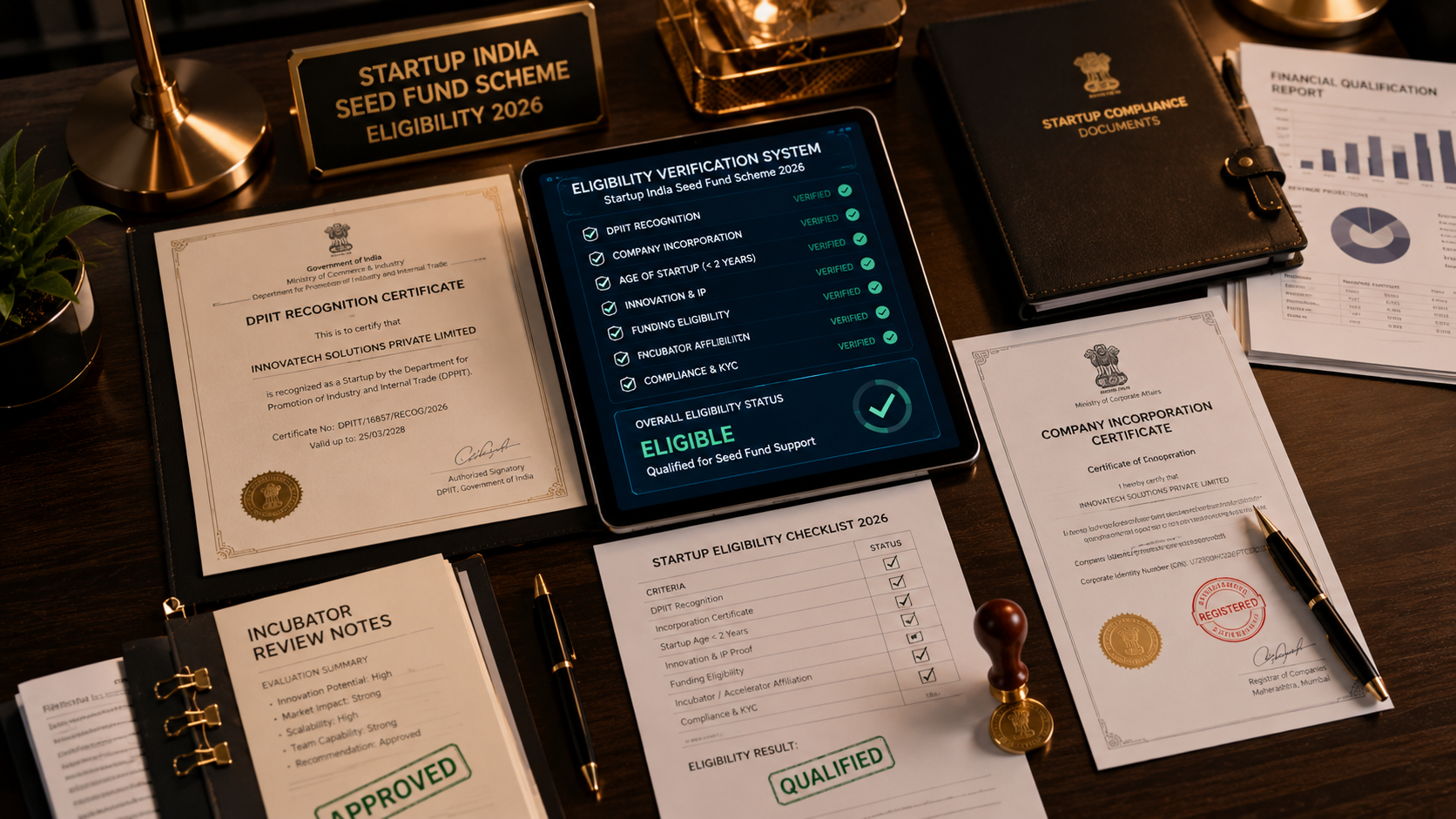
Importance of Startup Recognition by DPIIT Before SISFS Application
The reason why most startups do not succeed during the process of application for the startup India seed fund scheme is due to confusion between:
- startup company incorporation
and
- DPIIT startup recognition
They are two entirely different aspects.
This means that even when the founder has:
- GST
- MCA registration
- CIN
- Bank account
the startup may still be ineligible to participate in SISFS program since DPIIT recognition has not been made.
Why DPIIT Recognition is Necessary for Startups
Without DPIIT recognition,
- The application process through SISFS will not go through successfully
- The incubator rejects most startup applications during the screening process
- Benefits related to startup funding in India will not be available to the startup firm.
Recognition by DPIIT also implies that the startup has officially met the eligibility criteria for the startup India scheme.
How the Startup India Seed Fund Scheme Application Process Works
The startup India seed fund scheme application process is far more rigorous than what many entrepreneurs expect.
The process involves much more than submitting an application and getting funds.
Evaluation of incubators plays a significant role.
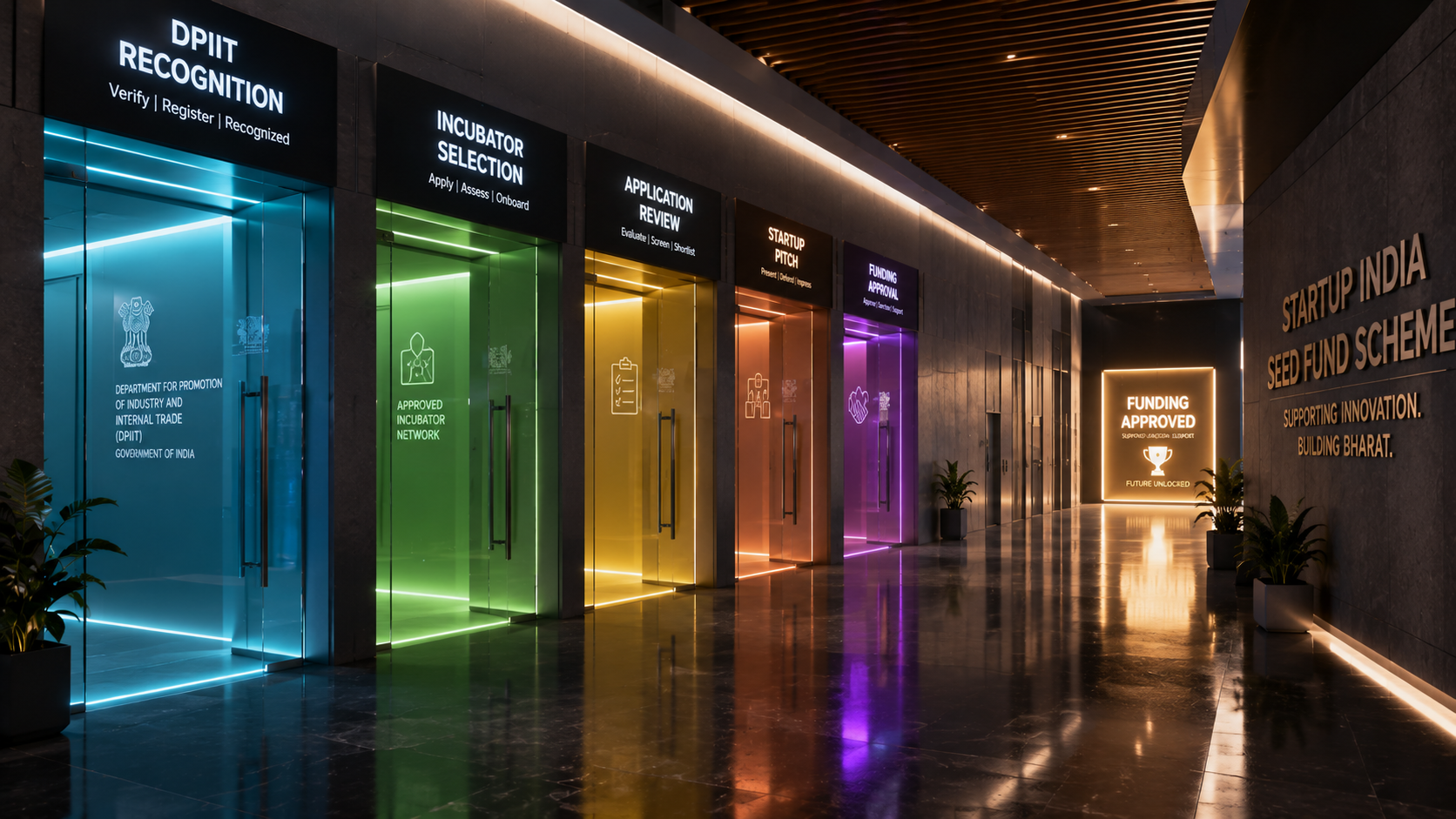
Stage 1: Get DPIIT Accreditation
First things first:
- ensure Startup India accreditation
- get the DPIIT startup certificate
- check eligibility for startup certification
Otherwise, SISFS application will fail.
Stage 2: Register on the Startup India Portal
The entrepreneur needs to register on the official SISFS portal using his/her Startup India login credentials.
The system integrates:
- DPIIT certification
- details about the startup
- company incorporation data
into the application dashboard.
Stage 3: Select Incubators Wisely
This is one of the most crucial steps.
An entrepreneur can submit applications to:
- up to 3 incubators at a time
However, selecting incubators at random is one of the major reasons for rejection.
For example:
| Startup | Correct Incubator |
|---|---|
| Agri Startup | Agribusiness incubator |
| AI SaaS Startup | Deep tech / SaaS incubator |
| Health Startup | Healthcare innovation incubator |
Step 4: Upload Necessary Documents
Necessary documents include:
- pitch deck
- Founder’s information
- DPIIT certificate
- Business Model
- Projection
- Incorporation Certificate
- Market validation
Lack of necessary documents often leads to rejection of the proposal.
Step 5: Apply
After the submission:
- Application is evaluated internally by the incubators.
- The process of eligibility screening commences.
- Any missing information could be asked for.
Step 6: Present to the Evaluation Committee
Most shortlisted startups have to make presentations in front of the evaluation committee of the incubator.
In this step,
- Foundation Clarity
- Scale-up potential
- Market Understanding
- Innovation Level
- Effective Utilization of funds are evaluated.
A lot of technically brilliant startups are rejected due to the inability of founders to justify their business models effectively during presentation.
Step 7: Fund Selection
Selection leads to
- Signing of agreement
- Disbursal based on milestones
As per the guidelines, the evaluation process is expected to be completed within 45 days.
Documentation Required by Startups Before Applying
Many SISFS applications get rejected due to the founders delaying preparation of documents.
List of SISFS Documentation Requirements
| Document | Purpose |
|---|---|
| DPIIT Certificate | Required startup recognition |
| Certificate of Incorporation | Proof of legal entity |
| Founder PAN and Aadhaar | KYC verification |
| Pitch Deck | Evaluating the business |
| Financial Projections | Determining scalability |
| Revenue Model | Viability analysis |
| Business Plan | Strategic planning |
| Cap Table | Verification of shareholding |
| Bank Account Info | Fund transfer |
| Demo/Product MVP | Validation support |
Good documentation will increase your chances with the incubator immensely.
Founders tend to increase the quality of their application through detailed startup documentation assessment by JackRabbit Consultants prior to submission.
Reasons for Startup Application Rejection under SISFS
That’s where most of them make the mistake.
There are many startups that apply for DPIIT funding which get rejected simply because the program has an extremely evaluation-intensive approach.
Common Reasons For SISFS Rejections
| Reason for Rejection | Problem |
|---|---|
| Poor Business Model | No monetization plan |
| Innovation Missing | Starts looking like a regular service firm |
| Low Scalability | No future potential |
| Bad Pitch | Presentation of execution |
| Insufficient Documentation | Missing uploads |
| Wrong Choice of Incubator | Startup-incubator misfit |
| Market Validation Missing | No MVP/pilot/users/test |
| Unrealistic Financials | High expectations with no logical basis |
| Weak Founder Capabilities | Can’t execute |
And the reality most founders overlook:
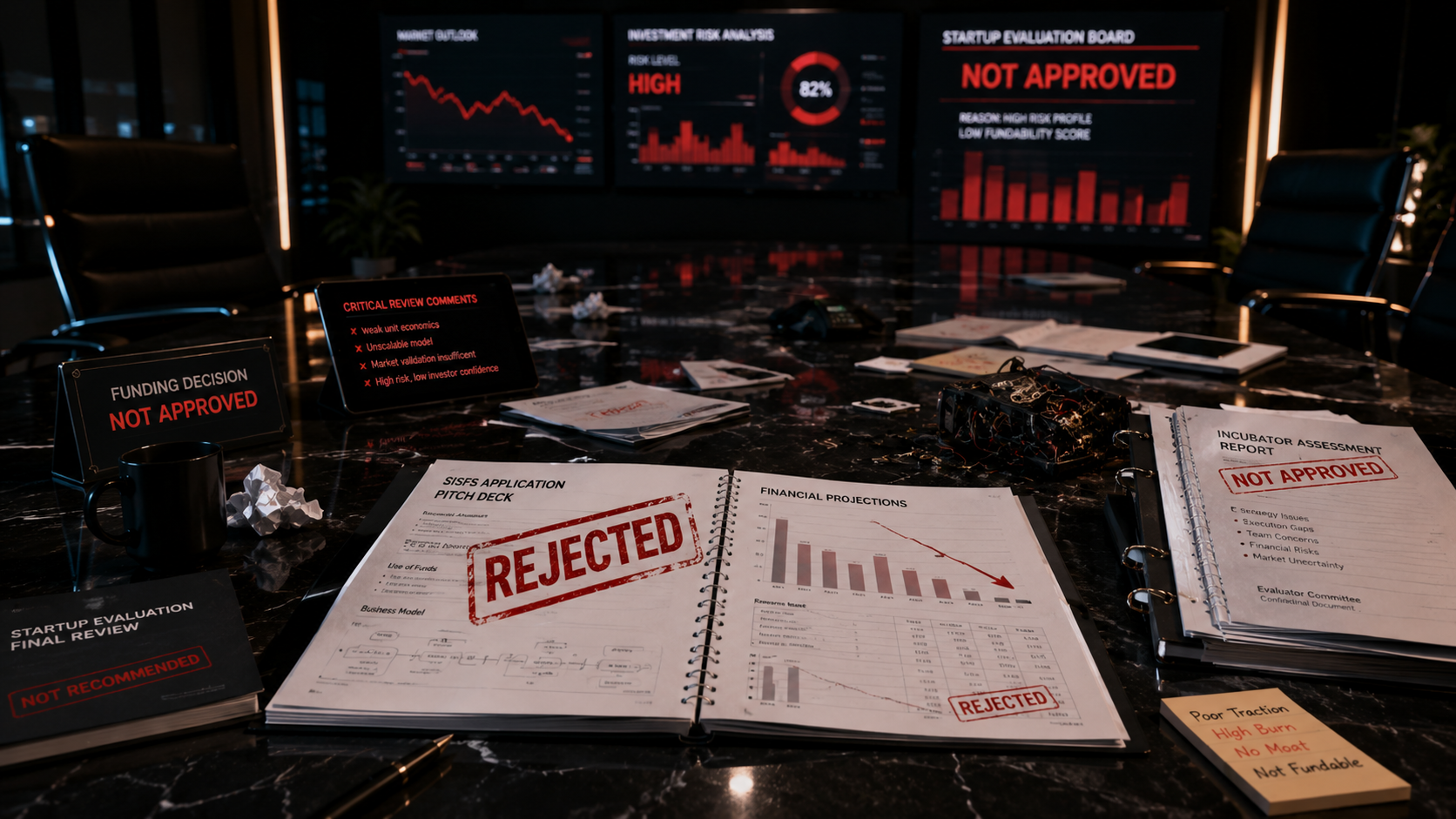
Just Having Idea Isn’t Enough in Most Cases
Some entrepreneurs opt to apply using:
- just their idea without
- MVP
- prototype
- customer validation
Though SISFS accommodates early stage startups, even incubators would like some proof of:
- foundation understanding market
- necessity of product for the user
- execution of the idea already
That is why many startups fail to be accepted in SISFS despite meeting eligibility criteria.
The Mistake Founders Often Make in Choosing Incubators
Startups don’t usually see the importance of choosing appropriate incubators.
Choosing right incubators makes a big difference.
Common Founders’ Mistakes while Choosing Incubators
They:
- have famous incubators in mind, but select randomly
- do not consider specializations of sector
- opt to apply without analyzing incubator interests
This lowers the chance of being selected by the incubator considerably.
Better Way to Optimize
Before applying to any incubator:
- research portfolio of incubator
- check sectors incubator funded before
- see mentors in place
Example
Manufacturing technology startup is unlikely to be selected by a fintech incubator.
But it has better chances in industrial innovation incubator.
Alignment helps in:
- greater probability of acceptance
- quality mentorship post-funding
What the Incubator Committee Really Assesses
Most entrepreneurs assume that the committee just assesses innovation alone.
On the contrary, incubators are more aggressive in assessing execution readiness.
Areas of Assessment
| Area of Assessment | What Is Being Assessed |
|---|---|
| Market Validation | Convincing demand proof |
| Innovation | Innovative product/process |
| Founders’ Capabilities | Execution confidence |
| Scalability | Scalability |
| Financial Planning | Practical financial projections |
| Funds Usage Plan | Reasonable planning for milestones |
| Competitive Advantage | Competitive edge over the rest |
Entrepreneurs who can:
- articulate customer problems properly
- provide a logical roadmap for business growth
- assess milestones properly
are likely to score higher in the evaluation process.
For this reason, most startups prefer to get help with startup documentation structuring and fund advisory services from JackRabbit Consultants before appearing before the incubators’ panel.
Time Frame: Typical SISFS Process Time Line
The SISFS process takes some time.
SISFS Process Time Line
| Stage | Time Frame |
|---|---|
| Recognition by DPIIT | 5-10 days |
| Submission of Application Form | 1-3 days |
| Initial Review | 1-2 weeks |
| Assessment by Incubators | 45 days |
| Presentation and Interview | N/A – based on incubators’ |
| Approval | 30-60 days |
| First Disbursement of Funds | Within 60 days from approval |
Depending on:
- startup strength
- fitting industry/sector
- documentation readiness
Can Startups Apply Again in Case of Rejection?
Yes.
But in general, there exists a cooling period of about 3 months for reapplication.
What Founders Need to Change Before Applying Again
Instead of sending the previous application again:
- MVP validation needs improvement
- Improve the pitch deck
- Refine financial projections
- Look for other incubators
- Work on scalability strategy
Most of the times, startups manage to secure funding when they improve their applications in the second attempt.
Deadline of SISFS & Important Information for 2026
According to current scheme information:
- Application will be due sometime in May 2026
- Incubators continue to select based on their timelines
- It is advised to not submit applications at the end of the month
The important reality that startups need to understand is that:
- The documents get submitted in rush near the deadlines
- There are no rules for incubators, it all depends on luck
- Financial projections aren’t complete
- No preparation goes into making the pitch deck
Misunderstandings of Founders About Startup India Funding
| Common Misunderstanding | Reality |
|---|---|
| “Government Funds Will Be Given Automatically.” | Startup India Seed Funding Scheme is competitive and based on evaluation. |
| “It’s Enough If My Startup Gets Registered With DPIIT.” | Getting registered under DPIIT only implies that your startup gets eligible to apply for the SISFS program. |
| Common Myth | Reality |
|---|---|
| “Startups in Idea Stages Always Get Funded” |
Most incubators still require:
• Prototype Readiness • Finding Market Validation • Readiness of Founders |
| “Any Incubator Is Good Enough” | Bad incubator alignment greatly decreases chances of approval. |
Before SISFS Funding Approval…
What differentiates successful SISFS applications from unsuccessful ones is rarely just innovation.
It is the level of preparedness.
Successful entrepreneurs always:
- Maintain good documentation
- Create realistic financial models
- Select incubators wisely
- Do a product validation before submitting the proposal
- Understand how incubators evaluate proposals
The startup india seed fund scheme can be one of the most significant early-stage funding sources if startups take a professional approach to the matter.
Additionally, many founders collaborate with startup advisory services such as JackRabbit Consultants for:
- DPIIT Recognition Guidance
- Structuring Their Companies for Compliance
- Pitch Documentation
- SISFS Application Preparation
- Support with Pitch Refinement
as in many cases, execution takes priority over ideation when SISFS evaluates proposals.