
FSSAI Licence Expiring Soon? Check These Points Before Assuming Renewal Is Required…
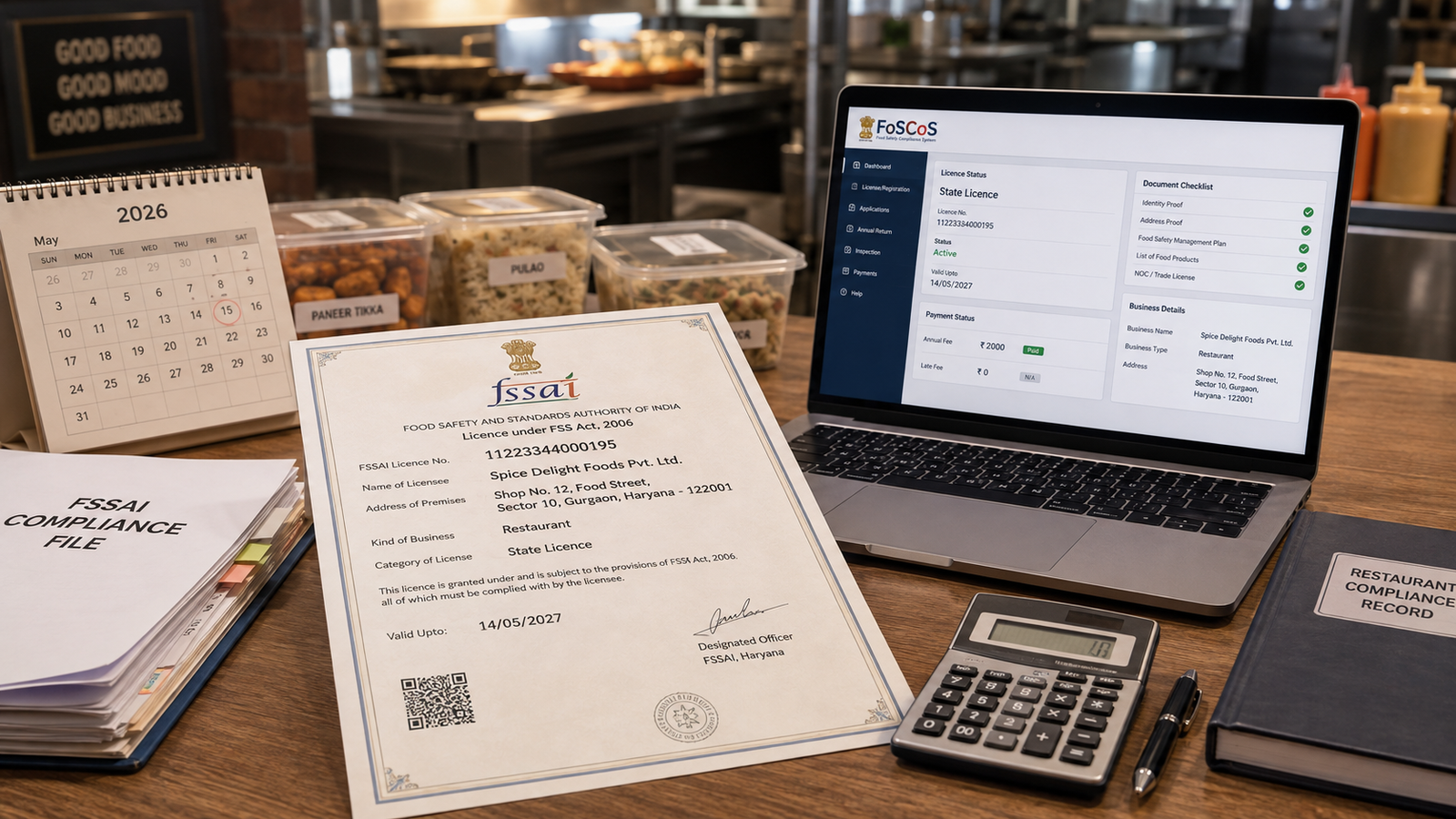
A restaurant owner may notice an FSSAI licence approaching its expiry date while preparing documents for a vendor, food-delivery platform, inspection, or internal compliance review. The immediate question is usually not just, “How do I renew my FSSAI licence?”
The more important questions are: Is the existing information still correct? Has the business category changed? Are the required documents available? And does the licence actually require a renewal application under the 2026 rules?
This last point is particularly important in 2026 because FSSAI has introduced significant changes to licence validity and turnover thresholds. According to the supplied regulatory research, from 10 March 2026, FSSAI licences move to a perpetual-validity framework, subject to continued compliance, payment of the applicable annual fee, and submission of required returns.
Therefore, FSSAI compliance in 2026 should be treated as an ongoing review process rather than simply a last-minute form-filling exercise. Businesses should verify their licence details, applicable category, turnover information, documentation, annual fee requirements, and other compliance obligations before taking any action.
Is Your FSSAI Licence Near Its Expiry Date? What Should a Business Verify First?
First, verify the current status of the FSSAI licence, its validity, and whether the information recorded on the licence still matches the present operations of the business.
| Checklist | Reason for Verification |
|---|---|
| Validity / Status of the Licence | To understand the current compliance status and determine what action, if any, is required. |
| Turnover / Business Category | To determine whether the business falls under the applicable FSSAI registration or licence category based on the 2026 thresholds. |
| Business Details | To identify outdated or incorrect information that may need to be updated. |
| Address and Premises | To ensure that the premises and address recorded with FSSAI accurately reflect the current business location. |
| Food Activities / Categories | To verify that the food activities and categories currently carried out by the business are correctly reflected in the FSSAI records. |
| Supporting Documents | To ensure that the relevant documents are available and accurate before undertaking any compliance action. |
| Annual Returns / Applicable Fees | To verify that ongoing compliance requirements have been addressed before deciding whether any further application or action is necessary. |
From 1 April 2026, significant changes apply to the FSSAI turnover thresholds. Based on the 2026 framework, basic registration applies to businesses with turnover of up to ₹1.5 crore, a State Licence applies to turnover above ₹1.5 crore and up to ₹50 crore, and a Central Licence generally applies to turnover above ₹50 crore or to specified categories such as importers and certain multi-state operations.
Therefore, businesses should not rely solely on the expiry date printed on an existing FSSAI document. The applicable category, current turnover, business activities, premises details, and continuing compliance requirements should be reviewed together before deciding the appropriate next step.
Top 7 FSSAI Renewal Application Mistakes Made by Food Businesses
Waiting until the FSSAI licence is close to expiry can leave insufficient time to identify missing documents, correct business information, or address application-related issues.
Where the applicable renewal process requires an application before expiry, businesses should follow the prescribed timeline rather than waiting until the final days. Under the earlier renewal framework, applications were generally expected to be submitted at least 30 days before expiry, with provisions for earlier submission.
The practical approach is to review the licence and supporting documents well before the relevant deadline.
Information recorded when the FSSAI registration or licence was originally obtained may no longer reflect the current business.
Changes in business location, ownership, activities, food categories, or business structure should be reviewed before proceeding with any FSSAI application or compliance action.
Incorrect, outdated, or incomplete documents can create avoidable issues during the application process. Businesses should cross-check their documents against the applicable FoSCoS requirements before submission.
Depending on the nature of the food business, relevant documents may include premises-related documents, identity information, FSMS-related documentation, nominee details, product information, and other supporting records.
FSSAI compliance should reflect how the food business actually operates. Simply submitting an application without reviewing the current business activities can result in incorrect information being carried forward.
For example, if a restaurant has substantially changed its menu, it should verify whether the food categories and activities recorded in its FSSAI records continue to accurately represent its present operations.
FoSCoS plays an important role in the FSSAI registration and licensing process. Businesses should check application details, payment status, acknowledgements, and other requirements instead of assuming that an application has been successfully submitted simply because the process was initiated.
Submitting an application or making a payment does not necessarily mean that every compliance requirement has been completed. Businesses should retain relevant acknowledgement or reference numbers and monitor the application status until the applicable process is completed.
If an FSSAI registration or licence shows an unresolved status, including expiry, suspension, or another compliance issue, the business should verify the current status and determine the appropriate corrective action.
Businesses should not assume that an old FSSAI certificate automatically establishes current compliance. The status and applicable requirements should be verified before relying on the certificate for ongoing operations.
Key takeaway: FSSAI compliance should be reviewed against the business’s current operations, documents, licence status, and applicable 2026 requirements. Starting the review early helps identify issues before they become urgent.
FSSAI Licence Renewal vs FSSAI Registration: What a Business Should NOT Mix Up
| Situation | What the Business Should Know |
|---|---|
| Licence is in force and valid | Continue meeting the applicable compliance requirements, including annual fee payment and required returns. |
| Licence is nearing expiry under the earlier regime | Check whether the new 2026 perpetual-validity framework applies before assuming that a conventional renewal application is required. |
| Business details have changed | Verify whether a modification or update to the existing FSSAI records is required to reflect the current business operations. |
| Licence has expired under the applicable earlier regime | Determine the correct compliance route based on the status of the licence and the applicable regulatory framework before continuing operations. |
| There is a problem with the application | Identify the specific defect, document issue, payment issue, or status problem before taking further action. |
The 2026 regulatory framework is particularly important because the amended FSSAI framework provides for licences to continue in force unless they are suspended, cancelled, or surrendered, subject to the applicable compliance requirements. Annual fee payment and required returns continue to remain important obligations for businesses.
Therefore, a business should not automatically treat an approaching expiry date as a conventional renewal situation. The current licence status, applicable 2026 framework, business details, annual fee requirements, returns, and any pending compliance issues should be reviewed together before deciding the appropriate course of action.
What Documentation & Business Details Need to Be Considered Before Renewal?
Before proceeding with FoSCoS, businesses should carry out a basic compliance reconciliation to ensure that their existing FSSAI records and supporting documents accurately reflect the current business.
- Existence and current status of the FSSAI licence or registration certificate.
- Name of the business and relevant entity details.
- Business address and registered premises details.
- Ownership details and authorised signatory information.
- Current food activities and categories of products being handled by the business.
- Supporting documents, wherever applicable.
- FSMS-related documents, wherever applicable.
- Nominee details, wherever applicable.
- Records relating to annual return filing.
- Applicable fee and payment records.
Based on the supplied research, common compliance issues include missing documents, incorrect business information, authorisation-related issues, and non-filing of required annual returns. Identifying these points before proceeding can help businesses address potential discrepancies in a more organised manner.
What If the FSSAI Licence Has Already Expired?
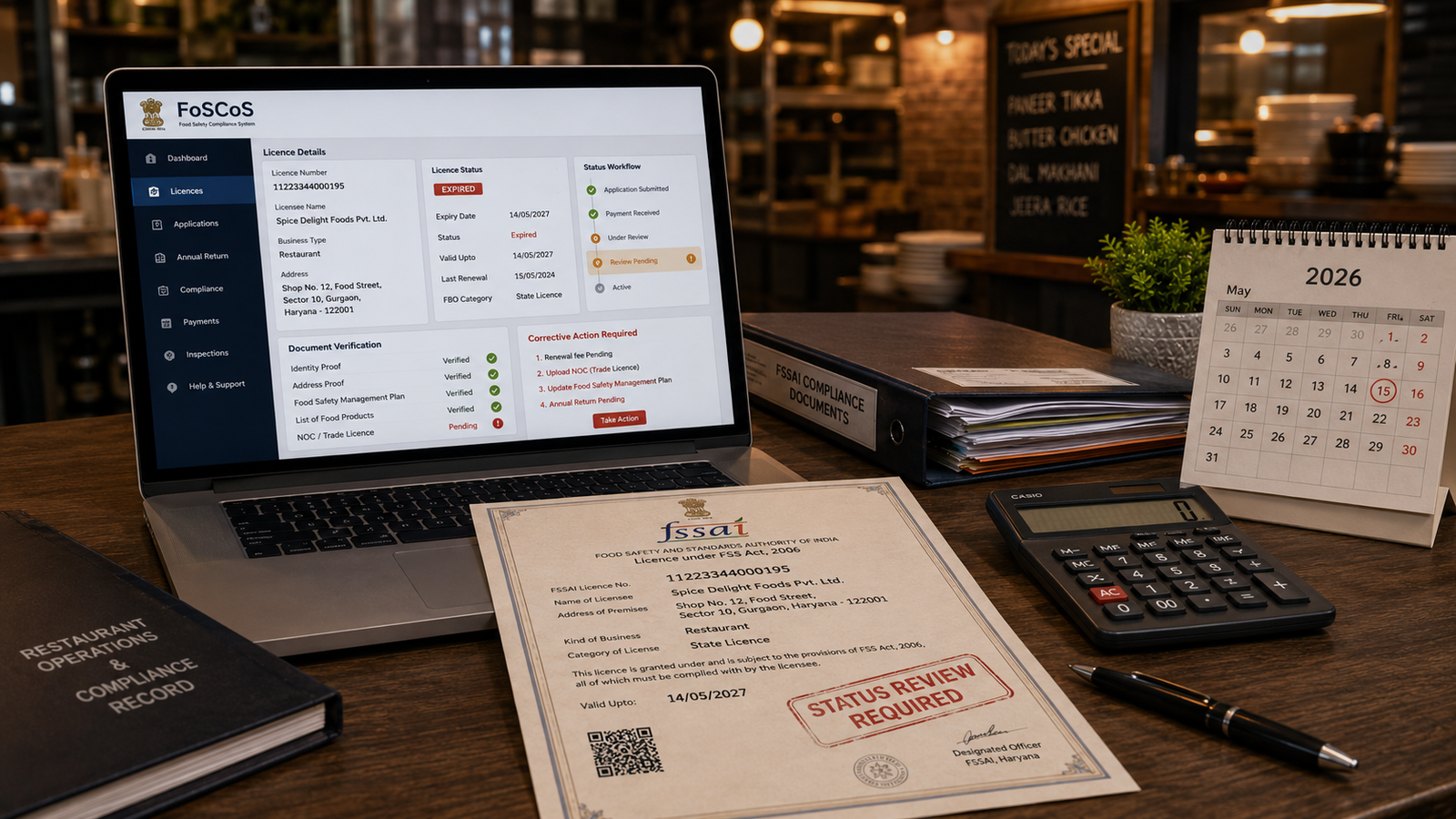
If an FSSAI licence appears to have expired, the first step should be to verify the current status of the licence and determine which regulatory framework applies. A business should not assume that the previous licence remains valid or immediately submit a fresh application without first reviewing its compliance position.
For licences governed by the earlier framework, the supplied research indicates that renewal could be undertaken within the prescribed post-expiry period, subject to the applicable additional fee or penalty. Under the earlier system, renewal was not permitted beyond the specified 180-day period after expiry.
Therefore, a business should review the following points before deciding the appropriate course of action:
- Check the licence number and current status — Verify the licence details and recorded expiry status.
- Check applicability of the 2026 perpetual-validity framework — Determine whether the licence falls under the amended framework before assuming that conventional renewal is required.
- Review outstanding annual fees and returns — Check whether any continuing compliance obligations remain pending.
- Verify changes in business details — Review the business name, premises, ownership, authorised signatory, food activities, and other relevant information.
- Check the relevant FoSCoS/application status — Review any existing application, payment, acknowledgement, or compliance status available on the system.
- Determine the appropriate compliance action — Based on the licence status and applicable regulatory framework, identify the steps required to regularise or update the FSSAI compliance position.
Why FSSAI Renewal Applications Get Delayed or Face Problems
| Problem Area | What Businesses Should Check |
|---|---|
| Incorrect information | Match the application with the current business details. |
| Documentation | Check completeness, validity, and consistency of the documents. |
| Business activity | Ensure that the current food activities are accurately represented. |
| Category / turnover | Recheck the applicable 2026 turnover threshold and category for the business. |
| Application issue | Identify the exact deficiency instead of repeatedly resubmitting the application without addressing the underlying issue. |
| Annual returns | Confirm that the required annual returns have been filed, wherever applicable. |
| Payment | Verify the applicable fee and retain the relevant payment record. |
This review also has a financial dimension. The 2026 fee structure cited in the research is ₹100 per year for Basic Registration, ₹5,000 per year for State Licence, and ₹7,500 per year for Central Licence for the relevant categories.
What Is the Right Time for a Food Company to Take Professional Help for FSSAI Compliance?
Professional assistance may become relevant when a food business encounters compliance situations that require a closer review of its licence, business details, documentation, or application status.
- FSSAI licence or registration is approaching expiry or its current status is unclear.
- There has been a change in the business activities, premises, ownership, or food categories.
- Existing documentation is incomplete, outdated, or difficult to verify.
- There is an issue with a FoSCoS application, payment, or application status.
- An application or compliance process has been delayed without a clear reason.
- The business is uncertain about the applicable FSSAI registration or licence category.
These considerations are particularly relevant in 2026 because of changes to the applicable turnover thresholds and the licence validity framework. Businesses should therefore avoid relying solely on older compliance information and should first determine how the current regulatory requirements apply to their specific operations.
Don’t Let FSSAI Licence Renewal Become a Compliance Problem
FSSAI licence renewal should not be treated as just another last-minute administrative activity. In 2026, businesses also need to understand the applicable perpetual-validity framework and the modified turnover thresholds before deciding what compliance action is required.
Before taking any action, businesses should review:
- FSSAI licence validity and current status.
- Applicable business type and category.
- Current food activities and product categories.
- Business and premises details.
- Required supporting documentation.
- Applicable annual returns and compliance records.
- Applicable fees and payment records.
- FoSCoS application and licence information.