
Annual ROC Filing Missed? Consequences for Companies, Directors & How to Regularise Compliance
Many companies operate smoothly throughout the financial year but unintentionally miss their Annual ROC filing. This may happen due to delayed finalization of financial statements, changes in the finance or compliance team, the absence of a compliance calendar, or the misconception that filing the Income Tax Return alone fulfills all statutory compliance requirements.
In many cases, the lapse comes to light only when the company is seeking investment, applying for loans, undergoing due diligence, or preparing for another statutory filing. At that stage, directors often ask a common question: What happens if our company has missed its Annual ROC filing? Can the compliance still be regularised?
In most situations, missing an Annual ROC filing does not mean that the company permanently loses the opportunity to become compliant. However, delaying corrective action may lead to additional compliance issues, financial implications, and regulatory complications. Identifying pending filings at an early stage and following a structured process to regularise them is generally more effective than allowing the non-compliance to continue.
This guide explains the possible consequences of missing an Annual ROC filing, how it may affect both companies and their directors, the common reasons behind delayed filings, and the practical steps businesses can consider while regularising their MCA compliance. The objective is not to create unnecessary concern, but to help businesses understand their compliance position and take informed corrective action.
What Is Annual ROC Filing & Why Is It Mandatory for Eligible Companies?
Annual ROC Filing is a mandatory statutory compliance process through which eligible companies are required to submit prescribed annual filings to the Registrar of Companies (ROC) under the Ministry of Corporate Affairs (MCA). These filings help maintain updated statutory records, promote corporate transparency, and ensure continuous compliance with the provisions of the Companies Act.
From a business perspective, Annual ROC compliance is much more than a routine legal requirement. It enables regulators, financial institutions, investors, and other stakeholders to access important information relating to a company’s financial position, management structure, and statutory records. Regular compliance also supports sound corporate governance and strengthens the company’s credibility.
Annual ROC Filing generally includes the submission of prescribed annual forms and financial statements within the applicable statutory timelines. It forms an essential part of a company’s overall compliance obligations under the Companies Act and the regulatory framework administered by the MCA.
Maintaining timely ROC compliance also helps businesses remain prepared for future corporate activities such as fundraising, bank financing, mergers and acquisitions, investor due diligence, and other strategic transactions. Well-maintained statutory records often simplify the due diligence process and help avoid unnecessary compliance-related delays.
Rather than treating Annual ROC Filing as a year-end formality, companies should consider it an integral part of their overall corporate compliance and governance strategy.
What Happens If Annual ROC Filing Is Not Done?
Missing an Annual ROC filing does not necessarily prevent a company from continuing its day-to-day business operations. However, it does result in statutory non-compliance. Unresolved ROC filings may affect future compliance, due diligence, corporate transactions, financing, and other regulatory requirements. Identifying pending filings and regularising them at the earliest is generally the most practical approach.
The overall impact depends on how long the compliance remains pending. Delays of a shorter duration are generally easier to regularise, whereas prolonged non-compliance may complicate future corporate activities and require additional review of statutory records.
| Compliance Status | Practical Business Impact |
|---|---|
| Annual ROC Filing Completed Within the Prescribed Timeline | The company remains statutorily compliant, and its MCA records are updated. |
| ROC Filing Overdue After the Due Date | Late filing requirements and applicable statutory compliances may need to be completed before restoring regular compliance. |
| Annual ROC Filing Not Yet Filed | Pending compliance may affect statutory records, due diligence, regulatory compliance, and business transactions that require updated MCA records. |
| Several Years of Pending ROC Compliance | Long-term non-compliance may become more complex and often requires a detailed review of pending statutory filings before regularisation. |
Ignoring pending ROC filings rarely improves the situation. A more effective approach is to identify outstanding compliance requirements, verify statutory records, and complete the necessary MCA filings with appropriate documentation.
It is equally important to understand that Income Tax Return (ITR) filing, GST compliance, and Annual ROC compliance are separate legal obligations governed by different statutes. A company may be fully compliant with its tax filings while still having pending ROC compliances under the Companies Act.
Regularly reviewing the company’s compliance status and addressing pending ROC filings without unnecessary delay can help avoid procedural hurdles and support smoother business operations in the future.
Common Reasons Why Companies Miss Annual ROC Compliance
Companies rarely miss their Annual ROC compliance intentionally. In most cases, delayed filings result from operational challenges, documentation issues, communication gaps, or the misconception that completing tax-related compliances alone satisfies all annual statutory obligations.
Understanding these common reasons helps businesses strengthen their compliance processes and reduce the risk of missing statutory filing deadlines in the future.
| Common Cause | Explanation |
|---|---|
| Delay in Finalising Financial Statements | Annual ROC compliance depends on finalized financial statements. Delays in financial finalization often postpone the entire filing process. |
| Audit-Related Delays | Pending audits or unresolved financial queries may delay the completion of annual ROC filings. |
| Change in Finance or Compliance Team | Changes in key personnel may interrupt compliance tracking and affect timely statutory filings and documentation. |
| Absence of a Compliance Calendar | Without a structured compliance calendar, ROC filing deadlines can easily be overlooked amid routine business activities. |
| Assuming Income Tax Return Filing Is Sufficient | Some companies mistakenly believe that filing an Income Tax Return fulfills all annual compliance requirements, whereas ROC filings are separate statutory obligations. |
| Incomplete Statutory Documents | Missing or incomplete statutory records can delay the preparation and filing of annual ROC forms. |
| Early-Stage Business Priorities | Startups and growing businesses often focus on operations, customers, funding, or production, causing compliance activities to receive less attention. |
| Poor Coordination Between Management and Advisors | Delayed sharing of financial information or statutory documents may affect the timely completion of ROC compliance. |
Although these situations are common, they can usually be managed through better planning, regular compliance reviews, and clearly defined responsibilities. Maintaining organized statutory records, following a compliance calendar, and monitoring filing timelines throughout the year can significantly reduce the likelihood of missed ROC filings.
Instead of treating Annual ROC Filing as a last-minute exercise, companies should integrate it into their overall corporate governance and compliance framework to ensure timely and consistent statutory compliance.
Effects of Non-Compliance with Annual ROC Filing on Companies and Directors
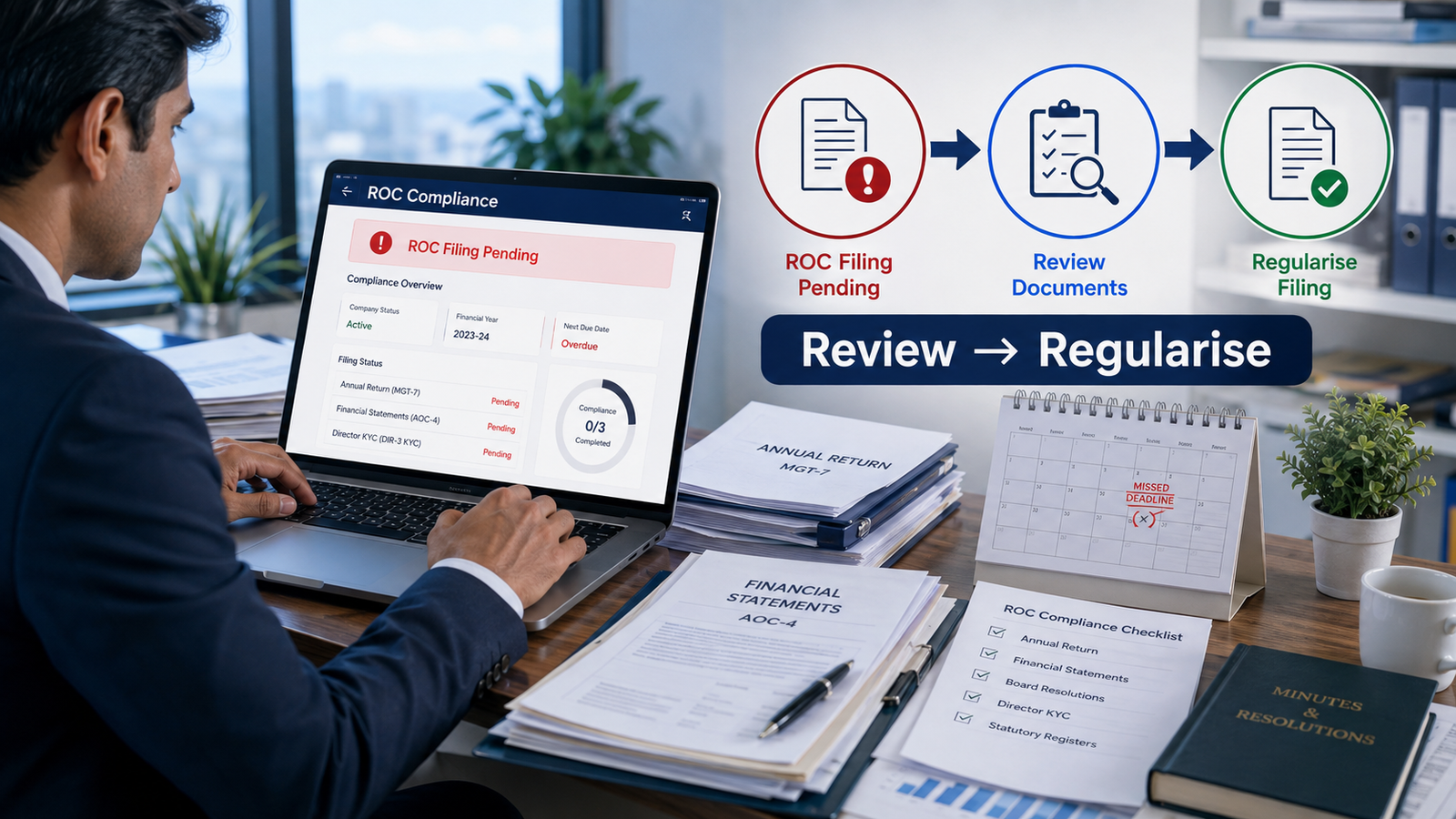
Missing Annual ROC filing is more than a statutory lapse. It may affect a company’s regulatory records, corporate governance, business transactions, and the responsibilities of its directors. Identifying and regularising pending ROC compliances at an early stage generally helps minimise future procedural and compliance challenges.
The practical impact depends on the nature and duration of the non-compliance. Companies that regularly monitor their statutory obligations are generally better prepared for regulatory requirements, corporate transactions, and compliance reviews.
| Area | Practical Impact of Pending Annual ROC Filing |
|---|---|
| Statutory Compliance | Pending Annual ROC filing represents non-compliance with statutory filing requirements and should be reviewed and regularised promptly. |
| Company Records | MCA records may not reflect the company’s latest statutory information until the pending filings are completed. |
| Corporate Due Diligence | Investors, buyers, and business partners often review MCA records during due diligence. Pending ROC filings may require clarification before business transactions proceed. |
| Banking & Financial Transactions | Banks and financial institutions may require updated statutory records while processing loans, credit facilities, or other corporate applications. |
| Funding & Investment | Companies generally prefer to regularise pending ROC compliances before initiating discussions relating to equity funding, investments, or strategic partnerships. |
| Future Regulatory Filings | Outstanding compliance issues may complicate or delay subsequent MCA filings and other statutory compliances. |
| Directors’ Responsibility | Directors are responsible for ensuring that the company fulfills its statutory compliance obligations under the applicable provisions of the Companies Act. |
From a corporate governance perspective, timely Annual ROC compliance demonstrates that the company maintains its statutory reporting obligations. Businesses that regularly monitor their compliance requirements generally encounter fewer procedural issues during audits, inspections, financing, due diligence exercises, or corporate restructuring.
It is also important to remember that ROC compliance, Income Tax compliance, and GST compliance are separate legal and regulatory processes. Filing GST returns or Income Tax Returns does not, by itself, satisfy a company’s Annual ROC filing obligations.
Common Mistakes Companies Make After Missing Annual ROC Filing
In many cases, the bigger compliance risk is not missing the Annual ROC filing itself but the actions taken afterward. Companies sometimes postpone corrective action, assume the issue will resolve automatically, or proceed with filings without first reviewing their statutory records. These mistakes can often be avoided through timely compliance planning.
| Mistake | Why It Creates Further Compliance Issues |
|---|---|
| Ignoring Pending ROC Filings | Delaying corrective action may make regularisation more complicated and increase the effort required to restore statutory compliance. |
| Taking No Corrective Action | Pending ROC compliance does not resolve automatically and continues until the necessary filings are completed. |
| Submitting Incorrect Information | Incomplete or inaccurate filings may require further corrections and delay the compliance process. |
| Not Organising Required Documents | Financial statements, annual return details, statutory registers, and supporting records should be compiled before initiating ROC filings. |
| Not Reviewing Earlier ROC Filings | Companies should verify whether previous ROC compliances are complete to identify any additional pending statutory obligations. |
| Treating ROC, GST, and Income Tax Compliance as the Same | ROC filing, GST compliance, and Income Tax compliance are separate legal requirements. Compliance under one law does not satisfy obligations under another. |
| No Internal Compliance Accountability | Without defined responsibility for statutory compliance, filing deadlines may continue to be missed in future years. |
Maintaining a compliance calendar, reviewing statutory obligations periodically, and ensuring coordination between management, the finance team, and compliance professionals can significantly reduce the risk of missed ROC filings.
Where Annual ROC filings remain pending for multiple years or statutory records are incomplete, conducting a comprehensive compliance review before initiating the regularisation process can help identify discrepancies and support a smoother compliance resolution.
Practical Checklist Before Regularising Annual ROC Filing
Before initiating the regularisation of any missed Annual ROC filing, companies should first review their statutory records, identify all pending filings, and ensure that the required documents are complete and accurate. A systematic review often makes the regularisation process more efficient and reduces the likelihood of further compliance issues.
Rather than immediately filing pending forms, businesses should first understand the nature of the default, organise the necessary documentation, and verify that all statutory records are up to date.
| Compliance Checklist Item | Purpose |
|---|---|
| Review All Pending ROC Filings | Identify every pending statutory filing that must be completed during the regularisation process. |
| Verify Statutory Registers and Company Records | Ensure that the information to be reported in ROC filings is accurate and supported by company records. |
| Audited Financial Statements | Confirm that the audited financial statements are available, as they form an essential part of annual ROC compliance. |
| Annual Return Information | Review details relating to shareholding, directors, the registered office, and other statutory information before filing. |
| Company Master Data | Verify that the company’s details available on the MCA portal are accurate and up to date. |
| Director Information | Confirm that all director-related information and identification records are complete and accurate. |
| Review Previous ROC Filings | Examine earlier filings to identify any unresolved compliance issues before proceeding with current-year filings. |
| Organise Supporting Documents | Maintain board resolutions, financial records, statutory registers, and other supporting documents in an organised manner. |
| Understand Filing Requirements | Review the applicable ROC filing process and statutory requirements before submitting pending forms. |
| Prepare a Compliance Calendar | Develop a compliance calendar for future statutory filings to minimise the risk of missed deadlines. |
Practical Checklist Before Regularising Annual ROC Filing
Before initiating the regularisation of any missed Annual ROC filing, a company should first review its statutory records, identify all pending ROC filings, and ensure that the required documents are complete and accurate. A systematic review generally makes the regularisation process more efficient and helps reduce avoidable compliance issues.
Rather than immediately filing pending forms, the company should first understand the nature of the default, organise the relevant records, and confirm that its statutory information is up to date.
| ROC Compliance Checklist | Why It Matters |
|---|---|
| ✓Identify All Pending ROC Filings | Determine every statutory filing that remains outstanding before beginning the regularisation process. |
| ✓Verify Statutory Registers | Ensure that statutory registers and company records are complete and consistent before filing. |
| ✓Review Audited Financial Statements | Audited financial statements form an important part of Annual ROC compliance and should be finalised before filing. |
| ✓Verify Annual Return Information | Confirm details relating to shareholding, directors, registered office, and other statutory information before submission. |
| ✓Review Company Master Data | Ensure that the company’s information available on the MCA portal is accurate and up to date. |
| ✓Verify Directors’ Information | Check that the details and identification records of all directors are complete and current. |
| ✓Review Previous ROC Filings | Examine earlier ROC filings to identify any unresolved compliance issues before filing the current year’s documents. |
| ✓Organise Supporting Documents | Maintain board resolutions, accounting records, statutory registers, and other supporting documents in an organised manner. |
| ✓Understand Filing Requirements | Review the applicable filing process and compliance requirements before submitting pending ROC forms. |
| ✓Maintain a Compliance Calendar | Plan future statutory deadlines to minimise the risk of missed ROC filings in subsequent years. |
A structured compliance review can significantly reduce the time and effort involved in regularising pending ROC filings. Companies that maintain updated statutory records throughout the year generally encounter fewer difficulties while preparing their Annual ROC compliance.
Where ROC filings are pending for multiple financial years, the review should cover all outstanding years rather than focusing only on the most recent compliance period.
Example Case Study: Identifying & Regularising Missed Annual ROC Compliance
Consider the example of a technology startup that spent its first year focusing on product development, customer acquisition, and business expansion. While management successfully handled day-to-day operations, Annual ROC compliance received limited attention during the year.
The issue came to light when the company entered discussions with a prospective investor. During the due diligence process, it was discovered that the company’s Annual ROC filing had not been completed within the prescribed timeline. Although the financial statements had been properly maintained, certain statutory records and ROC compliance requirements still needed to be reviewed.
Instead of immediately proceeding with the pending filings, the directors first carried out a structured review of the company’s statutory records, identified the outstanding compliance requirements, verified the supporting documents, and then planned the regularisation process in an organised manner.
Key Takeaways from the Scenario
- Annual ROC compliance should be monitored throughout the year instead of being treated as a year-end activity.
- Identifying pending filings early generally makes the regularisation process faster and more manageable.
- Maintaining organised statutory records simplifies annual filings and reduces the likelihood of compliance errors.
- Reviewing historical ROC filings helps identify any unresolved compliance issues from previous years.
- A structured compliance framework supports smoother fundraising, banking, due diligence, and other corporate transactions.
Many organisations encounter compliance challenges not because they intend to ignore statutory requirements, but because they do not have a structured compliance management process in place. Establishing clear internal procedures and reviewing compliance periodically can significantly reduce the risk of missed ROC filings in the future.
Why Annual ROC Compliance Should Be Treated as a Year-Round Process
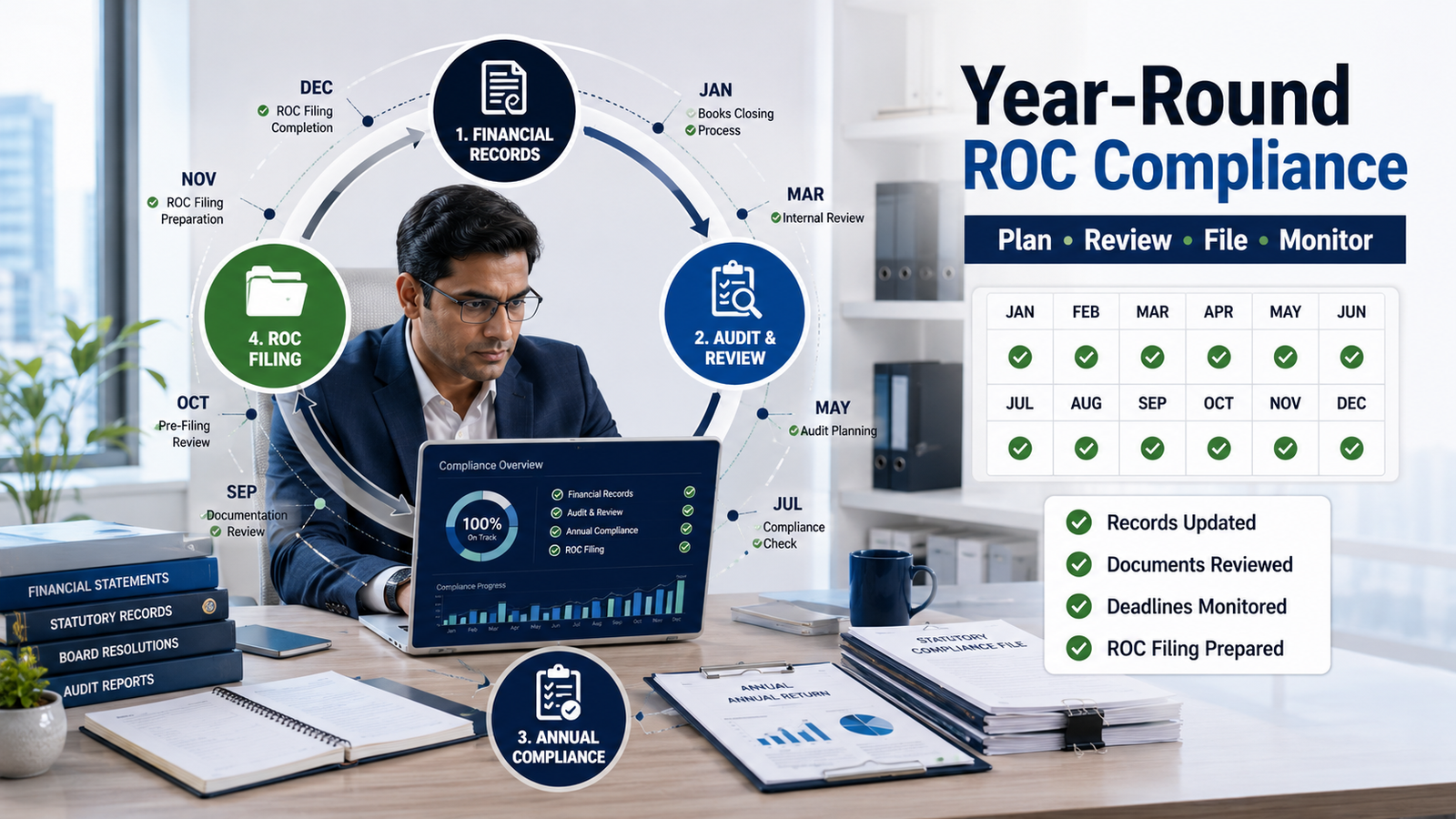
Annual ROC compliance should not be viewed as a one-time filing activity at the end of the financial year. Maintaining statutory records, monitoring compliance deadlines, and reviewing corporate information throughout the year enables companies to manage their filing obligations more efficiently while reducing the risk of missed compliances.
Many businesses begin preparing their Annual ROC filing only when the due date approaches. By that stage, delays in finalising financial statements, incomplete statutory records, or missing documentation can create avoidable compliance challenges. Establishing a proactive compliance framework helps companies stay prepared well before the filing deadline.
Maintain a Compliance Calendar
An annual compliance calendar helps track important statutory events such as board meetings, annual general meetings, preparation of financial statements, audit activities, and Annual ROC filing deadlines. Regular monitoring significantly reduces the possibility of overlooking important compliance obligations.
Keep Statutory Records Updated
Instead of collecting documents at the last moment, companies should maintain updated statutory registers, directors’ information, corporate records, and supporting documents throughout the year. Well-organised records make the annual filing process considerably smoother.
Coordinate Finance and Compliance Functions
Annual ROC filing depends on timely financial information and statutory documentation. Effective coordination between management, finance teams, auditors, and compliance professionals helps minimise delays arising from incomplete information or communication gaps.
Conduct Periodic Compliance Reviews
Rather than waiting until year-end, companies should periodically review pending statutory obligations and filing status. Early identification of missing documents or compliance gaps provides sufficient time to complete corrective actions before statutory deadlines.
Review Changes in Company Information
Businesses should regularly verify whether there have been changes relating to directors, the registered office, shareholding pattern, or other corporate records that may require updating before Annual ROC filing.
Monitor ROC, GST, and Income Tax Compliance Separately
Although these compliance areas often involve similar financial information, they are governed by different laws and require separate statutory filings. Completing GST or Income Tax compliance does not automatically satisfy Annual ROC filing requirements. Each compliance obligation should therefore be monitored independently.
A structured year-round compliance process not only supports timely Annual ROC filing but also strengthens corporate governance, improves internal controls, and simplifies future regulatory reviews, audits, funding activities, banking processes, and business expansion.
When Professional ROC Advisory Becomes Important
Professional ROC advisory becomes particularly valuable when a company identifies pending Annual ROC filings, multiple years of non-compliance, inconsistencies in statutory records, or requires assistance in reviewing and organising its compliance before completing MCA filings.
While many companies manage routine ROC compliance internally, more complex situations often require a detailed review of statutory records and filing history to ensure that all pending obligations are properly identified and addressed.
Professional assistance may be beneficial in situations such as:
- Reviewing pending Annual ROC filings to identify outstanding compliance requirements.
- Assessing multiple years of pending compliance and preparing a structured regularisation plan.
- Reviewing financial statements and annual return documentation before filing.
- Verifying statutory records to ensure company information is complete, accurate, and consistent.
- Understanding applicable MCA filing requirements and organising supporting documentation.
- Developing an ongoing compliance management system to minimise future filing delays.
Many businesses—including Private Limited Companies, Startups, MSMEs, and One Person Companies (OPCs)—seek professional guidance when corporate compliances become more complex or when historical filings require detailed review.
In such situations, experienced advisory firms such as JackRabbit Consultants assist companies by reviewing pending Annual ROC compliances, examining statutory documentation, supporting MCA compliance, preparing annual return documentation, and helping businesses establish structured compliance systems for future filing cycles.
The objective of professional advisory is not merely to complete pending filings, but to help companies build stronger compliance practices, reduce recurring administrative challenges, and strengthen corporate governance over the long term.
Before Assuming Missed Annual ROC Compliance Cannot Be Corrected…
Missing an Annual ROC filing should not automatically be viewed as an irreversible compliance failure. In many situations, companies that identify pending filings at an early stage, organise their statutory records, and take timely corrective action are generally in a better position to regularise their compliance in a systematic manner.
Annual ROC filing is an important component of ongoing compliance under the Companies Act. It supports accurate statutory reporting, corporate transparency, and sound governance. At the same time, businesses should remember that ROC compliance is separate from Income Tax and GST compliance, as each is governed by its own legal framework, filing requirements, and statutory timelines.
Companies that regularly review their statutory records, maintain organised documentation, and follow a structured compliance calendar are generally better prepared for audits, due diligence, banking requirements, fundraising opportunities, mergers, acquisitions, and other corporate transactions.
Where pending filings involve multiple financial years, incomplete statutory records, or more complex compliance matters, conducting a comprehensive review before beginning the regularisation process is often the most practical approach.
Many businesses choose to work with experienced corporate compliance professionals such as JackRabbit Consultants to review pending Annual ROC filings, organise statutory documentation, support MCA compliance, and strengthen their overall compliance management framework. A proactive and well-planned compliance approach not only helps resolve existing filing issues but also reduces future administrative challenges and supports stronger corporate governance over the long term.