
Receiving an email or notice from the Income Tax Department often causes immediate concern. Many taxpayers wonder whether it relates to scrutiny, whether a penalty may be imposed, or whether their Income Tax Return has been rejected.
In reality, every communication issued by the Income Tax Department does not have the same purpose or legal implication.
Understanding the distinction between an income tax assessment, reassessment, and scrutiny is essential before responding to any notice. Each of these proceedings serves a different objective, follows a separate legal process, and may require different explanations and supporting documents from the taxpayer.
Responding appropriately begins with identifying the type of proceeding involved. A notice for assessment, reassessment, or scrutiny should never be treated as though all three follow the same procedure.
From the assessment year beginning on or after 1 April 2026, India has transitioned from the Income-tax Act, 1961 to the Income-tax Act, 2025. Consequently, taxpayers and businesses should understand the applicable legal framework while reviewing notices and responding to departmental proceedings.
This guide explains the differences between income tax assessment, reassessment, and scrutiny, including their objectives, circumstances in which they may be initiated, procedural aspects, and the documentation typically required to respond effectively.
Income Tax Assessment vs Reassessment vs Scrutiny: A Quick Comparison
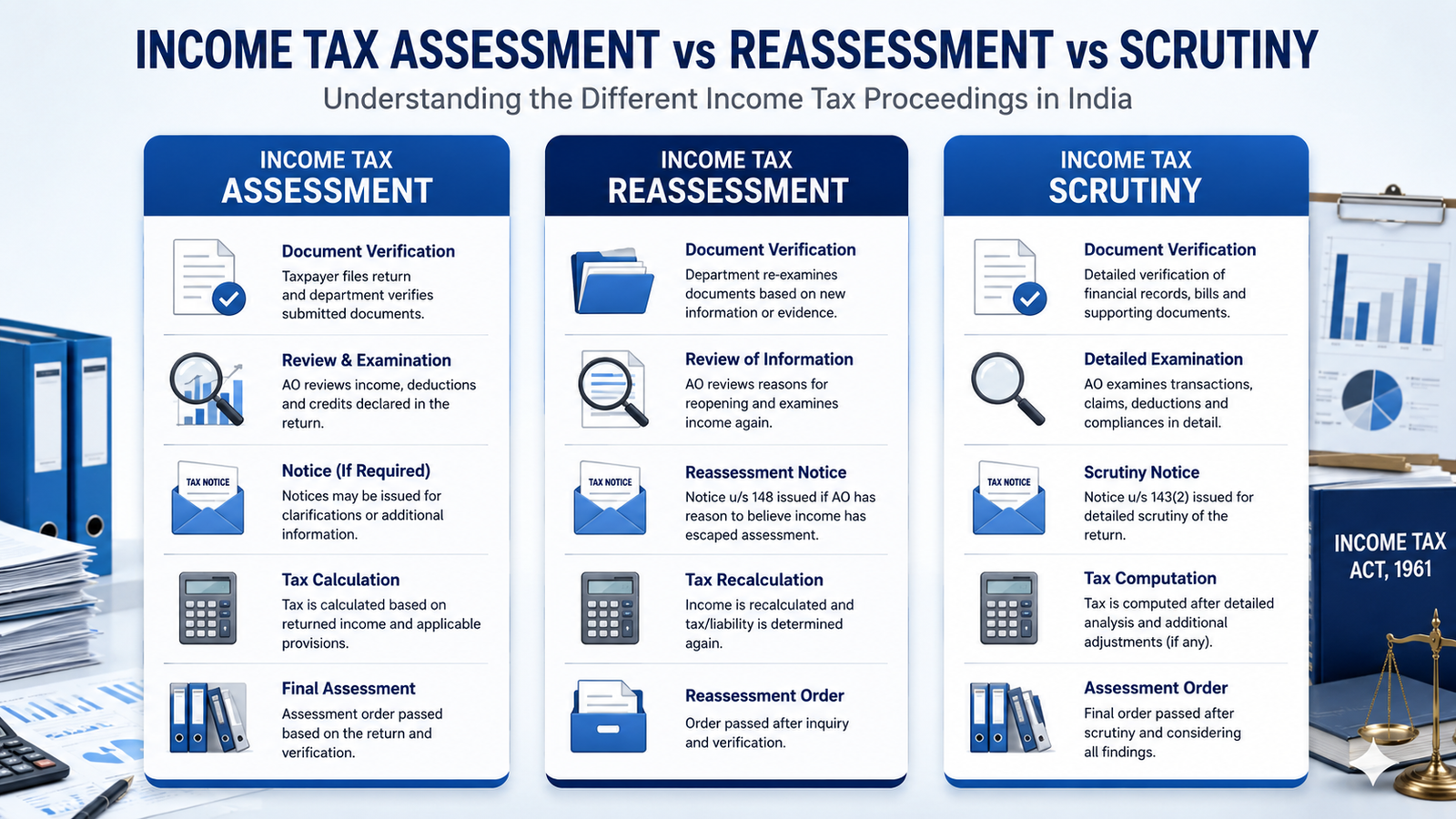
Although the terms assessment, reassessment, and scrutiny are often used interchangeably, they refer to different proceedings under the Income-tax law. Understanding the distinction helps taxpayers identify the purpose of a notice and prepare the appropriate response.
| Attribute | Assessment | Reassessment | Scrutiny |
|---|---|---|---|
| Primary Purpose | To process the Income Tax Return and determine the tax payable, refund due, or any adjustments based on the return filed. | To reopen a completed assessment where the Income Tax Department believes that income may have escaped assessment. | To verify the correctness of income, deductions, exemptions, expenses, and other claims made in the return. |
| When It Begins | After the Income Tax Return is filed and processed. | When new information or evidence suggests possible under-reporting of income. | When the return is selected for detailed verification under the prescribed selection process. |
| Typical Triggers | Return filing, system processing, apparent mismatches, or prima facie adjustments. | High-value transactions, third-party information, audit findings, risk parameters, or other information indicating escaped income. | Large deductions, unusual expenditure, income mismatches, discrepancies in books of accounts, or other verification requirements. |
| Taxpayer Involvement | Generally limited unless clarification or additional information is requested. | Requires a careful response to the reopening notice and supporting documentation. | Requires explanations and supporting documents relating to the issues selected for verification. |
| Documents Commonly Required | Income Tax Return, Form 16, Form 26AS, AIS, TIS, tax payment challans, and other basic tax records. | Earlier Income Tax Returns, bank statements, transaction records, reconciliations, and supporting evidence relating to the reopened issue. | Books of accounts, invoices, GST records, bank statements, agreements, reconciliations, and supporting documents for the claims under examination. |
| Possible Outcome | Intimation, refund, tax demand, or assessment order. | Reassessment order, additional tax demand (where applicable), or closure of proceedings. | Assessment order issued after completion of the verification process. |
In simple terms: An assessment is the overall process of determining a taxpayer’s tax liability, scrutiny is a detailed verification of specific claims or transactions during the assessment process, and reassessment involves reopening a previously completed assessment where the Income Tax Department believes that income may have escaped taxation.
Income Tax Assessment: The First Stage of Return Processing
Income tax assessment is generally the first stage of the tax administration process after a taxpayer files an Income Tax Return (ITR). It is not necessarily an indication of a dispute or non-compliance.
In many cases, the assessment process simply involves processing the return, matching tax credits, determining whether a refund or additional tax is payable, and issuing the appropriate intimation or assessment order.
Under the Income-tax Act, 2025, the provisions relating to return processing and assessment have been reorganized, with Section 270 governing the processing of assessments for assessment years covered by the new legislation.
However, for assessment years relating to periods prior to 1 April 2026, the provisions of the Income-tax Act, 1961 continue to apply, in line with the transition framework notified by the Income Tax Department.
An income tax assessment should generally be viewed as a verification process designed to ensure that the information reported in the Income Tax Return is consistent with the records available to the Income Tax Department.
During the assessment process, the department may compare information such as:
- Income reported in the Income Tax Return
- Tax Deducted at Source (TDS)
- Advance tax and self-assessment tax payments
- Deductions and exemptions claimed
- Carry-forward and set-off of losses
- Annual Information Statement (AIS)
- Taxpayer Information Summary (TIS)
- Form 26AS
Where the information reported by the taxpayer matches the records available with the department, the assessment process may conclude without requiring any further action from the taxpayer.
However, if inconsistencies, mismatches, or missing information are identified, the taxpayer may receive a communication seeking clarification or supporting documentation before the assessment is finalized.
When Can an Income Tax Reassessment Be Initiated?
Income tax reassessment is initiated when the Income Tax Department has information suggesting that income chargeable to tax may have escaped assessment in an earlier proceeding. Unlike a regular assessment, reassessment is not part of the routine return processing process but is intended to re-examine specific matters based on new information or identified risks.
Under the Income-tax Act, 2025, the provisions relating to reassessment are contained in Sections 279 to 285. As per the framework introduced under the new law, reopening of an assessment under Section 280 is generally based on information indicating possible escapement of income and must follow the prescribed statutory procedure before reassessment proceedings can commence.
For assessment years relating to periods prior to 1 April 2026, reassessment proceedings continue to be governed by the corresponding provisions of the Income-tax Act, 1961 in accordance with the transitional provisions.
A reassessment notice does not automatically imply tax evasion or wrongdoing. It indicates that the Income Tax Department seeks further verification of information suggesting that certain income may not have been assessed earlier.
Reassessment proceedings may be initiated on the basis of information relating to:
- High-value financial transactions
- Purchase or sale of immovable property
- Large cash deposits or banking transactions
- Differences between GST records and Income Tax disclosures
- Information received from reporting entities or other government agencies
- Undisclosed capital gains
- Income reflected in the Annual Information Statement (AIS) but not reported in the Income Tax Return
- Other information indicating that taxable income may have escaped assessment
Upon receiving a reassessment notice, taxpayers should carefully review the issues raised and provide factual explanations supported by appropriate documentary evidence, reconciliations, and financial records.
Timely and well-supported responses can help the reassessment process proceed more efficiently and enable the Income Tax Department to evaluate the matter based on complete and accurate information.
What Does an Income Tax Scrutiny Involve?
Income tax scrutiny is a detailed verification process in which the Income Tax Department examines specific aspects of a taxpayer’s Income Tax Return to determine whether the information reported is accurate and adequately supported by documentary evidence.
The scrutiny may focus on one or more specific issues rather than the entire return, depending on the nature of the case and the risk parameters identified by the department.
An income tax scrutiny should not automatically be interpreted as an allegation of tax evasion or wrongdoing. It is primarily a verification exercise that enables the department to examine selected claims and transactions in greater detail.
During scrutiny, the Income Tax Department may seek clarification regarding matters such as:
- Income reported in the return
- Deductions and exemptions claimed
- Business expenditure
- Loans and borrowings
- Capital gains transactions
- GST turnover and related reconciliations
- Outstanding creditors and liabilities
- Investments and financial transactions
For salaried taxpayers, scrutiny may relate to issues such as House Rent Allowance (HRA) claims, deductions claimed under various provisions, or mismatches between the Income Tax Return and the Annual Information Statement (AIS).
For businesses, scrutiny may involve examination of books of accounts, GST returns, purchase and sales records, business expenses, TDS compliance, loans and advances, related-party transactions, and other supporting financial records.
The most effective response to an income tax scrutiny is a well-organized, issue-wise submission supported by appropriate documentary evidence, reconciliations, books of accounts, invoices, agreements, bank records, and other relevant documents.
A clear, factual, and properly documented response generally enables the Income Tax Department to evaluate the issues under examination more efficiently and helps businesses and taxpayers address scrutiny proceedings with greater confidence.
Why Businesses and Taxpayers Commonly Receive Income Tax Notices
Income tax notices are generally issued when the information reported in an Income Tax Return differs from data available with the Income Tax Department through various reporting systems and third-party sources.
Modern tax administration relies heavily on data analytics and cross-verification. As a result, inconsistencies between different records may trigger a request for clarification or supporting documentation.
Receiving an income tax notice does not automatically imply tax evasion or concealment of income. In many cases, it simply indicates that the department requires clarification or documentary evidence relating to specific transactions or reported figures.
Information may be compared with records such as:
- Annual Information Statement (AIS)
- Taxpayer Information Summary (TIS)
- GST returns and related records
- TDS and TCS statements
- Banking transactions
- Property transaction records
- Securities and investment transactions
- Foreign remittance and other third-party information
Common Reasons for Business Notices
- Mismatch in reported turnover
- Unusually high business expenditure
- Large cash deposits or transactions
- Unsecured loans requiring verification
- Vendor payment discrepancies
- TDS defaults or reporting mismatches
- Differences between GST and Income Tax records
- Errors or omissions in financial reporting
Common Reasons for Individual Notices
- Mismatch in salary income
- Incorrect or undisclosed capital gains
- High-value credit card expenditure
- Undisclosed interest income from bank accounts
- Deductions or exemptions requiring supporting evidence
In many situations, these communications are issued simply to verify information rather than to initiate penal proceedings.
Responding with accurate explanations, reconciliations, and supporting documentation generally enables the Income Tax Department to examine the matter more efficiently and helps taxpayers address queries with greater confidence.
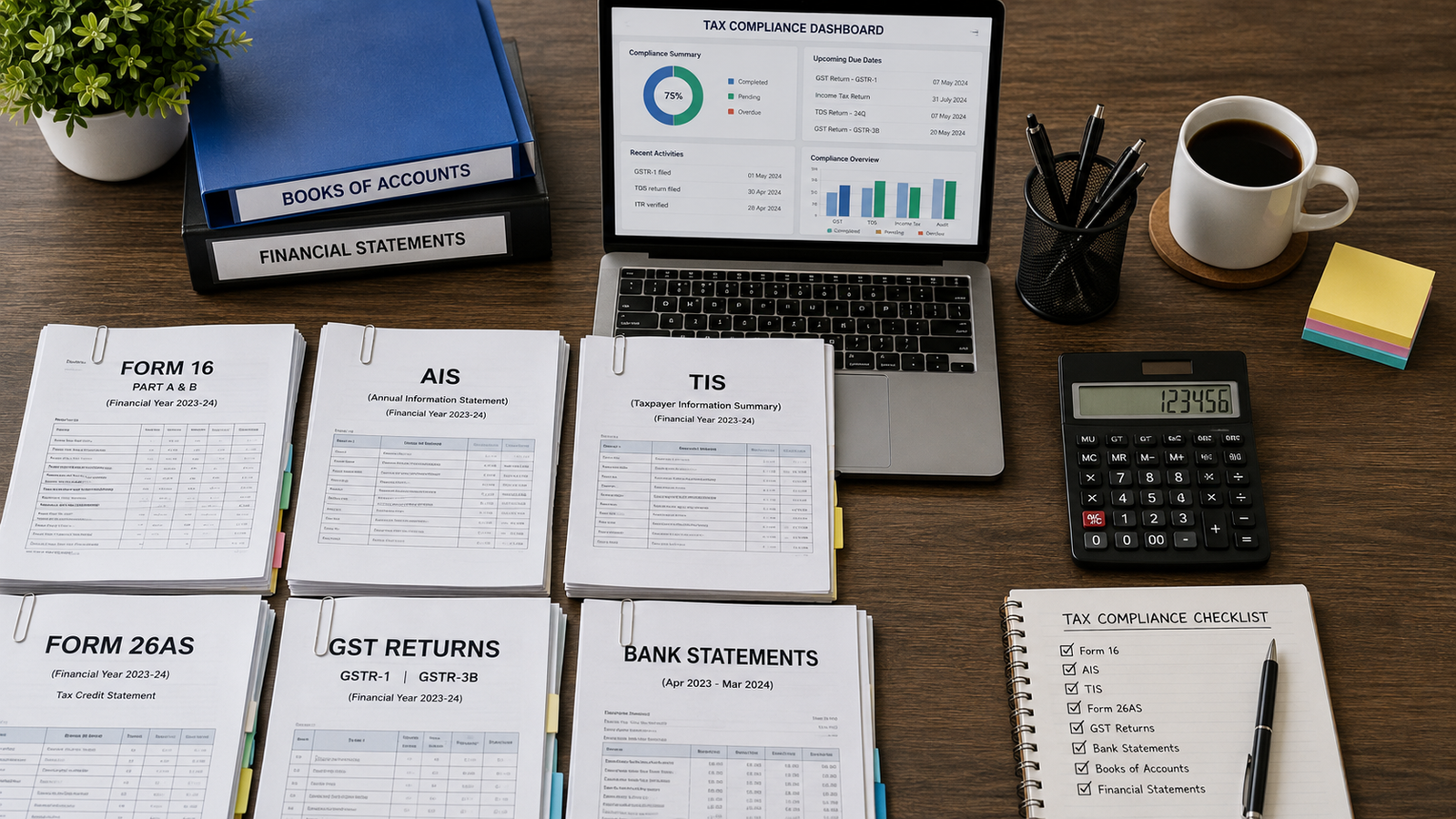
Illustration: Three Taxpayers, Three Different Income Tax Proceedings
The following examples demonstrate how assessment, reassessment, and scrutiny differ in practice. Although each involves communication from the Income Tax Department, the purpose, scope, and response required are different in every case.
Case 1 – Income Tax Assessment
A salaried taxpayer files an Income Tax Return claiming credit for Tax Deducted at Source (TDS). During the processing of the return, the Income Tax Department identifies a mismatch in the TDS credit claimed.
Upon reviewing Form 26AS, the taxpayer discovers that one TDS entry has not yet been reflected in the tax records.
In this situation, the matter relates to the normal assessment and return-processing stage rather than a scrutiny proceeding.
Case 2 – Income Tax Reassessment
A taxpayer sells an immovable property but does not report the resulting capital gains in the Income Tax Return.
Subsequently, the transaction is identified through information available with the Income Tax Department, and reassessment proceedings are initiated to examine whether any taxable income has escaped assessment.
The taxpayer should carefully review the reassessment notice and verify:
- The reasons recorded for reopening the assessment.
- The applicable limitation period.
- The transaction details and sale consideration.
- The computation of capital gains.
- Supporting documents and relevant evidence.
Case 3 – Income Tax Scrutiny
A Private Limited Company reports significant business expenditure, while variations are observed between its financial statements and GST records.
The return is selected for scrutiny so that the Income Tax Department can verify specific transactions and financial disclosures.
The company should be prepared to produce supporting documentation such as:
- Books of accounts
- General ledgers
- Purchase and sales invoices
- GST returns and reconciliation statements
- Bank statements
- Supporting agreements and other relevant records
These examples demonstrate that assessment, reassessment, and scrutiny are distinct proceedings. Understanding which process applies allows taxpayers to prepare the appropriate documentation, respond within the prescribed timelines, and address departmental queries more effectively.
What Should You Do Before Responding to an Income Tax Notice?
Receiving an income tax notice does not necessarily indicate a tax dispute. However, responding without understanding the nature of the notice or without adequate documentation can lead to unnecessary complications.
Before submitting any response, taxpayers should follow a systematic approach to ensure that all relevant information is verified and properly supported.
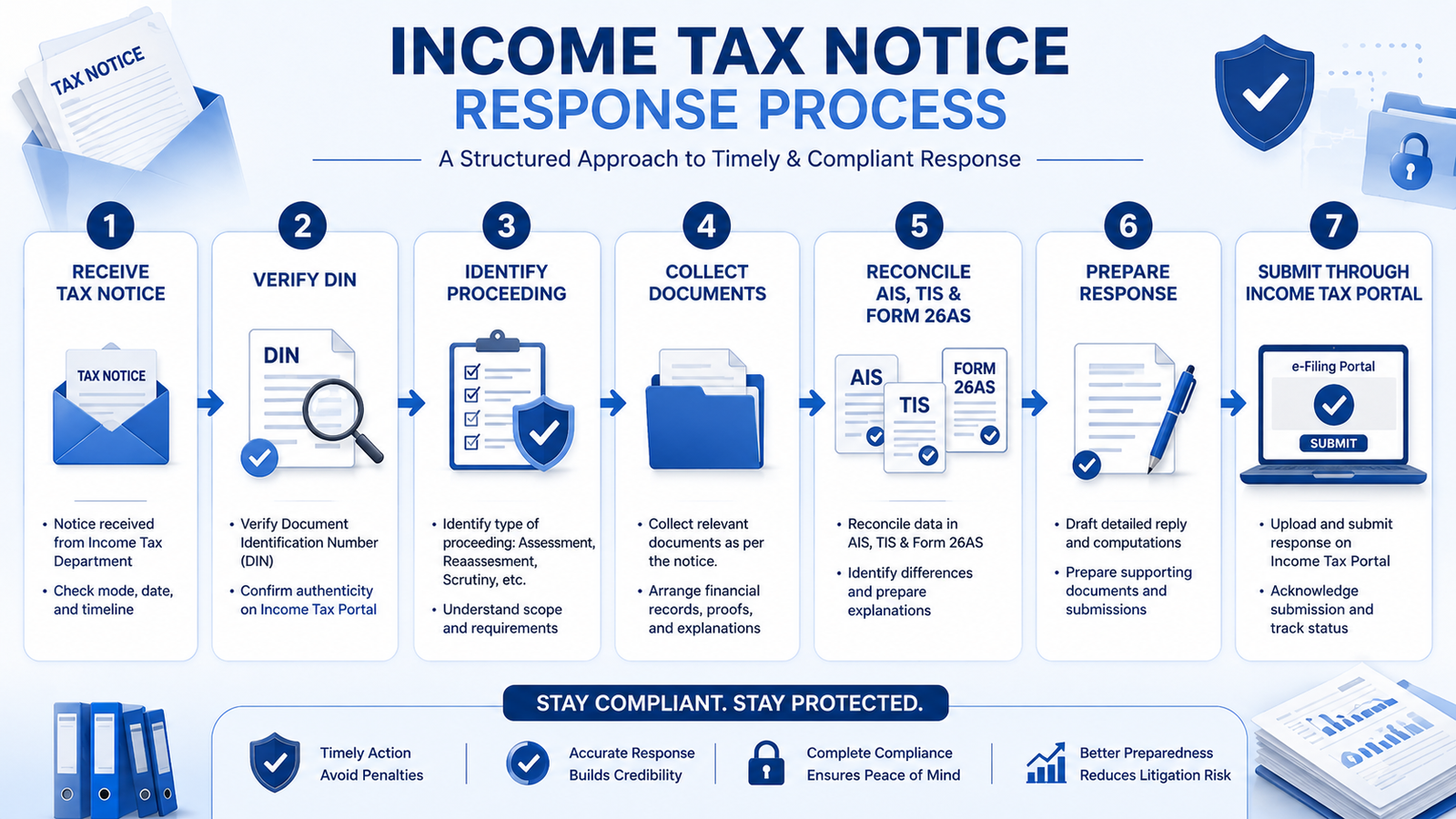
| Step | Recommended Action |
|---|---|
| Step 1 | Carefully read the notice and identify the section under which it has been issued, the relevant assessment year, the subject matter involved, the response deadline, and the documents or information requested by the Income Tax Department. |
| Step 2 | Verify the authenticity of the notice or order by validating the Document Identification Number (DIN) through the Income Tax e-filing portal. |
| Step 3 | Determine the nature of the proceeding. Identify whether the communication relates to a regular assessment, scrutiny, reassessment, or merely seeks additional information or clarification. |
| Step 4 | Collect all relevant supporting records, including the Income Tax Return, tax computation, AIS, TIS, Form 26AS, bank statements, GST returns (where applicable), invoices, agreements, books of accounts, and ledgers. |
| Step 5 | Prepare a point-wise response addressing every issue raised in the notice. Each explanation should be supported by reconciliations and appropriate documentary evidence rather than general or standard replies. |
| Step 6 | Consider obtaining professional advice where the matter involves reassessment proceedings, business scrutiny, high-value transactions, capital gains, GST-related mismatches, or company taxation matters requiring detailed legal or tax analysis. |
A well-prepared response is generally based on three elements: understanding the nature of the notice, gathering complete supporting documentation, and providing clear issue-wise explanations backed by documentary evidence. Taking these steps before replying can significantly improve the quality and effectiveness of the response.
How Professional Tax Reviews Can Help Before Assessment, Reassessment, or Scrutiny Proceedings
Responding to an income tax notice often requires much more than preparing a written explanation. It involves reviewing the applicable legal provisions, reconciling financial records, and ensuring that every claim is supported by appropriate documentary evidence.
For this reason, many taxpayers and businesses choose to obtain a professional tax review before responding to assessment, reassessment, or scrutiny proceedings. A structured review can help identify inconsistencies and address potential issues before a formal response is submitted to the Income Tax Department.
A professional review focuses not only on preparing a reply but also on verifying whether the underlying documentation, reconciliations, and legal position adequately support the taxpayer’s case.
A professional review may assist with:
- Determining the nature of the proceeding—assessment, reassessment, scrutiny, or information request.
- Reviewing statutory timelines and response requirements.
- Reconciling the Income Tax Return with the Annual Information Statement (AIS), Taxpayer Information Summary (TIS), and Form 26AS.
- Reconciling books of accounts with GST returns and other statutory records.
- Reviewing reassessment notices and validating the basis for reopening, wherever applicable.
- Identifying missing documents, incomplete reconciliations, or unsupported explanations before filing a response.
Professional advisory firms such as JackRabbit Consultants assist taxpayers by reviewing notices, verifying tax reconciliations, examining supporting documentation, evaluating compliance records, and helping prepare structured responses based on the issues raised by the Income Tax Department.
Such reviews can be particularly valuable for MSMEs, start-ups, LLPs, private limited companies, company directors, finance teams, and businesses managing large volumes of accounting, GST, and tax records across multiple reporting systems.
A well-prepared response supported by accurate reconciliations and complete documentation can help taxpayers address departmental queries more efficiently and reduce the likelihood of prolonged verification proceedings.
Before Responding to an Income Tax Notice or Departmental Correspondence…
Before preparing a response to any communication from the Income Tax Department, the first step is to identify the nature of the notice or correspondence. Different proceedings involve different legal requirements, documentation, and response strategies.
Whether the communication relates to an assessment, reassessment, scrutiny, or a request for information, understanding its purpose is essential before submitting any explanation or supporting documents.
The quality of an income tax response depends not only on the documents submitted but also on correctly identifying the nature of the proceeding before preparing the reply.
Before filing a response, taxpayers should generally:
- Identify whether the communication relates to an assessment, reassessment, scrutiny, or another type of proceeding.
- Verify the authenticity of the notice through the Document Identification Number (DIN), wherever applicable.
- Review the relevant legal provisions governing the notice.
- Collect all supporting documents, books of accounts, reconciliations, and financial records.
- Identify and reconcile any differences between the Income Tax Return, AIS, TIS, Form 26AS, GST records, bank statements, and books of accounts.
- Prepare a structured, issue-wise response supported by documentary evidence.
It is also important to recognize that different proceedings require different types of responses. For example, an information request or scrutiny proceeding may primarily require factual explanations and supporting documents, whereas a reassessment proceeding may also require careful consideration of the procedural and legal aspects governing the reopening of the assessment.
Many individuals and businesses choose to have income tax notices reviewed by professional advisers such as JackRabbit Consultants before submitting a response. Professional review can assist in evaluating the notice, verifying reconciliations, reviewing supporting documentation, and preparing a comprehensive response aligned with the applicable legal provisions.
A timely, well-documented, and carefully prepared response can help taxpayers address departmental queries more effectively while reducing the likelihood of avoidable delays during the assessment process.