

Founders don’t struggle to start businesses—they struggle to choose the right corporate structure.
The LLP vs Private Limited dilemma in India directly impacts taxation, compliance burden, and how investors perceive your business.
This is not just a legal choice—it is a financial and strategic decision that compounds over time.
Why This Decision Matters More Than You Think
Choosing the wrong structure can lead to long-term financial inefficiencies:
- 5–10% excess tax burden annually
- Higher ongoing compliance costs
- Difficulty in attracting investors
- Complexities during conversion
While conversion from LLP to Private Limited is possible, it involves documentation, valuation, and potential tax implications.
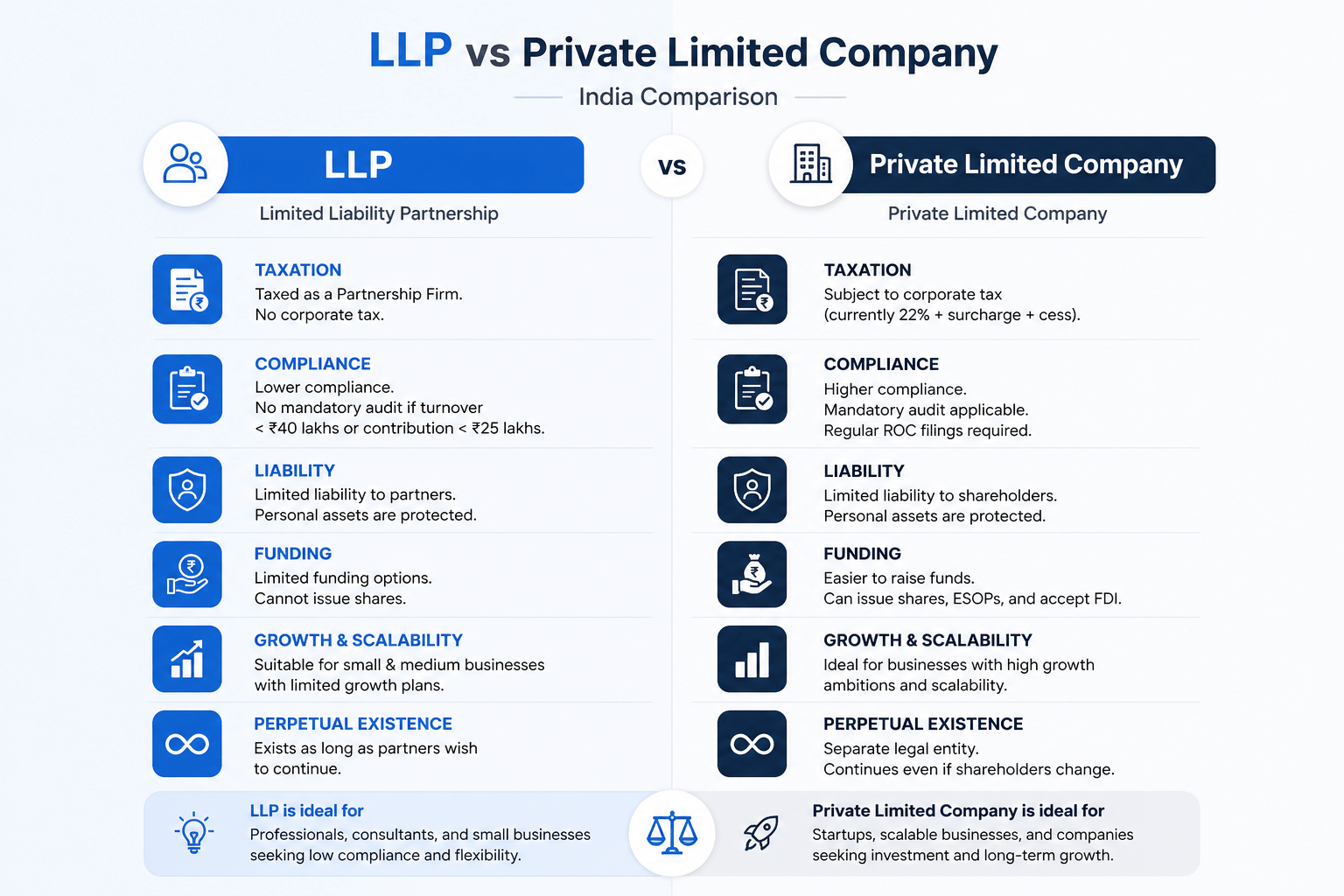
Summary Table: LLP vs Private Limited (2026)
| Parameter | LLP | Private Limited |
|---|---|---|
| Cost of Incorporation | ₹5k–₹15k | ₹10k–₹25k |
| Compliance Costs | Low | High |
| Taxes | ~30% flat | 22% (common regime) |
| Taxation of Dividends | Not applicable | Taxable in hands of shareholders |
| Audits | Only above threshold | Mandatory |
| Investment | Challenging | Easier |
| Ownership | Flexible | Well-defined |
| ESOPs | Not available | Available |
Real Cost Calculation (How Much Founders Actually Pay)
A. Initial Fee
- LLP: ₹5,000 – ₹15,000
- Private Limited: ₹10,000 – ₹25,000
The difference exists, but this is a one-time cost and not a major decision factor.
B. Compliance Fees per Year
| Entity Type | Key Requirements | Estimated Cost (Yearly) |
|---|---|---|
| Private Limited Company |
ROC Filings (AOC-4, MGT-7) Mandatory Audit Board Meetings CA/CS Fees |
₹30,000 – ₹1,00,000 |
| LLP |
Form 8 & Form 11 Filings Audit only if turnover exceeds ₹40L |
₹5,000 – ₹25,000 |
Observation: LLP may save ₹20k–₹50k annually in compliance costs. However, this difference is minor compared to potential tax advantages or disadvantages.
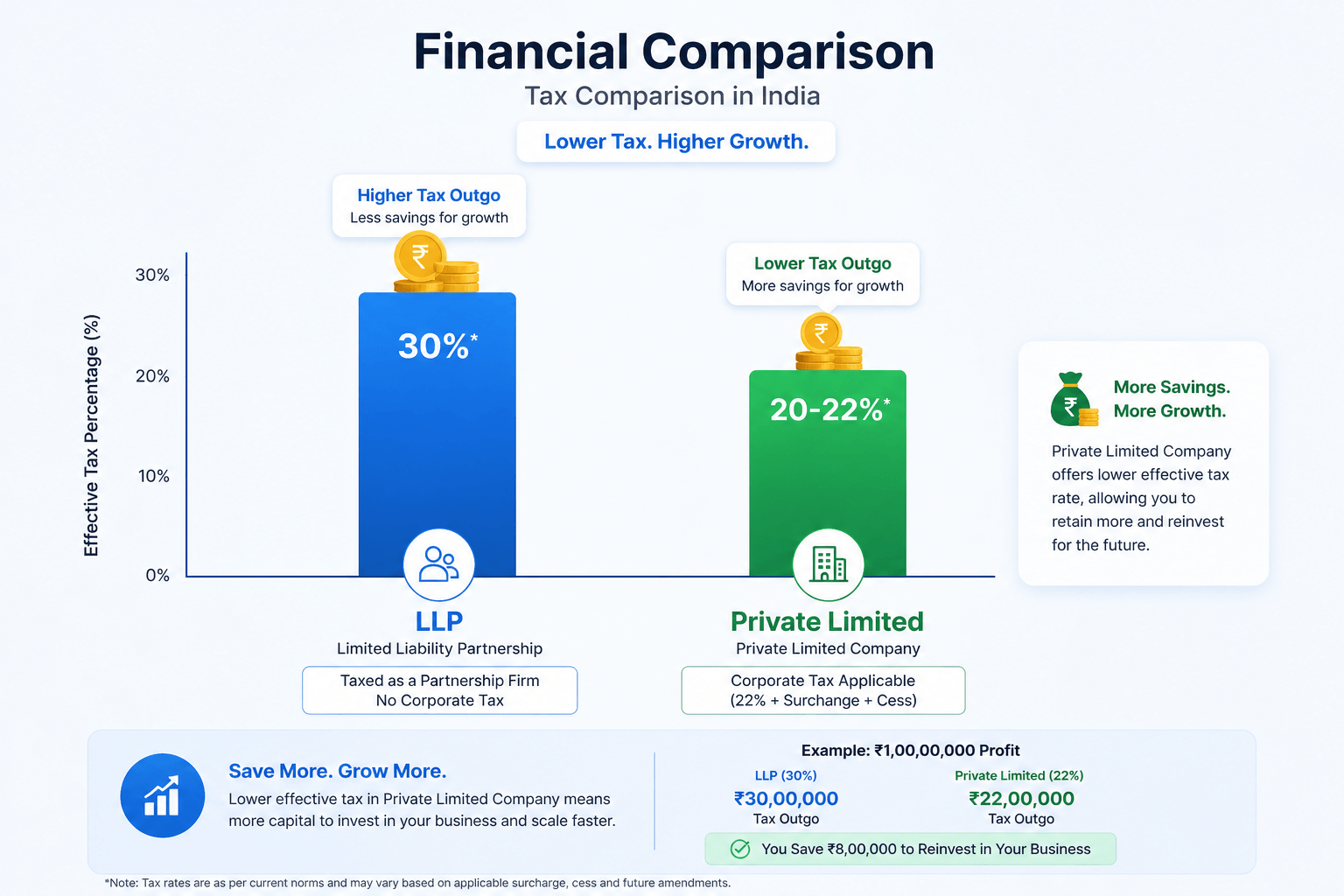
Tax Differences (Where Real Money Is Saved or Lost)
LLP Taxation
- Flat 30% tax
- Effective rate (including surcharge + cess): ~31–35%
- No dividend tax
Private Limited Taxation (FY 2026–27 Onwards)
No major structural changes. Companies can choose between two systems:
| Option | Tax Rate | Conditions |
|---|---|---|
| Regular Tax System |
25% (Turnover ≤ ₹400 Cr) 30% (Turnover > ₹400 Cr) |
Allows deductions and exemptions |
| Concessional Tax System (115BAA) | 22% |
No deductions/exemptions allowed MAT not applicable |
The concessional regime is the most widely used option, especially for startups.
Key Takeaway: A lower tax rate does not always mean lower total tax. However, in most startup scenarios:
LLP pays ~30–35%
Private Limited pays ~25% (concessional regime)
Difference: ~5–10% annually
Practical Example (Where It Really Matters)
If a startup earns ₹20 lakh annual profit:
- LLP Tax ≈ ₹6.5 – ₹7 lakh
- Private Limited Tax ≈ ₹5 lakh
Annual Saving: ₹1.5 – ₹2 lakh
Over 3 Years: ₹4.5 – ₹6 lakh
Funding & Scalability Reality (This is where things get interesting)
This is where most entrepreneurs make mistakes.
LLP Reality
- Unfavorable for investors
- No equity shareholding
- No ESOP structure
- Difficult to scale
Private Limited Reality
- Required for:
- Angel investment
- VC funding
- ESOP implementation
- Startup India benefits
If your goal is to build a scalable startup, Private Limited is not optional—it is necessary.
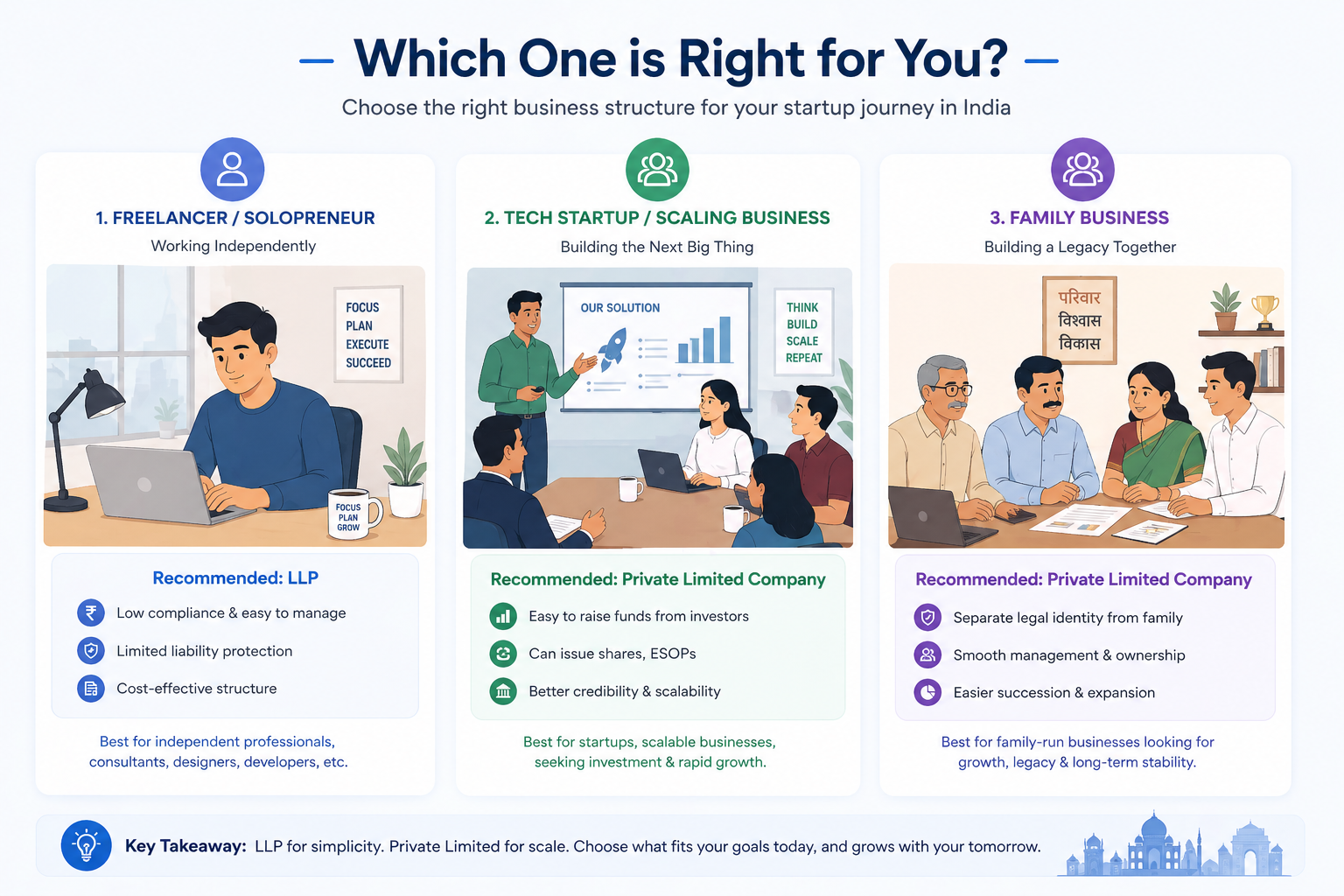
Real-world Use Case Examples
Example 1: Freelancer / Small Agency
- Solo founder or small partnership
- No funding requirement
- Stable income focus
Recommended: LLP
Example 2: Tech Startup Intending Funding
- SaaS / App / Product-based startup
- Seeking investors
- Aiming to scale rapidly
Recommended: Private Limited
Example 3: Family-Owned Business
- Small to moderate scale operations
- No external investment planned
- Profit distribution within family
Decision depends on:
• Simplicity → LLP
• Growth & expansion → Private Limited
Common Mistakes Founders Make
- Selecting LLP only to reduce initial costs
- Ignoring future fundraising requirements
- Lack of understanding of tax implications
- Copying decisions made by others
- Assuming conversion can be done easily later
Conditions When You Should Choose LLP
Choose LLP if:
- Your business is small or service-oriented
- No plans to raise funding
- Preference for low compliance burden
- Moderate profit expectations
Situations That Call for Private Limited
Choose Private Limited if:
- You are building a startup
- You plan to raise funding or scale operations
- Tax efficiency becomes important at higher profits
- ESOPs or venture capital funding is required
- You aim to build a long-term brand
Expert Analysis
In practice, founders often prioritize incorporation cost over long-term strategy.
However, the decision should be based on:
- Projected revenue growth (next 3–5 years)
- Funding requirements
- Profit expectations
- Operational complexity
Many startups overlook structured compliance planning. With proper advisory support from firms like JackRabbit Consultants, founders can align their company structure with long-term growth strategies.
The right company structure is not about saving money today—it is about enabling growth tomorrow.