

Executive Insight (Read it First)
It’s not that business owners fail to trademark their strong brands; it’s that they fail at the legal procedures involved in trademarking their strong brands.
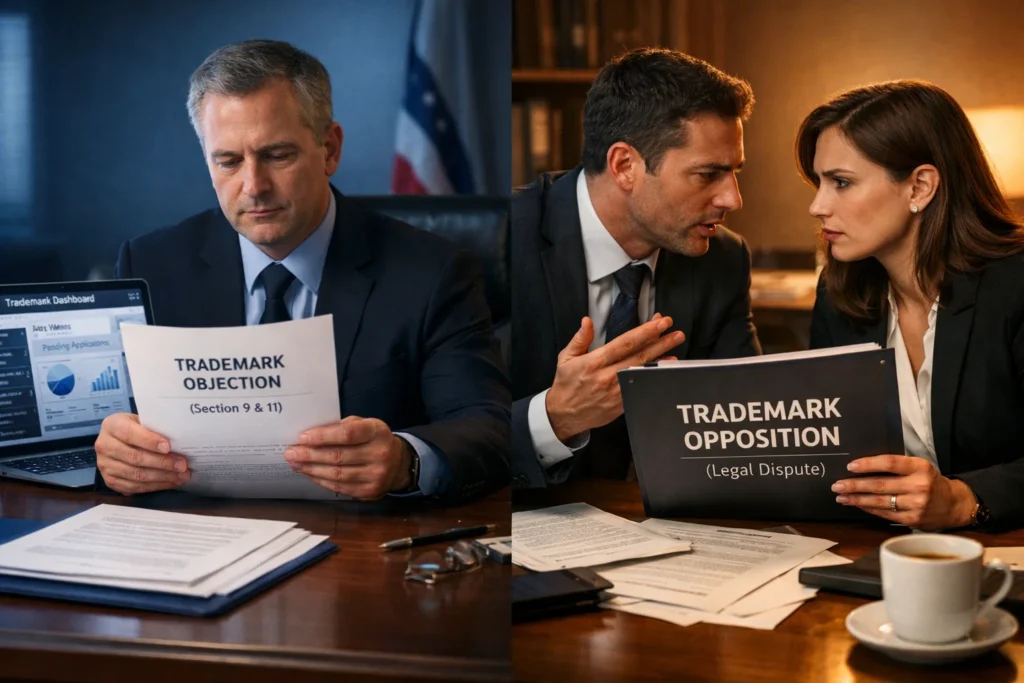
Misunderstanding the differences between trademark objection and trademark opposition is among the most costly errors that founders and startups commit. One concerns a procedural step at the registrar, the other involves a legal battle in the marketplace.
While there is no difference as far as the statute is concerned, objection and opposition differ widely when it comes to timing, procedures and other factors.
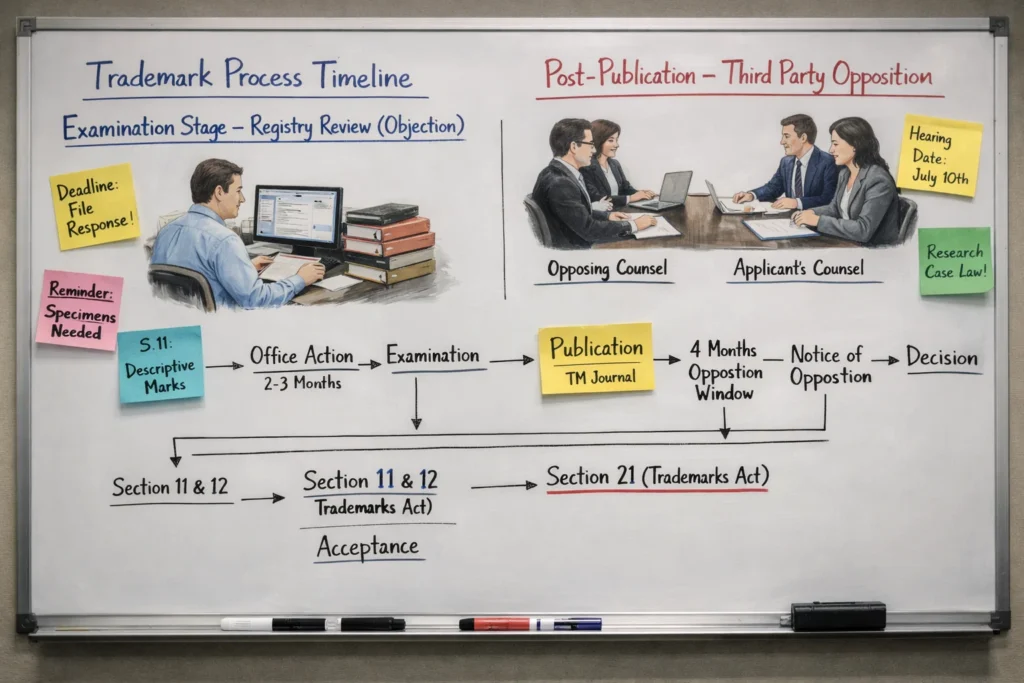
- Objection → Submitted by Registrar during examination process
- Opposition → Initiated by third-party applicant upon publication
Whereas the statutory scheme itself has not changed, the timeframes and procedures may depend on the Registry notices sent out, any extensions made, and the evolving Registrar practice (notably from digitisation efforts in 2025–2026). Failure to appreciate this crucial distinction affects the following:
- Ownership rights
- Access to investment funds
- Valuation in due diligence
- Multi-jurisdictional expansion
Trademark Objection vs Opposition: The Real Difference
Trademark Objection (Office Action)
The trademark objection is made by the Trademark Registry during the process of examination under:
- Section 9: Absolute grounds (distinctiveness, descriptiveness)
- Section 11: Relative grounds (conflict with prior marks).
Key Nature :
- Stage of administrative examination
- Is raised through an Examination Report
Important Clarification
An objection is not a refusal; rather, it is a request for explanation, correction, or clarification.
Trademark Opposition
The trademark opposition is initiated by a third party post-publication under:
- Section 21 of the Trade Marks Act, 1999
- Rules 42-51: Procedure
Key Nature :
- Legal dispute
- Is initiated by “any person”
It is a legal dispute that will definitely block registration.
Important Clarification
- Objection = Administrative review
- Opposition = Commercial challenge
Companies that confuse these two usually lose on both fronts.
2026 Legal Framework & Timelines (India + Global Context) :
India (2026 Practice)
Timeline may vary based on :
- Type of notice sent
- If there will be hearing
- Extension/condonation (not often granted)
- Tech problems or Registry circulars
Time period update in 2026 :
- The process of exam becomes more automated (faster objections filing)
- Strict compliance to deadlines leads to less condonation time period
- Greater caution when it comes to startup names in generics field
Time period for opposition
Important Notice
-
The time periods are generally strictly implemented but:
- There may be extensions available via prescribed forms
-
The time period may become delayed because of:
- Backlog at the Registry
- Scheduled hearing
Global Snapshot ( Important for Scaling Brands )
Why It Matters Financially
When your brand goes international:
- A refused trademark in one country could stall other international applications
- IP enforcement ability is now considered when investors evaluate companies

Where Businesses Mistake (Ground Reality)
Mistake #1: File without clearance search
Outcome:
- Sec 11 objection
- Imminent opposition from established brands
This is the easiest mistake to prevent.
Mistake #2: Consider opposition a mere formality
Companies file:
- General responses
- Lack of legal arguments
- Lack of any proof
Effect → Rejection or move to hearings
Mistake #3: Ignore the use of evidence strategy
By 2026, evidence will be compulsory.
Lack of:
- Invoice evidence
- Proof of website presence
- Evidence of social media usage
- Evidence of market recognition
Undermines both objection response and opposition defense.
Mistake #4: Procedural Mistakes
- Lack of counterstatement = automatic dismissal
- Lack of proof = case failure
This is a process issue—not a complicated legal issue.
Mistake #5: Underestimate the Opposition
The opposition is often:
- Strategically filed by competing businesses
- To delay fundraising or product launch
- To make your compliance costs higher
Trademark Objection Response Methodology (Professionals)
A. Section 9 (Absolute Grounds)
Issue:
The mark is descriptive/generic
Remedies:
- Establish secondary meaning
-
Provide the following:
- Sales figures
- Marketing activities
- Recognition by consumers
Argument:
“The mark has obtained secondary meaning due to continuous commercial use.”
B. Section 11 (Relative Grounds)
Issue:
Likeness to an established mark
Argument Structure:
- Visual dissimilarity
- Phonological dissimilarity
- Conceptual dissimilarity
Additional Proof Required:
- Belonging to different industry/class
- Different consumer demographics
C. Strategic Improvement Tactics (2026 Outlook)
- Include user’s affidavit
- State prior use with specific date
- Use comparative tables (very powerful in hearings)
Possible Scenarios
- Granted → Publication
- Hearing → Defense needed
- Rejected → Re-filing/appellate process
Trademark Opposition Response Protocol (Expert-Level)
Step 1: Counter-Statement (Crucial)
Should contain:
- Negative denial of all claims
- Ownership
- Previous usage (where applicable)
Poor wording here makes the whole case ineffective.
Step 2: Evidence Accumulation
Valid Evidence Includes:
- Income statements
- Advertising expenses
- Consumer database
- Domains owned
Step 3: Legal Positioning
Should concentrate on:
- No chance of consumer confusion
- Divergent trade routes
- Target different customer groups
Step 4: Hearing Strategy (2026 Perspective)
Trademark opposition hearings are increasingly:
- More structured
- More argument-oriented
- Unfavorable to poorly prepared submissions
Step 5: Out-of-Court Resolution
In most situations:
- Mutual coexistence
- Constrain specification
Substantially lowers litigation costs
Financial and Business Impacts (Underestimated Element)
Cost Implications
Investor Analysis (2026)
What investors look at:
- Trademarks registration
- On-going conflicts
- Ownership clarity
An active opposition case:
- Takes time
- Lowers valuation
- Highlights compliance issues
Hidden Cost
Consequences of a refusal:
- New website design
- Redesign marketing
- SEO gone down the drain
Usually costs more than dealing with the issue legally.
Strategy (Beyond Compliance)
The trademark strategy in fast-growing markets goes hand-in-hand with business strategy.
Includes such elements as:
- Pre-filing risk assessment
- Governance mapping
- Defensive filing
- Brand architecture strategy
Advisory firms that offer their services in structured environments, like those of Jackrabbit Consultants, will consider trademarks purely financial assets.
Decision-making Model (What You Have to Do)

Final Thoughts (2026)
- Objection is recoverable – if dealt with properly
- Opposition is an adversary process – should be approached as such
- The deadlines are strict and rigidly observed
- It’s the evidence that counts
- Trademarks are your business asset
Closing Perspective
For trademark law in the year 2026, companies that undervalue their importance create:
- Legal difficulties
- Inefficient use of money
- Vulnerability for brands
Those companies that have respect for their importance establish:
- Better financial value
- Solid investor relations
- Stability