


In the year 2026, the TDS compliance in India has become a vital aspect of the financial governance and tax administration system in the country. With the increasing level of digitization, the Income Tax Department has started monitoring the tax deductions, filings, and payments in real-time.
Moreover, the compliance monitoring has also become more advanced in the year 2026, as the Income Tax Department has started incorporating the PAN validation, AIS/TIS integration, and system-based reconciliation checks with effect from 1st April 2026, making the TDS compliance even more crucial.
As per the Income Tax Act, 1961, the Tax Deducted at Source (TDS) ensures that the tax amount is collected at the point of income generation. Businesses, professionals, and organizations that make specified payments are required to deduct the TDS amount and deposit it with the government.
What is TDS?
TDS stands for tax deducted at the time of making certain payments like:
- Salary payments
- Professional fee payment
- Rent payment
- Contractor payment
- Payment of interest
Here, tax is collected in advance instead of paying tax at a later date. The deductor collects tax in advance on behalf of the government.
From 1 April 2026, TDS transactions are increasingly being monitored through system-based financial reporting, where even minor discrepancies are easily traceable.
Legal Framework Governing TDS
TDS is governed by various sections of the Income Tax Act, 1961. These include the following:
| Section | Nature Of Payment |
| 392(1-6) | Salary |
| 6(i) | Contractor Payments |
| 6(iii)(b) | Professional Fees |
| 1(ii) | Commission |
| 2(i) | Rent |
| 5(iii) | Interest (Non- banking) |
Each of the above sections has the following information:
- Applicability of the rate
- Threshold Limit
- Compliance
With the introduction of system-level validation from 1st April 2026, it is easy to identify the incorrect mapping of sections.
TDS Rates in India (2026- Overview)
Here is a simple overview of the TDS rates that are usually applied:
| Section | Payment Type | Threshold | TDS Rate |
| 392(1-6) | Salary | Basic exemption | Slab Rate |
| 6(i) | Contractor | 30,000/1,00,000 | 1%/2% |
| 6(iii)(b) | Professional Services | 30,000 | 10% |
| 1(ii) | Commission | 15,000 | 5% |
| 2(i) | Rent | 2,40,000 | 10% |
| 5(ii) | Interest | 40,000 | 10% |
Note that the TDS Rates may differ in the following cases:
- Non PAN cases
- Non-residents
- Notifications
- Non-filing of returns under Section 206AB
In the upcoming year of 1st April 2026, systems will automatically identify incorrect TDS Rates while processing the returns. In such cases, it is always best to consult experts like JackRabbit – the best financial consultants in Gurugram.
TDS Due Dates (Compliance – Calender)
1. TDS Payment Due Dates
| Month of Deduction | Due Date |
| April – February | 7th of Next Month |
| March | 30th April |
From 1 April 2026, delays will be auto-tracked by compliance systems.
2. TDS Return Filing Due Dates
| Quarter | Period | Due Date |
| Q1 | Apr-Jun | 31st July , 2025 |
| Q2 | Jul-Sep | 31st October , 2025 |
| Q3 | Oct-Dec | 31st January , 2026 |
| Q4 | Jan-Mar | 31st May , 2026 |
From 1 April 2026, Enhanced Validation is applicable.
3. TDS Certificate (Form 16 / 16A)
| Type | Due Date |
| Form 16(Salary) | By 15th June |
| Form 16A | 15 days from Filing Return |
Must strictly match data in TRACES (Important from 1 April 2026).
TDS Returns: Forms and Applicability
| Form | Purpose |
| 24Q | Salary TDS |
| 26Q | Non – Salary TDS |
| 27Q | Non – Resident Payments |
| 27EQ | TCS Returns |
From 1 April 2026:
- PAN will be strictly validated
- Challan will be matched
- Errors in Return will be detected instantly
It is very important to file correct return form.

Step-by-Step TDS Compliance Process
Step 1: Identify Applicable Transactions
Businesses must identify transactions where TDS is applicable based on nature and threshold values
AIS helps detect missed transactions from 1st April 2026.
Step 2: Deduct TDS at Correct Rate
Ensure that:
- The correct section is applied.
- The correct rate is applied.
- The availability of PAN is ensured.
Step 3: Deposit TDS with Government
The TDS amount is deposited within due dates using a challan.
From 1st April 2026, challans will be auto-linked with returns.
Step 4: File TDS Returns
Quarterly filing of TDS returns with correct information:
- PAN of deductees
- Amount paid
- Tax deducted
Step 5: Issue TDS Certificates
Issue Form 16/16A to deductees.
Step 6: Reconciliation and Verification
Reconcile:
- Books of accounts with TDS returns
- Challans with TDS returns
- Form 26Q with Form 26AS
JackRabbit is a financial consultancy service located in Gurugram that helps businesses with TDS reconciliation.
Common TDS Defaults in 2026
In 2026, TDS defaults are no longer restricted to basic defaults. Thanks to AIS, PAN-based tracking, and reconciliation statements, even minor defaults are captured by the Income Tax Department.
With effect from 1st April 2026, this monitoring is even more stringent and completely automated.
1. Non-Deduction of TDS
The default occurs when TDS is not deducted on payments where TDS is legally applicable.
Example:
- professional fee payments without application of section 194J
- contractor payments without deduction of TDS under section 194C
- rent payments without deduction of TDS under section 194I
With effect from 1st April 2026, such instances will be captured using AIS and financial statement systems.
Impact:
- The entire expenditure may not be allowed under section 40(a)(ia)
- Interest under section 201
- Scanning for scrutiny notices
Many such organizations consult experts like JackRabbit – financial consultants in Gurugram to plan their transactions correctly.
2. Short Deduction
Short deduction occurs when TDS is deducted but at a lower rate than applicable.
Reasons for short deduction:
- wrong section applied (e.g., section 194C when it is section 194J)
- failure to apply higher rates for non-PAN recipients under section 206AA
- failure to account for surcharge/cess in certain cases
Such errors are quickly identified by automated validation systems with effect from 1st April 2026.
Impact:
- differential tax demand
- interest at 1% per month
- mismatch in form 26AS resulting in complaints by deductee
3. Late Deposit of TDS
TDS deducted but not deposited in due dates is one of the most tracked defaults.
Example:
- TDS deducted in May but deposited after 7th June
Such delay in the tracking of TDS will be completely automated with effect from 1st April 2026.
Impact:
- interest @ 1.5% per month
- penalty risk
- negative compliance rating in system tracking
4. Late Filing of Returns
TDS deducted, but return not filed within due date.
Impact:
- late fees under Section 234E
- penalties under Section 271H
- system-generated notices
5. Incorrect PAN Details
PAN errors are a major cause of mismatches in 2026.
Common errors:
- invalid PAN
- mismatch in name and PAN
- incorrect tagging of deductee
PAN validation is stricter from 1 April 2026. Errors are flagged immediately.
Impact:
- TDS not reflected in deductee’s Form 26AS
- notices for mismatch
- revised returns
6. Mismatch with Form 26AS / AIS
With the advent of advanced reporting systems, TDS information is cross-verified on multiple platforms.
Mismatch occurs for:
- incorrect information in returns
- non-linking of challans
- incorrect information on amount
Starting from 1 April 2026, AIS plays a crucial role in mismatch identification.
Impact:
- Systemically generated notices
- Reconciliations
- Audit issues
7. Wrong TDS Section Mapping
Inaccurate sections are a very common issue in TDS returns, and this is a serious problem.
Example:
- Considering professional services as contract payments
- Applying lower rates due to incorrect classification
Starting from 1 April 2026, incorrect classification is easily identified.
Impact:
- Short deduction
- Compliance notices
- Re-work in returns
8. Failure to Issue TDS Certificates
There may be a failure in the timely issue of the Form 16 / 16A.
From 1 April 2026, it will be monitored through TRACES.
Impact:
- deductee dissatisfaction
- compliance complaints
- possible penalties
Consequences of TDS Non-Compliance
Interest (Section 201)
| Type | Rate |
| Non – deduction | 1% per month |
| Late payment | 1.5 % per month |
Late Filing Fee (Section 234E)
₹200 per day (subject to TDS amount)
Penalty (Section 271H)
₹10,000 to ₹1,00,000
Disallowance (Section 40(a)(ia))
Expense may be disallowed in income tax computation.
From 1 April 2026, penalties are increasingly system-driven and automatically triggered.
TDS and Departmental Monitoring (2026 Trend)
In the year 2026, the monitoring of compliance is carried out through the following factors:
- AIS (Annual Information Statement)
- TIS (Taxpayer Information Summary)
- PAN
- System
Even small errors can result in notices being sent out. With the integration of systems becoming more comprehensive from 1st April 2026, compliance has become more transparent and traceable.
Organizations are now using structured compliance systems with the help of professionals such as JackRabbit – financial consultants in Gurugram.
Best Practices for TDS Compliance
In 2026, TDS compliance in India is no longer about manual tracking. It is about a process-driven and system-supported approach. These are the best practices that can help businesses comply with TDS regulations:
1. Monthly TDS Review System
Instead of quarterly TDS reviews, it is recommended that TDS is reviewed:
- While booking expenses
- While processing payments
- While closing accounts
The benefits of this practice are:
- No transaction is missed
- Correct section is applied
- TDS compliance is in real time
2. Proper Section Mapping Framework
Develop an internal TDS applicability matrix:
Nature of Expenses | Section | Rate | Threshold
The benefits of this practice are:
- Avoids confusion
- Standardizes deduction
- Reduces dependency on manual judgment
For such frameworks, organizations like JackRabbit – financial consultants in Gurugram can help.
3. Automation of TDS Processes
There is a risk of errors when tracking manually.
What businesses should do:
- Integrate TDS with ERP/accounting systems
- Auto-apply TDS on vendor category
- Auto-generate reports
Benefits:
- Eliminate errors
- Improve efficiency
- Ensure consistency
4. Vendor Compliance Monitoring
With IT systems in place for vendor-level compliance:
What businesses should do:
- Verify PAN for vendors before transacting
- Track vendor returns
- Track high-risk vendors
This is important to avoid:
- Discrepancies
- Disallowed expenses
- Compliance issues
5. Timely Deposit and Filing Discipline
Develop internal timelines:
- deduction -> immediate recording
- deposit -> before due date
- return filing -> well before due date
Prevents:
- interest
- penalty
- last-minute errors
6. Regular Reconciliation
Regularly reconcile:
- books of accounts and TDS returns
- challans and deductions
- Form 26Q and Form 26AS/AIS
Guarantees:
- accuracy
- errors are detected
- audit trail is clean
7.PAN and Data Validation Discipline
Before filing returns, ensure:
- PAN is validated by system tools
- deductee information is verified
- duplicate entries are eliminated
Prevents :
- rejection of returns
- mismatch issues
8. Documentation and Audit Trail Discipline
Maintain proper documentation:
- invoices
- deduction workings
- challans
- return copies
Essential for :
- audit purposes
- departmental inquiries
- internal verification
9. Periodic Compliance Health Check
Businesses should undertake:
- quarterly internal reviews
- annual compliance audits
- risk assessment of TDS processes
Many growing businesses seek professional help from financial consultants in Gurugram, like JackRabbit, to ensure that all these best practices are in place
10. Training and Internal Awareness
To ensure that:
- the accounts team is aware of the TDS sections
- changes in the law are tracked
- errors are minimized through awareness
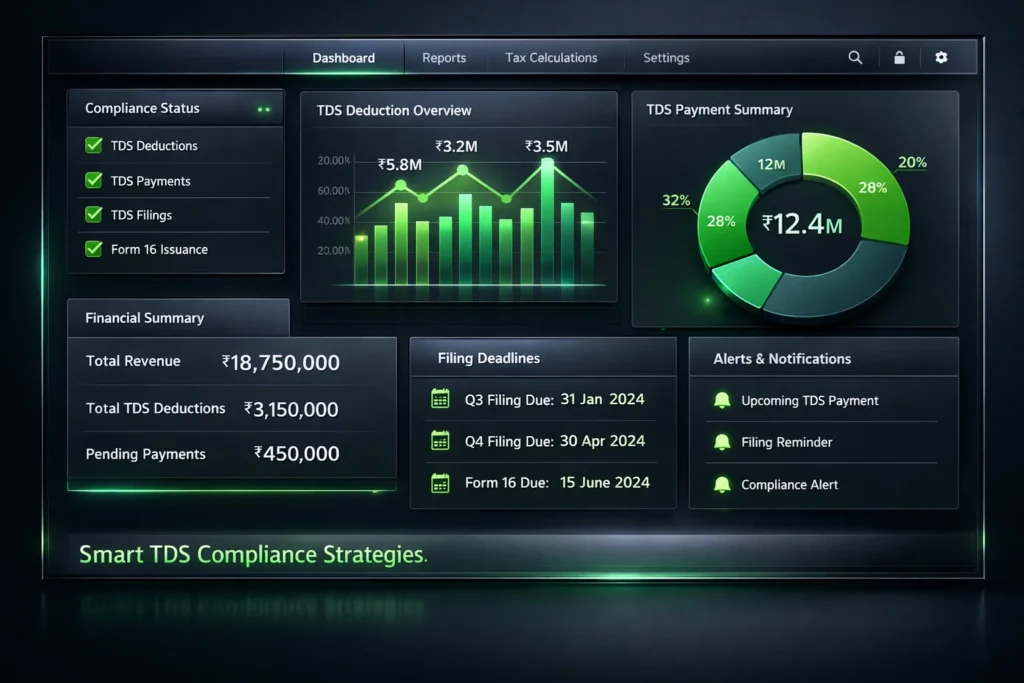
Role of Financial Consultants in TDS Compliance
TDS compliance now entails:
- Legal Interpretation
- Process Control
- System Integration
- Continuous Monitoring
Professional firms like JackRabbit – financial consultants in Gurugram assist in TDS compliance in India by performing the following functions for businesses:
- TDS applicability analysis
- Validation of TDS rates
- TDS return filing
- Reconciliations
- TDS notices
From 1st April 2026, they would also assist in the alignment of AIS/TIS and system compliance.
Conclusion
TDS compliance in India in 2026 is not simply an accounting process but has become a vital task with the introduction of strict timelines and provisions in the Income Tax Act.
It is imperative that the process is carried out in the correct manner through a structured approach to avoid any issues and ensure smooth business operations.
Businesses that are able to manage the TDS compliance process well, either through in-house operations or through the support of professional firms like JackRabbit – financial consultants in Gurugram, can minimize the risk and run the business in an efficient manner in the data-driven environment of TDS compliance.