

The role of the Chief Financial Officers (CFOs) has dramatically changed over the last ten years. Finance professionals are not just limited to keeping records or ensuring compliance with laws.
Today’s CFOs are expected to provide strategic financial insights, risk analysis, and forward-looking financial planning to enhance business growth.
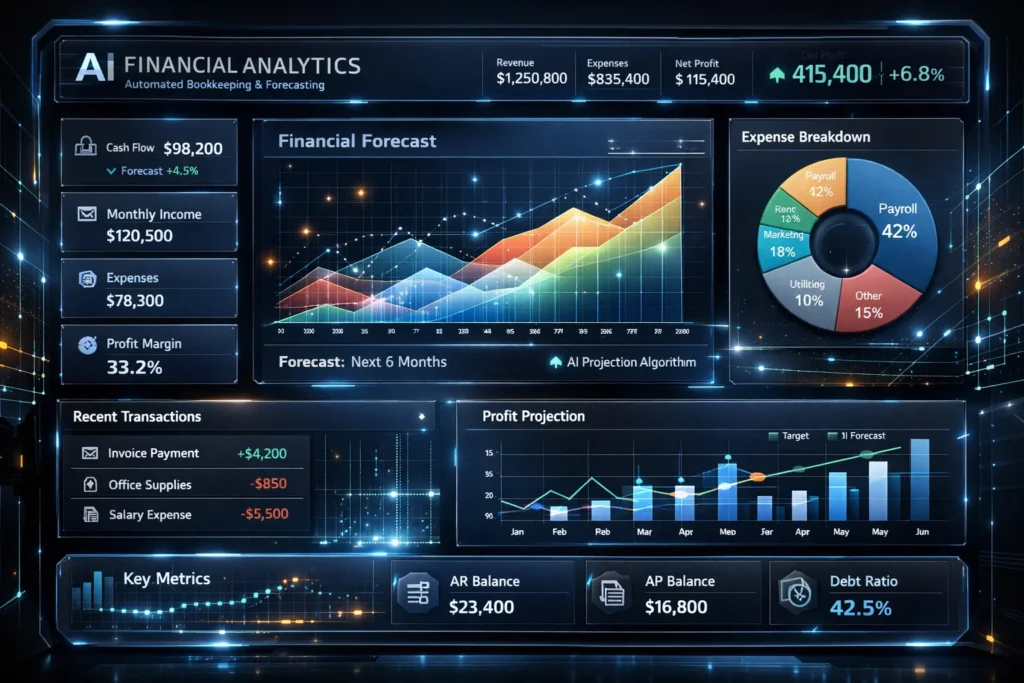
In recent years, with the advancement of artificial intelligence (AI) technology and data analytics tools, organizations are increasingly adopting AI tools to automate accounting processes and improve accuracy.
In addition, by 2026, the use of AI technology for finance functions such as automated bookkeeping, real-time financial analysis, forecasting, fraud detection, and financial risk analysis will be on the rise.
For technology companies or high-growth businesses that produce high volumes of financial transactions, finance professionals can use AI technology to improve efficiency and reduce the time spent on bookkeeping activities. However, finance professionals need to plan and implement AI technology for financial management with accuracy and compliance.
This article will discuss the use of AI technology for finance operations, CFOs’ ability to use AI to automate bookkeeping and forecasting activities, and the factors to be considered for implementing AI technology for financial management.
The Expanding Role of CFOs in Data-Driven Finance
The role of CFOs is not limited to traditional financial reporting and accounting practices. Organizations increasingly look for CFOs to provide insights that can be used in making long-term strategic decisions.
AI technologies enable finance teams to process large amounts of data and identify patterns that could be difficult to achieve through manual analysis. For instance, AI technologies can analyze historical financial performance, operational performance, and market trends to enable finance teams to make more informed decisions in the process of financial planning.
The new era of data-driven finance is particularly beneficial for technology firms, SaaS businesses, and startups with complex revenue models and customer acquisition costs that need continuous monitoring.
Professional advisory firms specializing in the financial needs of technology businesses can assist finance teams in developing structured financial systems with the integration of AI technologies while ensuring compliance with accounting standards and regulatory reporting needs.
For example, professional financial consultant firms such as JackRabbit – financial consultants in Gurugram – can assist businesses with the implementation of financial reporting frameworks and the integration of AI technologies in bookkeeping and financial management.
Understanding AI in Financial Operations
Artificial Intelligence in financial operations refers to the application of machine learning algorithms, automation tools, and predictive analytics systems to execute financial analysis operations that earlier required manual financial analysis.
The application of these tools helps process large amounts of financial data, identify patterns, and generate insights that help in financial decision-making.
The application of artificial intelligence in financial operations includes:
- Automatic classification of financial transactions
- Automatic processing of invoices
- Predictive financial analysis for cash flow management
- Automatic fraud detection
- Financial forecasting
- Budgeting automation
Artificial Intelligence in financial operations is not an alternative for financial standards and financial governance practices. Rather, it helps financial teams reduce manual effort and improve the speed and accuracy of financial analysis.
For any organization that plans to apply artificial intelligence in financial operations, it is still necessary to adhere to financial standards such as International Financial Reporting Standards (IFRS) or Indian Accounting Standards (Ind AS).
Automating Bookkeeping with AI
One of the most time-consuming activities within financial management is bookkeeping. Traditional accounting practices involve the recording of transactions, categorization of expenses, reconciliation of bank accounts, and verification of financial records.
AI-based bookkeeping systems can help to automate these activities to a certain extent.
Transaction Categorization
AI tools can be used to categorize transactions based on patterns obtained from bank records, vendor records, and accounting records. This eliminates the need to manually categorize transactions or expenses.
Invoice and Expense Processing
Machine learning tools can be used to read invoices and expense receipts with the help of optical character recognition (OCR) technology and automatically process these transactions.
Bank Reconciliation
AI tools can be used to compare transactions with the accounting records and detect discrepancies for further analysis.
Error Detection
The automated system would also enable the detection of unusual transactions, repeated payments, and inconsistencies, which could point to errors or financial misconduct.
However, companies would still need to ensure the presence of internal controls to guarantee the integrity of their financial reports.
Finance advisors for technology companies would often be involved in the implementation of automated bookkeeping systems, incorporating enterprise resource planning, financial accounting systems, and banking systems.
Financial consultants, such as JackRabbit – financial consultants in Gurugram, would aid companies in the implementation of a structured financial reporting system.

AI Driven Financial Forecasting
Financial forecasting is a key responsibility of the CFO, especially for companies operating in industries where revenue generation trends vary according to the growth of customers, the market, and the business operations of the company.
Financial forecasting using traditional techniques often involves the use of spreadsheet software and historical financial data. However, these traditional techniques might not effectively handle the ever-changing nature of business operations and the market.
Examples of financial forecasting models:
- Revenue forecasting using customer acquisition trends
- Cash flow forecasting using payment and expense trends
- Demand forecasting for companies operating in the inventory business
- Cost forecasting using business operations data
Machine learning would enable the continuous update of financial forecasts as new data becomes available, thus enabling finance teams to maintain accurate financial forecasts
However, financial forecasting systems using AI must be used as a guide for the CFO to make financial decisions, and the CFO must ensure the financial forecasts align with the business strategy.

Integrating AI with Existing Financial Systems
For the successful adoption of AI systems in finance, it is important to integrate these systems with existing financial systems.
Most firms use accounting systems, ERP systems, payroll systems, and banking systems to manage their financial systems. It is important to integrate AI systems with these systems to allow for proper flow.
Integrating AI with existing systems involves the following steps:
- Integrating accounting systems with AI systems to allow for proper analysis.
- Integrating banking systems to allow for proper tracking of finance.
- Integrating operations to allow for proper forecasting.
- Integrating data governance to allow for proper reporting.
Integrating AI with existing systems requires proper coordination with finance teams, IT teams, and external advisors to allow for proper automation of systems with existing finance systems.
For firms adopting AI systems, it has been noted that they often require the services of external advisors to determine the proper technology to use, ensuring that finance systems are not compromised.
Data Governance and Compliance Considerations
Financial efficiency is one area where the application of AI is useful. However, the financial automation tools used should comply with the relevant financial regulations and governance.
Some of the key considerations include:
- Data accuracy and integrity
- Financial audit trails
- Compliance with accounting standards
- Protection of sensitive financial information
- Transparency of financial reporting
Regulatory and audit bodies expect companies to maintain transparent financial process documentation, even if financial automation tools are used.
Organizations that use AI-based financial tools should have governance mechanisms that clearly define the process of financial data collection, processing, and validation.
Financial consulting firms assist businesses that use financial management tools. These firms, such as JackRabbit – financial consultants Gurugram, help businesses implement financial tools that maintain accurate financial reporting structures
Challenges in Implementing AI in Finance
Though there are various benefits of using AI, organizations may still face challenges in implementing AI in financial operations.
The challenges that organizations may face in implementing AI in financial operations are:
- Poor quality of financial data
- Integration problems with existing financial accounting software
- Lack of technical expertise
- Governance and audit risks
- Operational resistance
To overcome these challenges, organizations need to develop an effective implementation plan in association with financial professionals, technical experts, and financial advisory experts.
Professional financial advisors often help organizations in evaluating the strategies for automation and ensure that the implementation of AI in financial operations is in compliance with operational needs.
The Future of AI in Corporate Finance
By 2026, the use of AI is likely to spread further in the field of finance as more businesses look for more efficient ways of managing their financial information.
Today, more finance leaders are embracing the use of automation technologies to help them improve their financial management.
However, the success of AI technologies relies on the quality of financial information, governance, and oversight from qualified finance professionals.
Today, many growing businesses use financial management practices that incorporate the use of AI technologies. In this case, many growing businesses hire financial advisors who understand the regulations and the use of financial technologies.
Companies like JackRabbit – financial consultants in Gurugram – help technology businesses and growing businesses design their financial management practices while ensuring that they comply with the regulations. Growing businesses often use financial management practices that incorporate the use of financial technologies to help them grow.

Conclusion
Artificial intelligence is slowly changing how finance teams manage accounting activities, financial reporting, and strategic planning. For CFOs, it presents an opportunity to simplify tasks, improve financial visibility, and enhance predictive abilities.
For AI to be implemented in finance teams, it is not just about adopting new technology. There is a need to ensure that financial information being used is accurate, internal controls are maintained, and financial information is being reported in a way that complies with relevant laws and accounting standards.
This will ensure that automation improves financial decision-making in an organization that is growing rapidly.
For this reason, there are financial planners who are aware of new financial technologies and relevant laws.
There are professional advisory firms that assist businesses in designing finance teams that are scalable, implementing bookkeeping automation systems, and improving financial planning systems to enable a business to adapt to changes in finance in a data-driven business environment. Such firms include JackRabbit – financial consultants in Gurugram.
Disclaimer: This article is for informational purposes only and does not constitute legal, financial, or professional advice. Businesses should consult qualified professionals before implementing financial automation systems or adopting AI-based financial management solutions.