


The process of tax compliance for businesses and professionals in India is governed by several specific statutory requirements under the Income Tax Act, 1961. However, for all eligible businesses and professionals in India, one of the most important tax compliance requirements is the tax audit requirement under Section 44AB of the Act.
The process of tax audit is an essential requirement for ensuring that all financial records are maintained in an appropriate manner and that all applicable provisions of law in relation to computing taxable income are complied with. So we have provided tax audit checklist 2026 for businesses and professionals whose financial year pertains to Assessment Year 2026-27, a critical evaluation of their turnover or receipts is required to check if they exceed a specific limit for a mandatory tax audit.
The present article is a guide to the limits for tax audit applicability, deadlines, penalties, and a Tax Audit Checklist for 2026.
Businesses often seek professional assistance to evaluate tax audit applicability and maintain compliance with statutory requirements. Financial advisory firms such as JackRabbit, financial consultants in Gurugram, assist businesses in reviewing turnover thresholds, organising accounting records, and preparing documentation required under Section 44AB.
Businesses that have recently completed the startup registration process in India should also review their tax compliance obligations, including turnover thresholds for tax audit applicability.
What is a Tax Audit under Section 44AB?
Tax audit is an examination of the financial records of a taxpayer by a Chartered Accountant to check whether the income is disclosed in accordance with the provisions of the Income Tax Act.
The objective of a Tax Audit:
- Maintenance of books of accounts
- Accuracy of income computation
- Compliance with various tax provisions
- Furnishing prescribed financial and tax information to the Income Tax Department
The audit is completed in electronic form in the prescribed forms in Form 3CA/3CB along with Form 3CD.
Tax Audit Turnover Limits for 2026
The applicability of a tax audit is determined based on turnover or gross receipts for a particular financial year.
1. Businesses
The tax audit is applicable when the turnover for a particular financial year is:
₹1 crore.
However, in cases where:
- Cash receipts are not in excess of 5% of total receipts
- Cash payments are not in excess of 5% of total payments
The turnover limit for a business is increased to ₹10 crore.
The increased limit is applicable for businesses that use digital transactions for most of their business operations.
2. Professionals
For professionals such as doctors, lawyers, architects, consultants, etc., the tax audit is mandatory if gross receipts exceed ₹50 lakh for the financial year.
This applies regardless of the digital transaction ratio.
3. Presumptive Taxation Cases
In cases where taxpayers have opted out of the presumptive taxation schemes or have reported income lower than the presumptive rate, the tax audit may apply.
Examples:
- Businesses under Section 44AD, who have lower income than the presumptive rate, and have total income above the basic exemption limit.
- Professionals under Section 44ADA, who have lower income than 50% of gross receipts, and have total income above the basic exemption limit.
For these, books of account and tax audit will apply.
For most businesses, it is imperative that the appropriate determination of the increased ₹10 crore digital turnover limit involves the correct evaluation of cash receipts. Financial consultants often help organisations evaluate the structure of the transaction for compliance with the stipulated limits.
Small businesses operating under the Presumptive Taxation Scheme 2026 may avoid tax audit requirements if they declare income according to prescribed presumptive rates.
Startups claiming benefits under Section 80-IAC tax benefits for startups must ensure their accounting records remain compliant with income tax reporting requirements.

Due Date for Tax Audit Filing (2026)
For taxpayers who need to undergo tax audit, the due date for filing the Income Tax Return will be 31st October of the assessment year.
Thus, for Financial Year 2025-26 (Assessment Year 2026-27):
- Tax Audit Report: 30th September 2026 (subject to extension by Government Notification)
- ITR Filing: 31st October 2026 for audited assesses
Both tax audit and filing of return need to be done electronically on the online portal for income tax. Businesses should plan their audit well in advance to avoid last-minute compliance risks.
In practice, many companies rely on structured compliance support to maintain such records throughout the financial year. Organizations such as JackRabbit in Gurugram assist companies in organizing financial documents, tax filings, and preparing for statutory audits.
Section 44AB Tax Audit Checklist 2026 for Businesses
Preparation for a tax audit is a systematic process that requires the maintenance of financial records and their reconciliation.
An elementary audit preparation checklist would include the following:
Financial Records
- Profit and Loss Account
- Balance Sheet
- Trial Balance
- General Ledger
Books of Accounts
- Cash book
- Bank statements
- Purchase register
- Sales register
- Expense ledgers
Tax Compliance Records
- GST returns and reconciliation
- TDS returns and challans
- Advance tax payment details
- Form 26AS and AIS reconciliation
Supporting Documentation
- Loan agreements
- Fixed asset register
- Depreciation calculation
- Expense invoices and supporting documents
Systematic maintenance of financial records throughout the financial year is a great way to simplify the audit process.
Businesses that involve a higher number of transactions may require detailed reconciliation between financial books, GST returns, and income tax computation prior to the finalization of the audit report.
Periodic financial reviews of the accounting records of the business throughout the financial year can greatly reduce the risk of such discrepancies in the tax filings of the business. Organizations can seek the services of financial consultants to assist in reviewing the accounting records of the business, as well as ensuring statutory compliance before the tax audit stage.
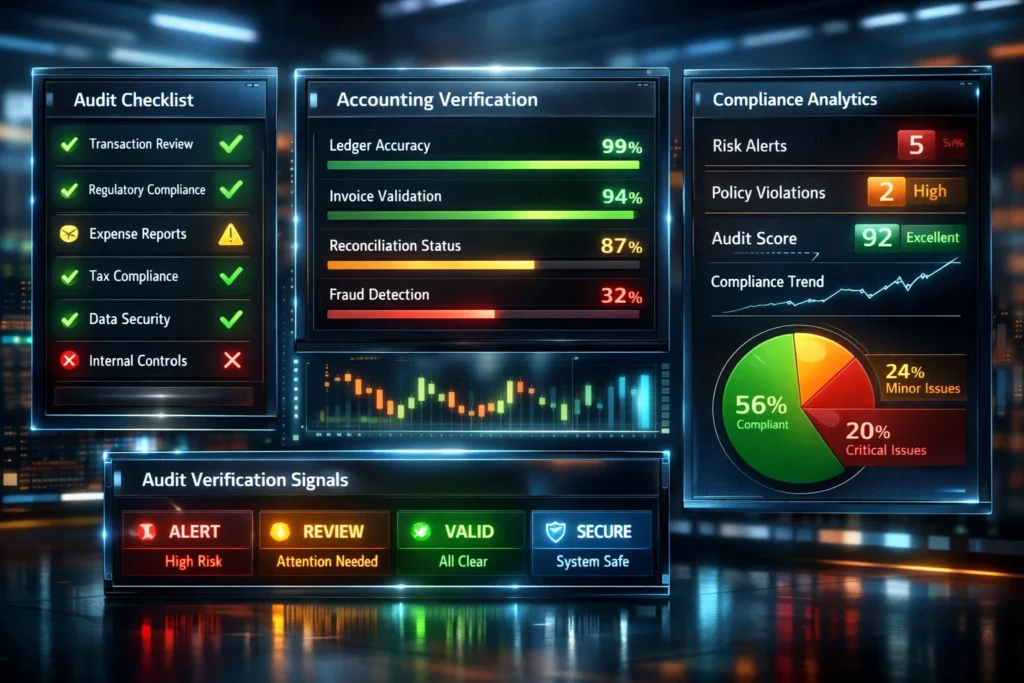
Common Issues Identified During the Audit
There are various issues that auditors commonly come across during the audit process, including:
- Wrong classification of expenses
- Breach of TDS provisions
- Difference between GST and financial turnovers
- Expenses not allowed under tax provisions
- Bank transactions not reconciled
- Lack of documentation for claiming deductions
These issues, when identified and resolved, can prevent adjustments during assessment proceedings.
For small and medium-sized businesses, conducting periodic compliance reviews during the financial year helps to prevent discrepancies from arising in the final audit process.
Businesses that monitor the turnover limits, digital transaction ratios, and statutory compliance of the business can better manage the risk of such complexities in the tax audit of the business. Professional advisory services such as JackRabbit, financial consultants in Gurugram, can assist the business in such compliance reviews, tax filings, and reporting as per the requirements of Section 44AB.
Penalty for Non-Compliance of Section 44AB
In case of non-compliance of the tax audit, businesses may face a penalty as per Section 271B of the Income Tax Act.
Penalties may be levied on businesses for non-compliance, which may be:
- 0.5% of total turnover or gross receipts, or
- ₹1,50,000
whichever is lower.
However, businesses may be exempted from paying such penalties if they can show sufficient cause for non-compliance.
Nonetheless, businesses should always aim at compliance, as it can help them avoid any unpleasant situations with the tax authorities.

Practical Compliance for Businesses
Ideally, businesses should start preparing for the tax audit much before the due date. For this, businesses should keep the following things in mind:
- They should check the turnover levels early on during the financial year
- They should keep their accounting records organized
- They should keep their GST records updated
- They should keep their TDS records updated
- They should keep their records of expenses and deductions updated
Businesses located in commercial hubs such as Gurugram, which come under the Delhi NCR region, should always keep their records updated, as the volume of transactions is high.
In practice, financial advisory companies help companies with turnover limits, digital transaction ratios, and audit documentation preparation, among other things. As a financial consultant in Gurugram, JackRabbit is accustomed to working with companies to organize financial data, review compliance, and coordinate the preparation of tax audit under the provisions of Section 44AB.
Conclusion
Tax audits under Section 44AB are a significant part of the overall Indian taxation regime, and in the case of Financial Year 2025-26, companies need to assess if the turnover crosses the limits of Rs. 1 crore or Rs. 10 crore in case of digital transaction ratios, and professionals need to assess if the turnover crosses Rs. 50 lakhs in gross receipts.
Preparation of books of accounts, documentation, and timely coordination with auditors are key factors that help in smooth compliance and avoid incurring penalties on companies.
Many companies prefer to review compliance on a periodic basis and assess if the company is eligible for a tax audit and if the financial reporting is accurate and in line with the overall provisions under the Income Tax Act.