

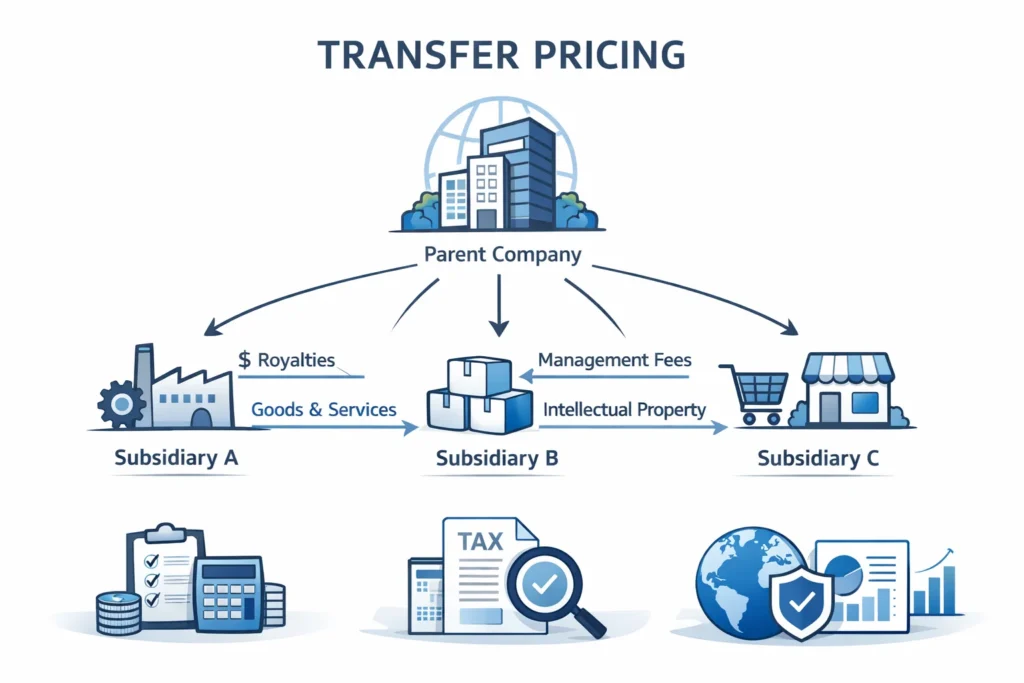
Today’s global environment is characterized by the existence of multiple subsidiaries, branches, or related entities of a company operating in different jurisdictions across the world. In order to maintain transparency and avoid the manipulation of taxation laws, the inter-company or related-party transactions have to be conducted in compliance with the transfer pricing in India.
Transfer pricing regulations have been framed to ensure that the profits are not shifted from one related entity to the other in order to avoid paying taxes. In order to achieve this objective, the governments and related tax authorities have made it mandatory for the companies to justify the pricing structure used in the inter-company or related-party transactions.
For businesses that have operations across different jurisdictions or have related-party domestic transactions in specific jurisdictions, the importance of understanding the concept of transfer pricing and conducting periodic audits is critical from the perspective of maintaining the required level of compliance with the related laws.
Financial advisory organizations like JackRabbit Financial Consultants help businesses in maintaining the required level of compliance with the related laws.
What is Transfer Pricing ?
Transfer pricing is a term used to describe the price at which goods, services, intangible items, or financial instruments are traded among different companies within a single corporate body.
Some examples of inter-company transactions include:
- Sale of goods between a parent company and a subsidiary company.
- Providing management or technical services among companies within a single corporate body
- Licensing of intellectual property rights such as trademarks or software programs
- Providing loans or financing arrangements among companies within a single corporate body
- Splitting costs for research and development activities among companies within a single corporate body
Tax authorities expect these inter-company transactions to be conducted at a price that complies with the ‘Arm’s Length Principle’. In this principle, the price at which goods or services are traded among different companies within a single corporate body must be similar to the price at which goods or services would be traded by two different companies.
The ‘Arm’s Length Principle’ is a widely recognized principle by all countries in the world through guidelines set by the Organisation for Economic Co-operation and Development.
What is Associated Enterprises (AE) ?
Associated Enterprises (AE), as defined under the Income Tax Act 1961 with regard to the rules of transfer pricing, are two or more enterprises where one enterprise directly or indirectly joins in the management, control, or capital of another enterprise.
Enterprises can also be defined as associated if the same persons are involved in the management, control, or capital of the two or more enterprises.
Some of the common circumstances when two or more enterprises can be defined as associated are as follows:
- Where one company has significant shareholding in another company
- Where there is control of management decisions
- Where one company is dependent on the intellectual properties of another company
- Where one company is dependent on inter-company financing
The definition of associated enterprises is significant as the rules of transfer pricing are specifically applicable to associated enterprises.
Business organizations with cross-border group structures often seek professional advice in determining whether they are associated with the definition of associated enterprises and whether they are subject to the rules of transfer pricing.
What is Specified Domestic Transactions (SDT) ?
In addition to international transactions, the rules on transfer pricing can also apply to certain domestic transactions involving related parties. Such transactions are referred to as Specified Domestic Transactions (SDTs) in the context of the Income Tax legislation.
Specified domestic transactions generally cover transactions involving related parties in India where the value of the transaction exceeds certain thresholds and falls within specific categories as provided in the tax legislation.
- Transactions involving parties claiming tax deduction benefits based on profit-linked incentives
- Transactions involving related parties where any of the parties has tax incentives
- Business transfer between related domestic businesses
In such cases, the prices would also be required to be at arm’s length so as not to shift taxable profits between related parties in India.
Financial advisory companies like JackRabbit Financial Consultants can assist businesses in determining whether the transactions involving related parties in India are covered under the rules on Specified Domestic Transactions and whether the transfer pricing documentation needs to be complied with.
Transfer Pricing Regulations in India
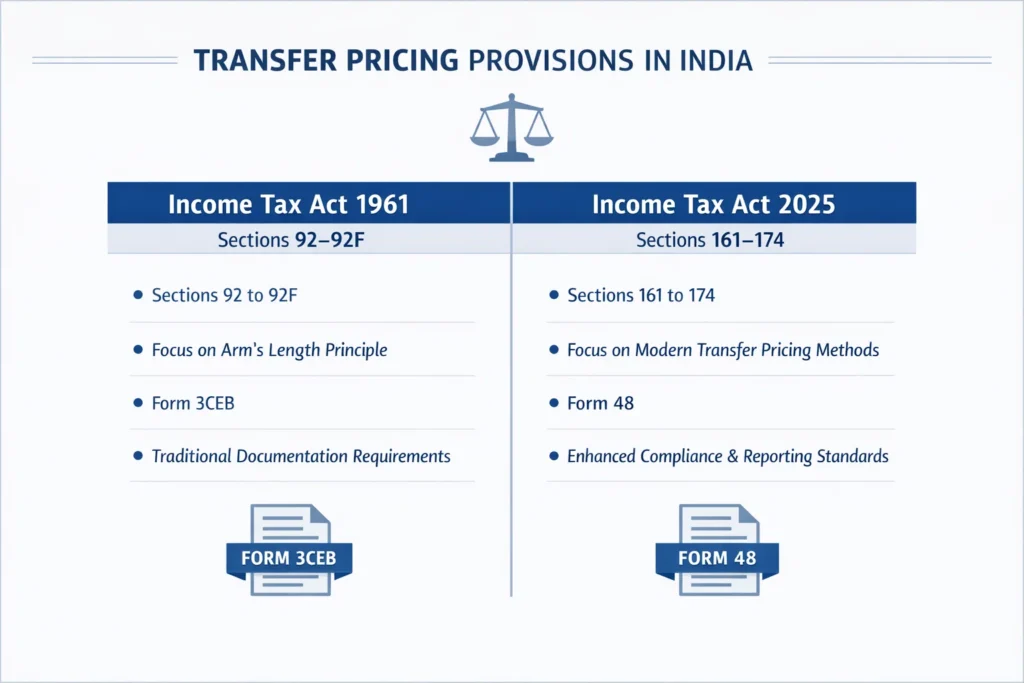
Transfer pricing regulations in India are governed by Sections 92 to 92F of the Income Tax Act, 1961.
These regulations apply to:
- International transactions with associated enterprises
- Some domestic transactions
Compliance with the regulations involves the following requirements:
- Preparation of detailed documentation
- Computation of the ALP using the methods outlined
- Filing the accountant’s report in Form 3CEB
- Suplying documentation during the course of tax assessment at the request of the tax authority
These requirements ensure that profits are reported in the correct jurisdiction.
Changes Under the New Income Tax Act
India has developed a new framework under the Income Tax Act 2025, which reorganizes and renumbers certain provisions pertaining to TP.
The revised provisions are likely to be applicable from 1 April 2026.
In accordance with the revised framework:
| Old Income Tax Act , 1961 | New Income Tax Act ,2025 |
| Sections 92 – 92F | Sections 161 – 174 |
| TP Audit Report – Form 3CEB | Form 48 |
| Section 92E | Section 172 |
According to the new legislation:
- Transfer pricing rules are revised in Sections 161 to 174
- The format for transfer pricing audit documentation has been revised
- A new form, Form 48, replaces Form 3CEB for transfer pricing reporting
- The reporting requirement for Section 92E is now incorporated in Section 172
Organizations, especially those in international or domestic related-party transactions, may want to assess their compliance systems in light of the new legislation once it is implemented.
Professional consulting firms, such as JackRabbit Financial Consultants, can assist businesses in understanding the changes in legislation and ensure compliance with the revised regulations.
Why Transfer Pricing Audits Are Important ?
Transfer pricing audit or review is an assessment process to ensure that related-party transactions are being conducted in accordance with the applicable laws and in compliance with the arm’s length principle.
For businesses with multiple entities, transfer pricing audit or review is essential to ensure compliance and maintenance of proper documentation.
Periodic reviews can assist businesses in clarifying their pricing structures and their compliance with the applicable laws.
Regulatory Compliance
Regulations on transfer pricing require businesses to maintain documentation on the basis of the prices applied in the course of intercompany transactions.
If the documentation is not properly maintained, there are possibilities for changes during the assessment.
An audit on transfer pricing helps in ensuring the documentation is in compliance with the regulations.
Financial consulting firms such as JackRabbit Financial Consultants help businesses in the proper maintenance of documentation and the required financial and benchmark data
Risk Identification
Financial transactions involving intercompany operations are complex in nature.
If the transfer pricing and documentation are not in compliance with the regulatory requirements, the tax authorities tend to be skeptical.
Periodic audits help in identifying the potential risks.
Financial Transparency
Transfer pricing determines how profit is distributed among different entities in a business organization.
The audit helps in ensuring that transfer pricing is conducted on a basis that takes into account the functions performed, assets employed, and risks assumed by different entities in a business organization.
Avoiding Double Taxation
In case tax authorities in different countries disagree with transfer pricing policies, a dispute can arise where income is taxed twice.
Documentation and transfer pricing policies can be used in dispute resolution mechanisms in international tax conventions.
Transfer Pricing Methods Utilized in Calculating Arm’s Length Price
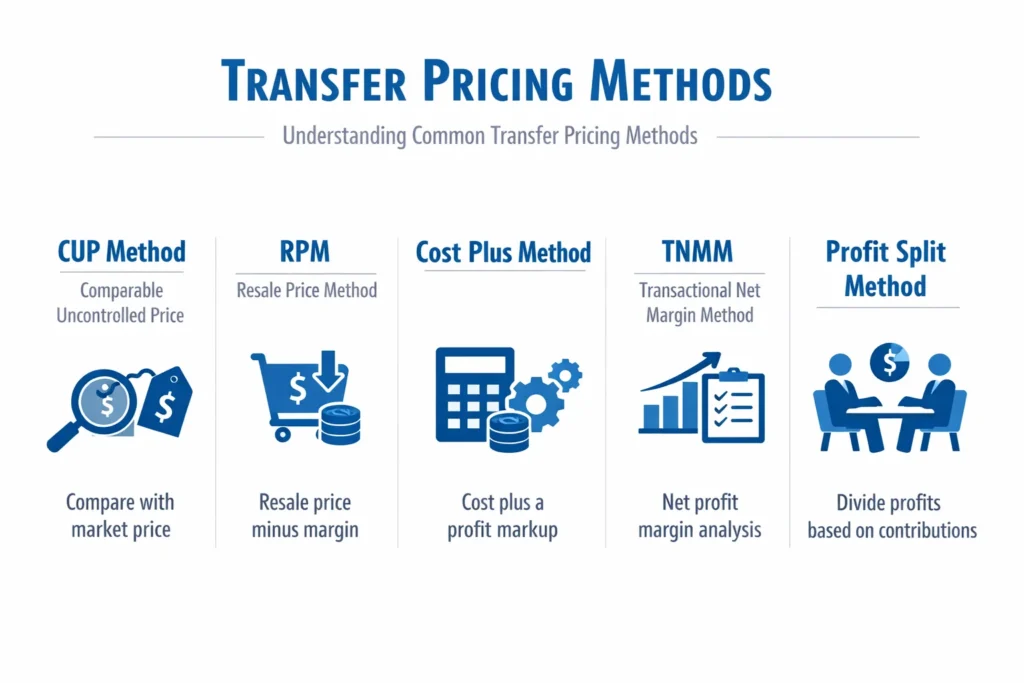
Tax laws have identified different methods of calculating the price for inter-company transactions at which two related entities can trade with each other at an arm’s length price:
Comparable Uncontrolled Price Method (CUP)
In this method, the price of a related-party transaction is compared with the price of a similar transaction between two independent entities.
Resale Price Method (RPM)
In this method, the product is resold to an independent party after purchase from a related party.
Cost Plus Method (CPM)
In this method, an additional markup is added to the cost incurred by the supplier of the products or services.
Transactional Net Margin Method (TNMM)
In this method, the net profit margins are compared with the costs, sales, and assets.
Profit Split Method (PSM)
In this method, the profits are allocated between two associated entities based on their contribution to the business.
Elements Reviewed During a Transfer Pricing Audit
A transfer pricing audit involves the following key elements:
Functional Analysis
An analysis of the functions performed, assets employed, and risks assumed by the entities.
Transaction Structure
An examination of the contractual terms and intercompany relationships.
Benchmarking Analysis
An examination of the financial information using independent companies that perform similar functions.
Documentation Review
Transfer pricing documentation involves the following:
- Economic analysis
- Description of related party transactions
- Transfer pricing method selection
- Comparable company benchmarking
Advisory firms assist organizations in the compilation and maintenance of documentation.
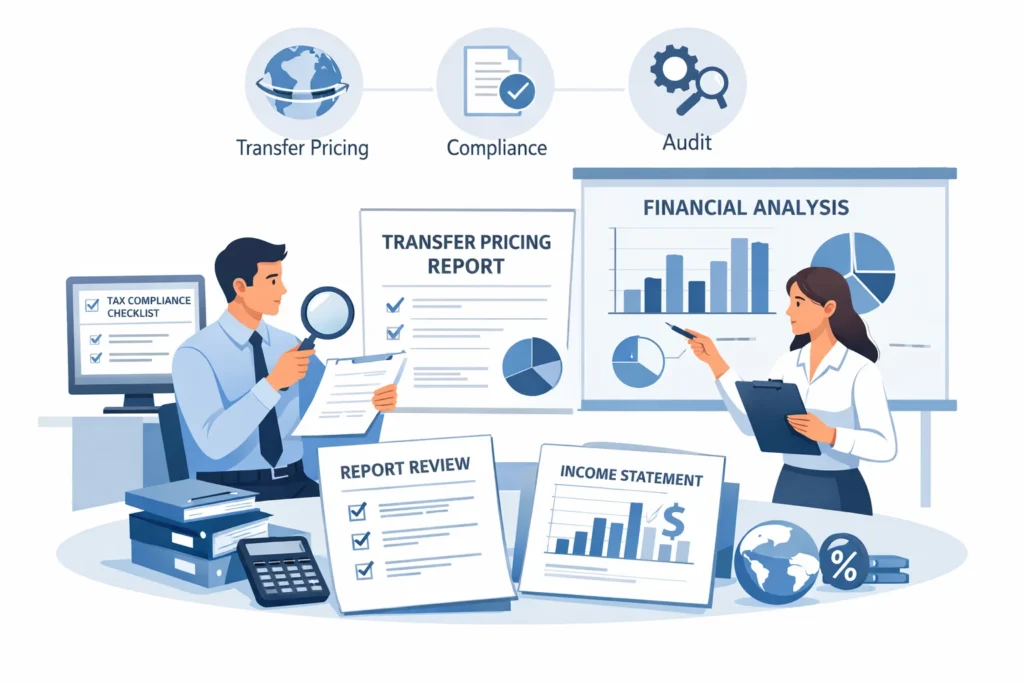
Improving Transfer Pricing Compliance
Businesses that engage in related party transactions can improve their compliance with the following:
- Updating their transfer pricing documentation
- Periodically reviewing related party transactions
- Using the appropriate transfer pricing method
- Ensuring consistency in the company’s financial reports and transfer pricing reports
Advisory firms like JackRabbit Financial Consultants can help businesses improve their compliance by reviewing their related party transactions and supporting them during the review process.
Conclusion
Transfer pricing has a vital role to play in ensuring that inter-company operations are carried out in a manner that conforms to tax legislation and the arm’s length standard.
Business entities involved in international or specified domestic related-party transactions are required to ensure proper documentation of operations and undertake periodic review of transfer pricing structures to ensure compliance.
With the introduction of the revised provisions under the Income Tax Act 2025, which includes a revision of the transfer pricing sections and reporting requirements, effective 1st April 2026, companies are advised to review their compliance procedures.
Transfer pricing reviews are essential in ensuring effective regulatory compliance, as well as transparency in financial information disclosure.