


India has become one of the most promising destinations for investing in the country due to the expanding economy and the ever – increasing consumer base. For global companies planning to enter the Indian market , for setting up an Indian Subsidiary the country is a viable option to carry out business activities.
This approach also gives the company a chance to strategically control the operations in Indian market .However , establishing a subsidiary in the country involves a number of legal and regulatory compliance under the Companies Act 2013 , Foreign Exchange Management Act (FEMA) ,and the rules and regulations framed by the Reserve Bank Of India and Ministry Of Corporate Affairs .
Foreign companies planning to enter the Indian market and setting up an indian subsidiary in the country need to be aware of the regulatory compliances that need to be met to incorporate a company .Many international companies planning to enter the Indian market and establish a subsidiary in the country often hire the services of financial consultants to efficiently incorporate a company
JackRabbit – Financial Consultants in Gurugram helps international companies in the establishment of Indian subsidiaries and meeting the regulatory compliance. In this guide , the entire compliance roadmap will be discussed in detail for the foreign companies interested in establishing a subsidiary in the country
What is an Indian Subsidiary?
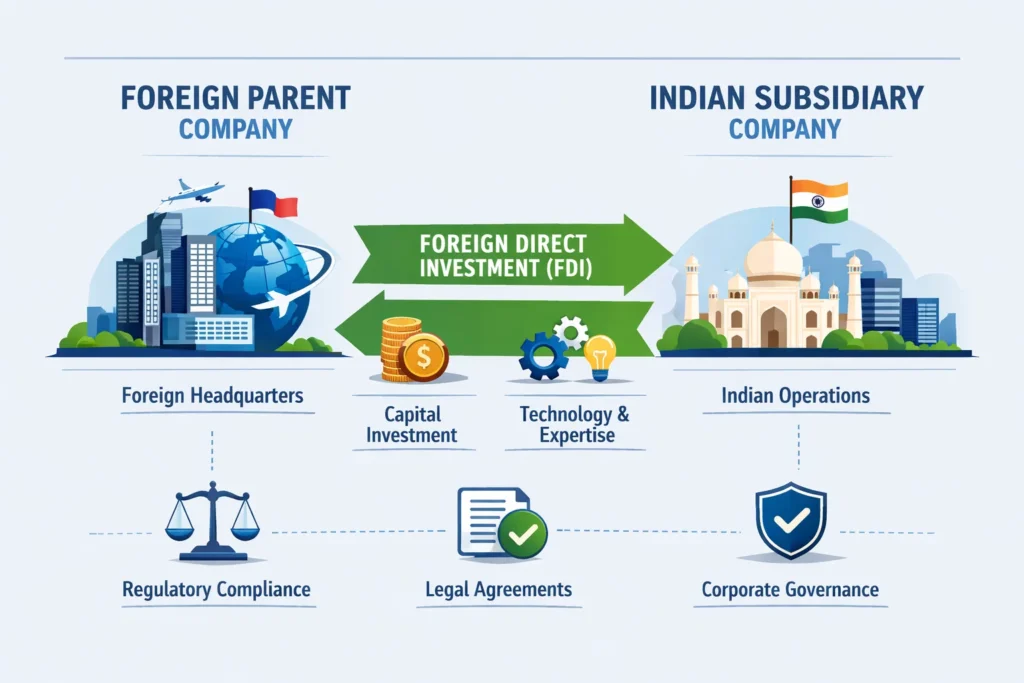
An indian subsidiary is a company formed in India in which a parent company from another country holds more than 50 % shares or a controlling interest in the company.
Despite the parent company being based in another country, the Indian subsidiary is a
separate legal entity that must abide by all the regulations applicable to Indian companies.
Most investors prefer to open a Private Limited Company as a subsidiary due to the many operational benefits that the company will enjoy .These benefits include :
- Independent legal entity
- Limited liability for the shareholders
- Foreign Direct Investment (FDI)
- Flexibility in operation
- Ability to enter contracts and operate business within the country
Once the company is formed as a subsidiary, the company will be considered a separate legal entity with the parent company based in another country as the major shareholder.For companies that are new to the Indian corporate environment, JackRabbit provides advisory services to companies seeking to set up a subsidiary company in the country.
Why Foreign Companies Set Up a Subsidiary in India
Establishing a subsidiary helps international firms to do business in India through a legally compliant structure.
1. Establishment of a Separate Legal Entity
Establishing a subsidiary in India provides a legally independent entity from the international organization. This minimizes the risk to the parent organization from the various risks involved in the operations of the local businesses.
2. Access to the Direct Indian Market
Establishing a subsidiary provides an opportunity for international firms to directly do business in India ,hire employees, enter into contracts, and access various business opportunities.
3. Compliance of Foreign Direct Investments
Foreign direct investments in India are regulated through the Foreign Direct Investment Policy. The policy outlines the sectors where foreign direct investment is allowed through the automatic route or through government approval.
4.Operational Flexibility
Unlike liaison or branch offices, a subsidiary enjoys more freedom to operate business activities and earn revenue in India.
Establishing a subsidiary ensures that foreign investment is structured in accordance with these regulations.
For these reasons, JackRabbit helps foreign companies navigate these complex regulations by assessing their FDI eligibility, structuring their shareholding, and guiding them through incorporation.
TYPES OF BUSINESS STRUCTURES AVAILABLE FOR FOREIGN COMPANIES IN INDIA
Foreign companies have the option to enter the market in India through various business structures depending on their investment objectives.
Wholly Owned Subsidiary
Wholly Owned Subsidiary is a company wherein the foreign company holds 100% of the share capital.
The business structure is normally adopted by foreign companies when the investment policies permit foreign investment through the automatic route, which does not require any approval from the government.
Joint Venture Company
Foreign companies have the option to form a joint venture with an Indian company, wherein the ownership and management of the company are shared.
The business structure is normally adopted by foreign companies when they find it useful to form a joint venture
Branch Office or Liaison Office
Foreign companies have the option to open their offices in India, but the business structure has some operational constraints and cannot perform all the business activities like a subsidiary.
Key Regulatory Framework Governing Indian Subsidiaries
There are various regulatory authorities that govern the incorporation of the subsidiary companies.
Ministry of Corporate Affairs (MCA)
MCA regulates the incorporation of companies, their functioning, and compliances under the Companies Act 2013.
Reserve Bank of India (RBI)
RBI regulates the Foreign Direct Investments through the Foreign Exchange Management Act (FEMA) and monitors the Foreign Equity through reporting requirements.
Income Tax Department
Indian subsidiary companies have to comply with the tax regulations, including the transfer pricing regulations while dealing with the foreign parent companies.
Goods And Services (GST) Authorities
Indian subsidiary companies have to obtain a GST registration certificate if the aggregate turnover exceeds the threshold limit.
JackRabbit assists international companies in facilitating the regulatory compliances before the MCA, RBI, tax authorities, etc., to ensure a hassle-free market entry.
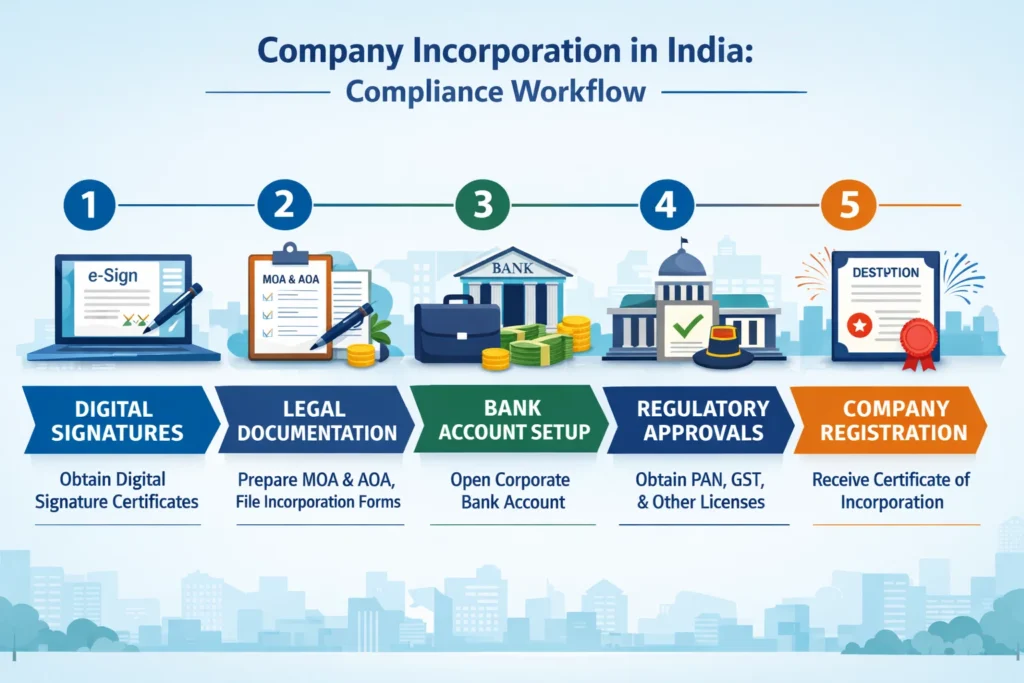
Step-by-Step Process to Set Up an Indian Subsidiary
Setting up an Indian subsidiary involves a series of steps.
1. Digital Signature Certificate (DSC)
Directors of the company have to procure a Digital Signature Certificate to digitally sign the documents to be filed with the Ministry of Corporate Affairs.
2. Director Identification Number (DIN)
Each director of the proposed company has to procure a Director Identification Number, which is a mandatory requirement for any individual who becomes a director of an Indian company.
3. Company Name Approval
The proposed company name has to be approved through the RUN (Reserve Unique Name) facility or the SPICe+ incorporation form on the MCA portal.
4. Company Incorporation Filing
The subsidiary company is incorporated by submitting the SPICe+ form and relevant documents such as:
- Memorandum of Association (MoA)
- Articles of Association (AoA)
- Director identity proof documents
- Proof of the registered office in India
Upon verification, the Registrar of Companies issues a Certificate of Incorporation, thus incorporating the company.
5.Opening an Indian Bank Account
It is mandatory for the subsidiary company to open a bank account in India to receive the capital investment from the parent company.
6. Foreign Investment Reporting
After the receipt of capital investment, the company needs to report the foreign investment to the RBI within the due date by submitting the FC-GPR form.
JackRabbit helps the foreign company with the entire process of incorporating a company in India by preparing the company incorporation documents and taking care of the FDI reporting requirements.
Post-Incorporation Compliance Requirements
After the incorporation of the company, the company is required to comply with a number of post-incorporation compliance requirements.
ROC Filings
Companies are required to submit their annual financial statements and annual returns to the Registrar of Companies.
Accounting and Audit
A company is required to maintain proper books of accounts and undergo a statutory audit if the company meets the threshold requirements in the hands of a Chartered Accountant.
Corporate Tax Compliance
Companies are required to comply with corporate tax returns and the rules relating to transfer pricing when dealing with their foreign parent companies.
GST Compliance
Businesses that provide goods and services are required to register and submit periodic GST returns.
FEMA Reporting
Foreign investment and share transfer transactions are required to be reported to the RBI in accordance with the FEMA guidelines.
Handling these multiple compliance requirements may be a challenge for the foreign companies.
Indian Accounting Standards (Ind AS) and GAAP Compliance
Foreign companies operating a subsidiary in India are required to follow the accounting standards in India.
India’s accounting standards are based on two major systems: Indian Accounting Standards (IndAS) and Indian GAAP (Accounting Standards – AS).
Indian Accounting Standards (IndAS)
Indian Accounting Standards (IndAS) are accounting standards notified by the Ministry of Corporate Affairs.
Indian Accounting Standards are substantially converged with International Financial Reporting Standards (IFRS).
Indian Accounting Standards (IndAS) is applicable to the following class of companies based on net worth thresholds:
- Listed Companies with a net worth of ₹500 crore or more
- Unlisted Companies with a net worth of ₹500 crore or more
- Unlisted Companies with a net worth of ₹250 crore or more but less than ₹500 crore
- Holding Companies, Subsidiary Companies, Joint Venture
Companies, Associate Companies of the above Companies.
Other Companies not meeting the above thresholds will have to follow Indian GAAP issued by the Institute of Chartered Accountants of India.
Financial Statement
Indian Companies are required to prepare the following financial statements:
- Balance Sheet
- Statement of Profit and Loss
- Cash Flow Statement
- Statement of Changes in Equity (for IndAS Companies)
- Notes to Accounts
JackRabbit helps businesses in compliance services such as Accounting, ROC, GST Registration, Taxation, FEMA.
Key Documents Required for Incorporation
Foreign companies are required to provide several documents for incorporation of an Indian subsidiary company. Some of the usual requirements include:
- Certificate of incorporation of the parent company
- Board resolution for the formation of the subsidiary company
- Identity and address proof of directors
- Passport copies of foreign directors
- Proof of registered office address in India
- Memorandum and Articles of Association
Documents from outside India may be required to be notarized or bear a post till stamp prior to submission . JackRabbit helps foreign companies prepare and verify incorporation documents and submit the same as required by Indian regulations.
Compliance Challenges Foreign Companies Should Plan For
Even though India has a structured regulatory framework, there are a few challenges for foreign companies to be aware of while doing business.
These challenges include:
- Understanding sector-wise FDI norms
- Regulatory filing requirements
- Compliance with transfer pricing regulations
- Proper accounting
- Proper reporting requirements under FEMA
Planning the compliance roadmap will be useful for the company to avoid any delays in the operation of the company.

Conclusion
The opening of an Indian subsidiary enables foreign companies to conduct business in one of the world’s most dynamic growth markets, with a business structure that complies with the law.
The process, however, demands strict adherence to corporate, foreign investment, tax, and other statutory compliances.
A structured compliance process enables businesses to set up shop efficiently, without any complexities arising from non-compliance with the law.
JackRabbit, a financial consultancy based in Gurugram, offers incorporation services for Indian subsidiaries, FDI compliance, tax registrations, and corporate compliance to foreign companies seeking to enter the Indian market.