

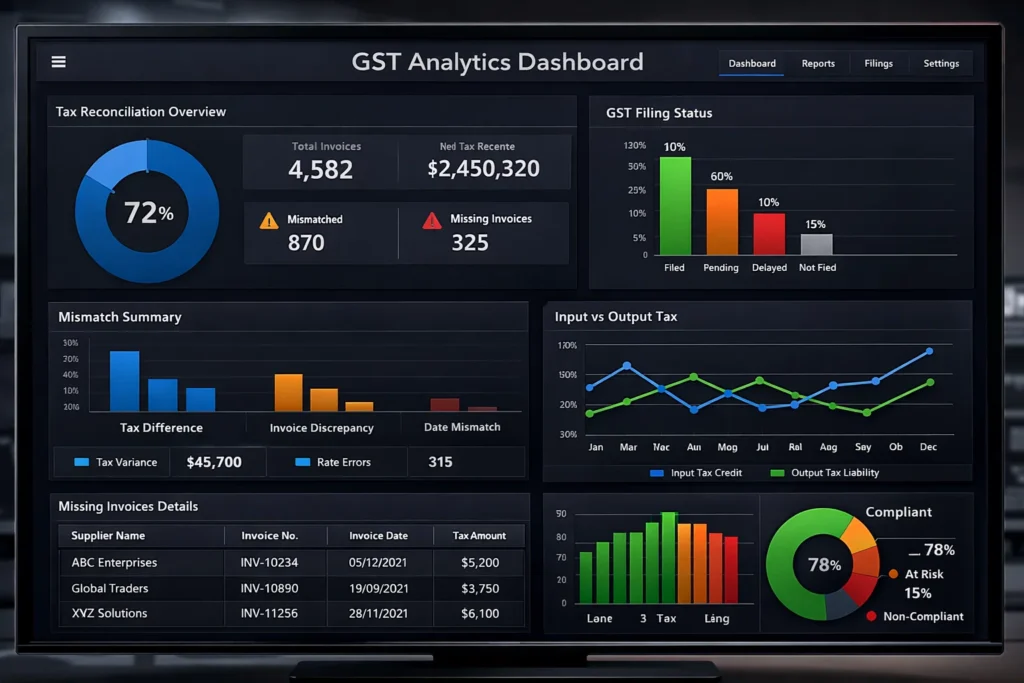
The Goods and Services Tax (GST) compliance process is becoming more data-driven with the implementation of digital reporting tools such as e-invoice reporting, return matching, and data analysis tools for monitoring by tax authorities. The Goods and Services Tax system in India is heavily relying on data reconciliation techniques for identifying discrepancies in tax returns.
Businesses may be issued GST notice in India in cases where discrepancies are identified in their tax returns, tax payments, or input tax credit claims. These Goods and Services Tax notices are issued as part of the overall compliance and verification process as prescribed under the Central Goods and Services Tax Act, 2017.
In the current fiscal year, i.e., 2026, the Goods and Services Tax system continues to rely on automated tools for matching data across returns such as GSTR-1, GSTR-1A, GSTR-3B, GSTR-2B, e-invoice data, and e-way bills. Recent developments in the Goods and Services Tax portal have improved reconciliation tools and system-generated notifications for monitoring compliance .If inconsistencies arise in these data sets, the tax authorities may engage in communication with the taxpayer by sending notices through the GST portal.
Knowing the common causes of GST notices can help businesses improve their GST compliance processes and avoid regulatory issues.
What are GST Notice in India Under Indian Tax Law?
A GST notice is an official letter sent by the tax authorities seeking information, explanation, or action with regard to GST and tax compliances.
The GST notices in India may be for the following purposes:
- Verification of tax liability
- Reconciliation of transactions
- Verification of input tax credits
- Recovery of tax dues
- Audit and investigation proceedings
The GST notices are issued under various provisions of the CGST Act. For instance:
- Section 61 – scrutiny of returns
- Section 73 – tax demand (non-fraud cases)
- Section 74 – tax demand (fraud/suppression cases)
With the increase in digital reporting requirements, companies face a need to develop processes to ensure accurate GST reporting.
Professional financial advisors help companies address these issues by reviewing their GST compliance processes, reporting gaps, and responding to queries in a timely manner.
Role of GSTR-1A and Recent Changes on GST Portal
GSTR-1A is gaining importance in recent changes to the GST compliance process, enabling taxpayers to add details related to outward supplies, even after filing GSTR-1.
GSTR-1A is used to:
- Correct errors or omissions related to outward supplies reported in GSTR-1
- Align data related to outward supplies before finalizing tax liability
- Reduce discrepancies between GSTR-1 and GSTR-3B
With the introduction of GSTR-1A, GST authorities have a further layer of data to compare, helping them identify inconsistencies related to reported transactions.
Along with this, various system-related changes have also been incorporated in the GST portal, such as:
- Improved return reconciliation
- Data availability through e-invoice and GSTR-2B
- Automatic generation of discrepancy notifications
- Risk identification using analytics tools
With these changes, tax authorities have been able to identify discrepancies between various documents more effectively. Now, even minor discrepancies between various documents, amendments, and transactions can lead to GST notices.
Businesses, therefore, have to ensure that there is greater accuracy in filing their GST returns, making use of available tools such as GSTR-1A to avoid any kind of compliance risk.
Financial advisory companies such as JackRabbit – financial consultants in Gurugram – help businesses ensure accurate GST return processes, identify discrepancies, and design a structured system of compliance according to changes in GST portal functionalities.
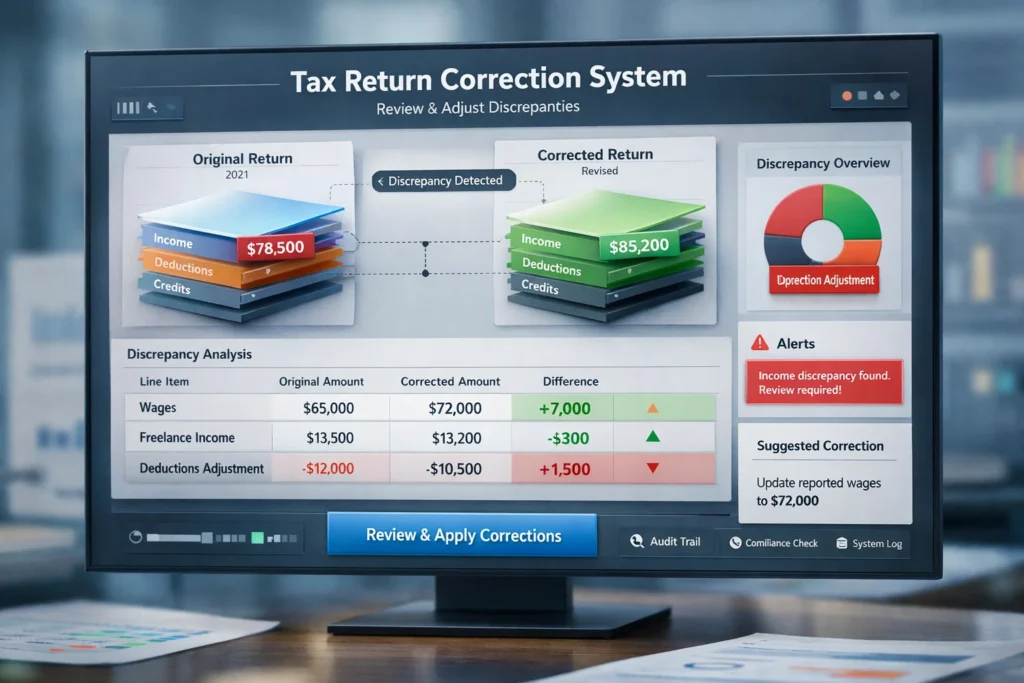
1. Mismatch between GSTR-1 and GSTR-3B
One of the most common reasons why a firm receives a notice under GST is a mismatch between their GSTR-1 and GSTR-3B returns.
If there is a difference between the amount of sales declared in the GSTR-1 return and the tax liability declared in the GSTR-3B return, then it is likely that a notice under GST may be sent to the firm on account of an under-reportment of taxes.
The common causes of this mismatch are:
- Mismatch in reporting of taxable value
- Non-inclusion of invoices in the GSTR-3B return
- Amendments in future tax returns
However, if a firm has a system of regular reconciliation between their returns, then it can avoid such a mismatch between their returns.
Financial consulting firms such as JackRabbit – financial consultants in Gurugram can help a firm in this regard.
2. Input Tax Credit (ITC) Mismatch with GSTR-2B
Input Tax Credit claims are often under the scanner.
If the business has claimed Input Tax Credit more than the amount reflected in GSTR-2B, the following are the possible causes for the mismatches:
- Non-compliance by the supplier
- Incorrect reporting of invoices
- Early claim of Input Tax Credit
Authorities may send notices asking for justification.

3. Inconsistencies Between E-Invoice Data and GST Returns
With e-invoicing, data is electronically reported to GST.
If there is any mismatch between IRN generated invoices and GST returns:
- Missing invoices
- Incorrect values
- Incorrect amendments
Such inconsistencies are detected through automated analytics.
4. E-Way Bill and Supply Data Mismatch
Discrepancies between the data provided in the e-way bills and the GST return may lead to notices being sent out.
The authorities may raise doubts about:
- Under-reporting of sales
- Lack of invoices
- Inaccurate data on the value of transactions
It is important to ensure that the logistics and the GST data match
5. Non-Filing or Delayed Filing of GST Returns
Non-filing of GST returns within the stipulated time is one of the major reasons for receiving notices.
The applicable returns for this purpose include the following:
- GSTR-1
- GSTR-3B
- Annual return (GSTR-9)
- Reconciliation statement (GSTR-9C), applicable in the case of taxpayers
with an annual turnover exceeding Rs. 2 crores
Non-filing of GST returns may also result in suspension of the GST registration.
According to the CGST Act, under Section 29 with Rule 21A:
For Composition taxpayers:
In case GSTR-4 or CMP-08 is not filed for a consecutive period of 3 tax periods
For Regular taxpayers:
In case GSTR-3B or GSTR-1 is not filed for a continuous period of 6 months
In the above cases, the GST registration will be suspended.
6. Excessive or Irregular Refund Claims
Excessive or irregular claims of refunds attract scrutiny, especially if:
- Excessive amounts of refunds are claimed
- There is incomplete documentation
- There is a mismatch between refunds and returns
Documentation such as export invoices, shipping bills, tax records, etc. may be demanded.
7. Incorrect Classification of Goods or Services
Incorrect classification of goods or services under HSN/SAC can lead to incorrect GST rates
This can lead to:
- Non-payment of tax
- Liability to pay interest
- Liability to pay penalties
Reviewing classification is critical, especially for businesses with a wide range of products.
8. Data Analytics-Based Compliance Monitoring
GST authorities are using data analytics for monitoring compliance behavior.
The data they are analyzing is:
- GST returns
- e-invoices
- e-way bills
- patterns in financial data
Such system-driven monitoring helps in identifying high-risk taxpayers and sends notices even without human intervention.
Financial consultancy companies like JackRabbit – financial consultants in Gurugram – help businesses in conducting internal GST reviews and building robust systems in accordance with the dynamic environment.
Strengthening GST Compliance to Reduce Notice Risk
Receiving a GST notice does not always imply that something is amiss. Many GST notices are simply part of the verification process.
Businesses can reduce the risk of receiving GST notices by:
- Reconciling GST returns regularly
- Verifying ITC eligibility
- Ensuring vendor compliance
- Ensuring documentation is in order
- Filing GST returns regularly
Businesses with complex operations may benefit from structured GST compliance solutions and advisory services

Conclusion
The Indian GST compliance process is becoming increasingly advanced with the incorporation of digital technologies in the reporting and reconciliation processes. This has made it even more important for organizations to ensure accurate and compliant GST reporting.
This is because even a minor discrepancy in the GST reporting process may result in a notice from the tax authorities.
It is important for organizations to understand the major reasons for receiving a GST notice. This will not only help them improve their compliance process but also minimize errors in the GST return and financial document filing process
In fact, there are many financial advisory services that help organizations comply with the GST regulations. JackRabbit is a financial consultancy service in Gurugram that provides financial consultancy services to organizations.